Devoe Connor, Gabbidon Harriett, Schussler Nina, Cortese Lauren, Caplan Emily, Gorman Colin, Jethwani Kamal, Kvedar Joseph, Agboola Stephen
Partners HealthCare Pivot Labs, Partners HealthCare, Boston, MA, United States.
Harvard Medical School, Harvard University, Boston, MA, United States.
JMIR Med Inform. 2019 Apr 26;7(2):e10020. doi: 10.2196/10020.
Participant recruitment, especially for frail, elderly, hospitalized patients, remains one of the greatest challenges for many research groups. Traditional recruitment methods such as chart reviews are often inefficient, low-yielding, time consuming, and expensive. Best Practice Alert (BPA) systems have previously been used to improve clinical care and inform provider decision making, but the system has not been widely used in the setting of clinical research.
The primary objective of this quality-improvement initiative was to develop, implement, and refine a silent Best Practice Alert (sBPA) system that could maximize recruitment efficiency.
The captured duration of the screening sessions for both methods combined with the allotted research coordinator hours in the Emerald-COPD (chronic obstructive pulmonary disease) study budget enabled research coordinators to estimate the cost-efficiency.
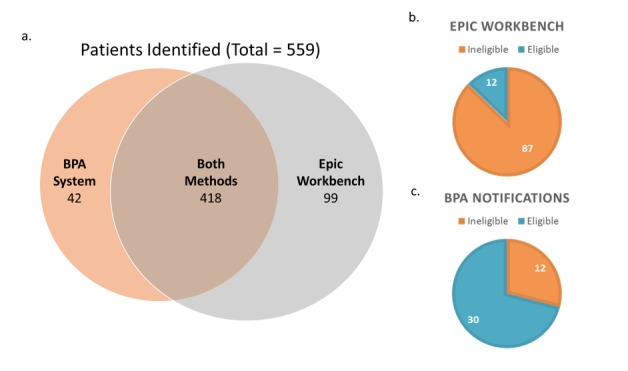
Prior to implementation, the sBPA system underwent three primary stages of development. Ultimately, the final iteration produced a system that provided similar results as the manual Epic Reporting Workbench method of screening. A total of 559 potential participants who met the basic prescreen criteria were identified through the two screening methods. Of those, 418 potential participants were identified by both methods simultaneously, 99 were identified only by the Epic Reporting Workbench Method, and 42 were identified only by the sBPA method. Of those identified by the Epic Reporting Workbench, only 12 (of 99, 12.12%) were considered eligible. Of those identified by the sBPA method, 30 (of 42, 71.43%) were considered eligible. Using a side-by-side comparison of the sBPA and the traditional Epic Reporting Workbench method of screening, the sBPA screening method was shown to be approximately four times faster than our previous screening method and estimated a projected 442.5 hours saved over the duration of the study. Additionally, since implementation, the sBPA system identified the equivalent of three additional potential participants per week.
Automation of the recruitment process allowed us to identify potential participants in real time and find more potential participants who meet basic eligibility criteria. sBPA screening is a considerably faster method that allows for more efficient use of resources. This innovative and instrumental functionality can be modified to the needs of other research studies aiming to use the electronic medical records system for participant recruitment.
参与者招募,尤其是对于体弱的老年住院患者来说,仍然是许多研究团队面临的最大挑战之一。传统的招募方法,如图表审查,往往效率低下、产出不高、耗时且成本高昂。最佳实践警报(BPA)系统此前已被用于改善临床护理并为医疗服务提供者的决策提供信息,但该系统在临床研究环境中尚未得到广泛应用。
这项质量改进计划的主要目标是开发、实施和完善一种无声最佳实践警报(sBPA)系统,以最大限度地提高招募效率。
在翡翠慢性阻塞性肺疾病(COPD)研究预算中,将两种方法的筛查时间与分配给研究协调员的小时数相结合,使研究协调员能够估计成本效益。
在实施之前,sBPA系统经历了三个主要开发阶段。最终,最终版本产生了一个与手动Epic报告工作台筛查方法结果相似的系统。通过两种筛查方法共识别出559名符合基本预筛查标准的潜在参与者。其中,418名潜在参与者由两种方法同时识别,99名仅由Epic报告工作台方法识别,42名仅由sBPA方法识别。在由Epic报告工作台识别出的参与者中,只有12名(99名中的12名,12.12%)被认为符合条件。在由sBPA方法识别出的参与者中,30名(42名中的30名,71.43%)被认为符合条件。通过将sBPA与传统的Epic报告工作台筛查方法进行并排比较,sBPA筛查方法比我们之前的筛查方法快约四倍,并估计在研究期间可节省442.5小时。此外,自实施以来,sBPA系统每周识别出相当于另外三名潜在参与者。
招募过程的自动化使我们能够实时识别潜在参与者,并找到更多符合基本资格标准的潜在参与者。sBPA筛查是一种速度快得多的方法,能够更有效地利用资源。这种创新且实用的功能可以根据其他旨在利用电子病历系统进行参与者招募的研究需求进行修改。