MRC Clinical Trials Unit at UCL, London, UK.
Clinical Trials Research Unit, Leeds Institute of Clinical Trials Research, University of Leeds, Leeds, LS2 9JT, UK.
Trials. 2019 Apr 27;20(1):241. doi: 10.1186/s13063-019-3343-2.
Monitoring and managing data returns in multi-centre randomised controlled trials is an important aspect of trial management. Maintaining consistently high data return rates has various benefits for trials, including enhancing oversight, improving reliability of central monitoring techniques and helping prepare for database lock and trial analyses. Despite this, there is little evidence to support best practice, and current standard methods may not be optimal.
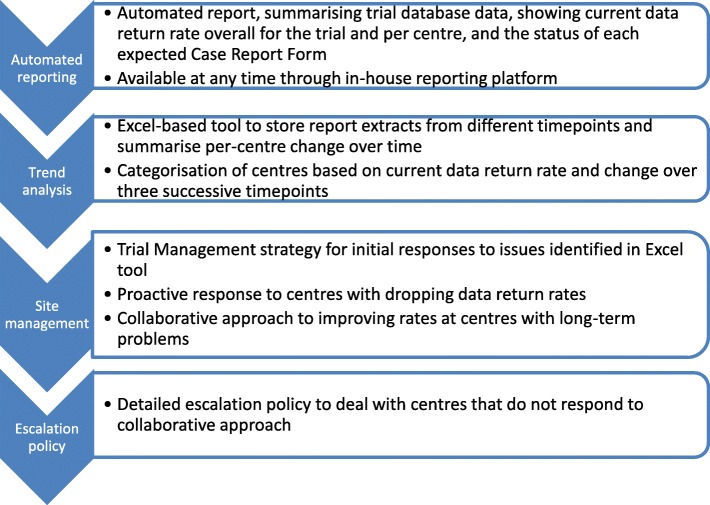
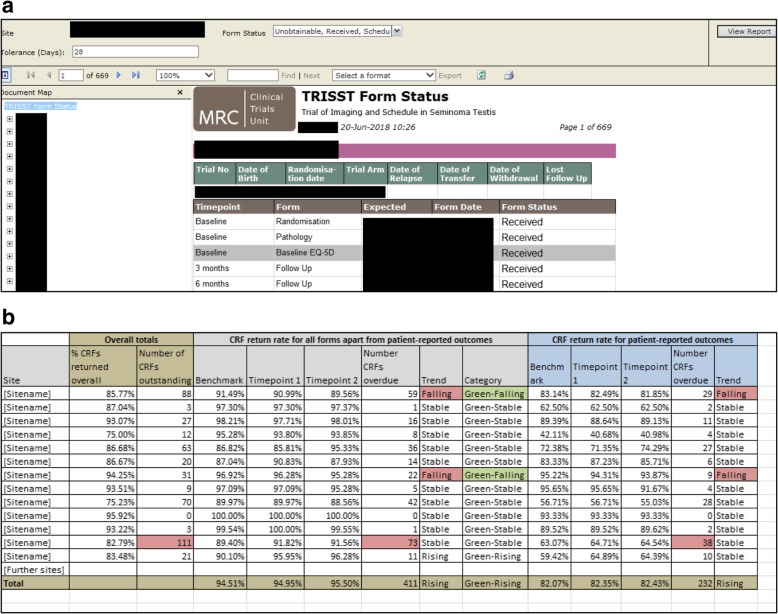
We report novel methods from the Trial of Imaging and Schedule in Seminoma Testis (TRISST), a UK-based, multi-centre, phase III trial using paper Case Report Forms to collect data over a 6-year follow-up period for 669 patients. Using an automated database report which summarises the data return rate overall and per centre, we developed a Microsoft Excel-based tool to allow observation of per-centre trends in data return rate over time. The tool allowed us to distinguish between forms that can and cannot be completed retrospectively, to inform understanding of issues at individual centres. We reviewed these statistics at regular trials unit team meetings. We notified centres whose data return rate appeared to be falling, even if they had not yet crossed the pre-defined acceptability threshold of an 80% data return rate. We developed a set method for agreeing targets for gradual improvement with centres having persistent data return problems. We formalised a detailed escalation policy to manage centres who failed to meet agreed targets. We conducted a post-hoc, descriptive analysis of the effectiveness of the new processes.
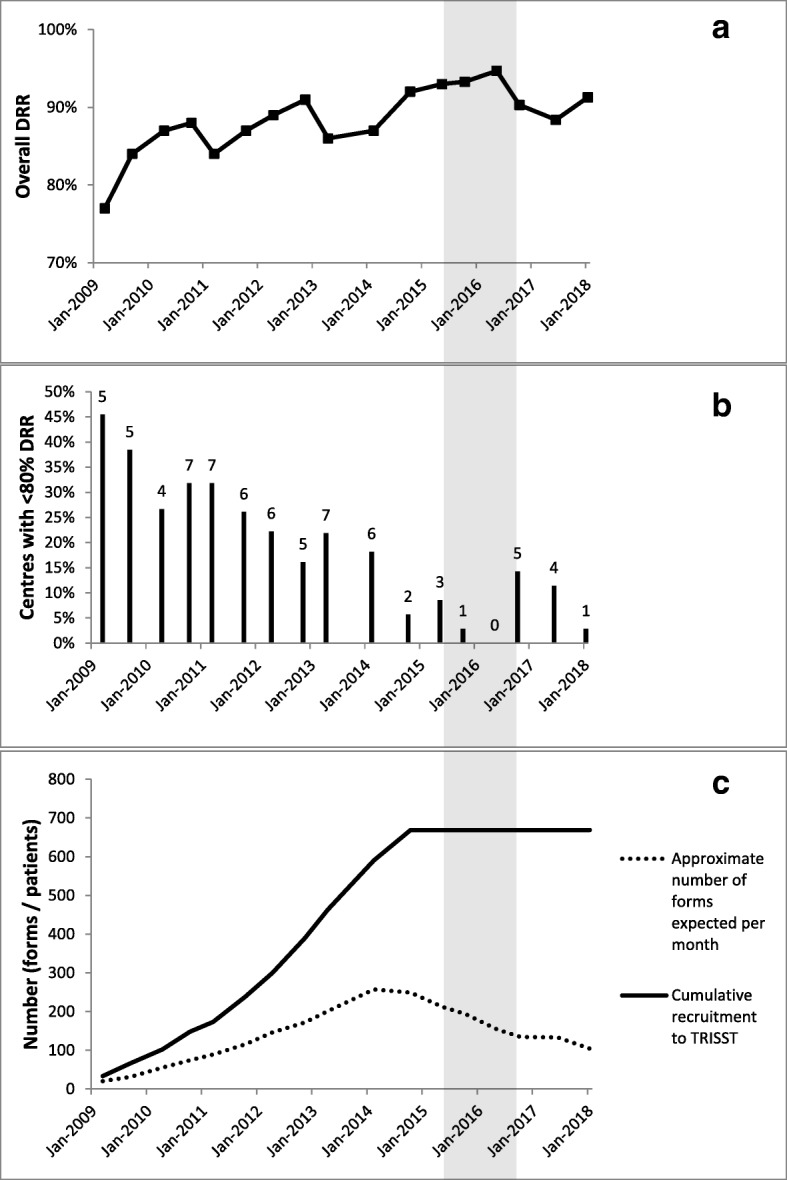
The new processes were used from April 2015 to September 2016. By May 2016, data return rates were higher than they had been at any time previously, and there were no centres with return rates below 80%, which had never been the case before. In total, 10 centres out of 35 were contacted regarding falling data return rates. Six out of these 10 showed improved rates within 6-8 weeks, and the remainder within 4 months.
Our results constitute preliminary effectiveness evidence for novel methods in monitoring and managing data return rates in randomised controlled trials. We encourage other researchers to work on generating better evidence-based methods in this area, whether through more robust evaluation of our methods or of others.
在多中心随机对照试验中监测和管理数据回报是试验管理的一个重要方面。保持始终较高的数据回报率对试验有各种益处,包括增强监督、提高中心监测技术的可靠性,并有助于为数据库锁定和试验分析做好准备。尽管如此,几乎没有证据支持最佳实践,而且当前的标准方法可能并不理想。
我们报告了来自睾丸精原细胞瘤影像学和时间表试验(TRISST)的新方法,这是一项英国多中心、III 期试验,使用纸质病例报告表在 6 年的随访期内为 669 名患者收集数据。使用自动数据库报告,总结总体和每个中心的数据回报率,我们开发了一个基于 Microsoft Excel 的工具,允许观察数据回报率随时间的中心间趋势。该工具使我们能够区分可以和不能回顾性完成的表格,以了解个别中心的问题。我们在定期的试验单位团队会议上审查了这些统计数据。我们通知了那些数据回报率似乎正在下降的中心,即使他们尚未达到 80%数据回报率的可接受阈值。我们为那些持续存在数据回报问题的中心制定了逐步改进目标的一套方法。我们制定了一个详细的升级策略来管理那些未能达到商定目标的中心。我们对新流程的有效性进行了事后描述性分析。
新流程从 2015 年 4 月至 2016 年 9 月使用。到 2016 年 5 月,数据回报率高于以往任何时候,并且从未出现过任何中心的数据回报率低于 80%的情况。共有 35 个中心中的 10 个因数据回报率下降而受到关注。其中 6 个在 6-8 周内显示出改善的比例,其余的在 4 个月内显示出改善的比例。
我们的结果构成了监测和管理随机对照试验中数据回报率的新方法的初步有效性证据。我们鼓励其他研究人员在这一领域开展更好的基于证据的方法研究,无论是通过更有力地评估我们的方法还是其他方法。