Department of GI Oncology, The Fifth Medical Center, General Hospital of PLA, Beijing 100071, China.
Geneplus-Beijing Institute, Beijing 102206, China.
EBioMedicine. 2019 May;43:261-269. doi: 10.1016/j.ebiom.2019.04.003. Epub 2019 Apr 25.
Circulating tumor DNA (ctDNA) isolated from plasma contains genetic mutations that can be representative of those found in primary tumor tissue DNA. These samples can provide insights into tumoral heterogeneity in patients with advanced gastric cancer (AGC). Although trastuzumab has been shown to be effective in first-line therapy for patients with metastatic gastric cancer with overexpression of human epidermal growth factor receptor 2 (HER2), the mechanism of AGC resistance is incompletely understood.
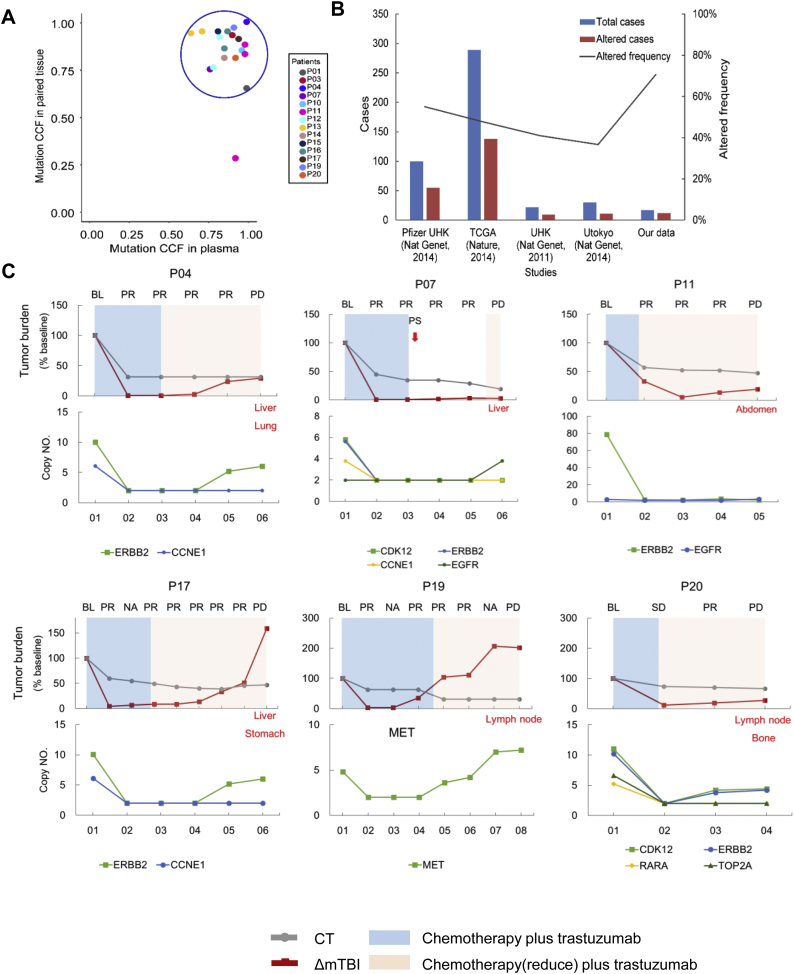
In this prospective study, we used targeted capture sequencing to analyze 173 serial ctDNA samples from 39 AGC patients. We analyzed cancer cell fractions with PyClone to understand the clonal population structure in cancer, and monitored serial samples during therapy. Serial monitoring of ctDNA using the molecular tumor burden index (mTBI), identified progressive disease before imaging results (mean: 18 weeks).
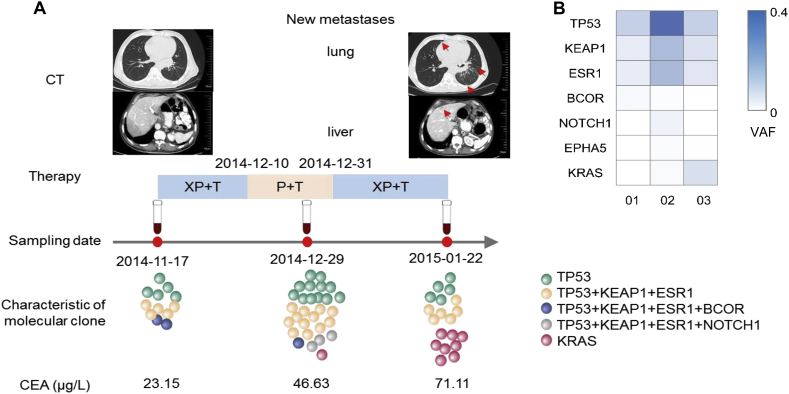
We reconstructed the clonal structure of ctDNA during anti-HER2 treatment, and identified 32 expanding mutations potentially related to trastuzumab resistance. Multiple pathways activating in the same patients revealed heterogeneity in trastuzumab resistance mechanisms in AGC. In patients who received chemotherapy, mTBI was validated for the prediction of progressive disease, with a sensitivity of 94% (15/16). A higher mTBI (≥1%) in pretreatment ctDNA was also a risk factor for progression-free survival.
Analysis of ctDNA clones based on sequencing is a promising approach to clinical management, and may lead to improved therapeutic strategies for AGC patients. FUND: This work was supported by grants from the National International Cooperation Grant (to J.X.; Project No. 2014DFB33160).
从血浆中分离的循环肿瘤 DNA(ctDNA)包含可代表原发性肿瘤组织 DNA 中发现的基因突变。这些样本可以深入了解晚期胃癌(AGC)患者肿瘤异质性。尽管曲妥珠单抗已被证明对人表皮生长因子受体 2(HER2)过表达的转移性胃癌患者的一线治疗有效,但 AGC 耐药的机制尚未完全了解。
在这项前瞻性研究中,我们使用靶向捕获测序分析了 39 例 AGC 患者的 173 个连续 ctDNA 样本。我们使用 PyClone 分析癌细胞分数,以了解肿瘤中的克隆群体结构,并在治疗期间监测连续样本。使用分子肿瘤负担指数(mTBI)对 ctDNA 进行连续监测,在影像学结果之前(平均:18 周)确定疾病进展。
我们重建了抗 HER2 治疗期间 ctDNA 的克隆结构,并确定了 32 个可能与曲妥珠单抗耐药相关的扩展突变。同一患者中多个途径的激活揭示了 AGC 中曲妥珠单抗耐药机制的异质性。在接受化疗的患者中,mTBI 验证了预测疾病进展的能力,敏感性为 94%(15/16)。治疗前 ctDNA 中较高的 mTBI(≥1%)也是无进展生存的危险因素。
基于测序的 ctDNA 克隆分析是一种有前途的临床管理方法,可能为 AGC 患者带来改进的治疗策略。资金:本工作得到国家国际合作资助(项目编号:2014DFB33160)的支持。