Department of Medical Oncology, Kindai University Faculty of Medicine, 377-2 Ohno-higashi, Osaka-Sayama, Osaka, Japan.
Department of Surgery, Kindai University Faculty of Medicine, 377-2 Ohno-higashi, Osaka-Sayama, Osaka, Japan.
Breast Cancer. 2018 Sep;25(5):605-613. doi: 10.1007/s12282-018-0861-9. Epub 2018 Apr 26.
Trastuzumab emtansine (T-DM1) is approved for the treatment of patients with human epidermal growth factor receptor 2 (HER2)-positive advanced breast cancer (ABC), and has high efficacy. However, some patients exhibit primary resistance to T-DM1, and thus methods that can predict resistance in clinical practice are needed. Genomic analysis of circulating tumor DNA (ctDNA) in plasma is a non-invasive and reproducible method. This study aimed to predict primary resistance to T-DM1 by combining genomic analysis of ctDNA and other clinicopathological features of patients with HER2-positive ABC.
The study population comprised 34 patients with HER2-positive ABC who had been treated with T-DM1. Correlations between clinicopathological characteristics of patients and primary resistance to T-DM1 were examined, and HER2 gene copy number and PIK3CA gene mutations were analyzed using plasma ctDNA samples obtained from 16 patients before T-DM1 administration.
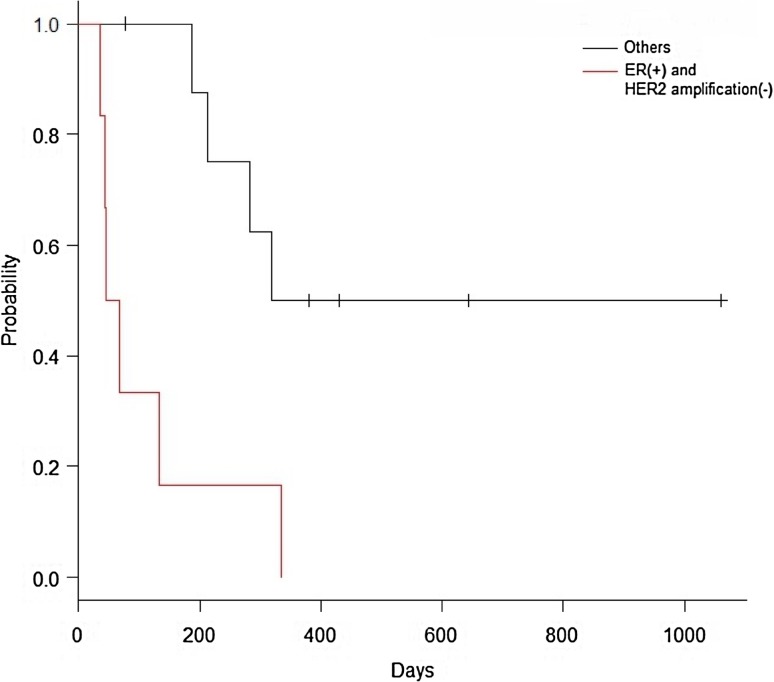
Among the 34 patients, nine (26.5%) had progressive disease at the first efficacy analysis; these patients were considered to have primary resistance to T-DM1. No significant difference was found in the rate of primary resistance to T-DM1 between groups. Among 16 patients whose ctDNA was analyzed, four showed primary resistance to T-DM1. These four patients showed negative HER2 gene amplification in ctDNA and were ER-positive and/or PR-positive by immunohistochemistry.
HER2 gene amplification in ctDNA and ER and PR status may predict primary resistance to T-DM1. A liquid biopsy before the initiation of T-DM1 treatment could be a non-invasive way to predict whether a patient would exhibit primary resistance to T-DM1.
曲妥珠单抗-美坦新偶联物(T-DM1)获批用于治疗人表皮生长因子受体 2(HER2)阳性晚期乳腺癌(ABC)患者,疗效显著。然而,部分患者对 T-DM1 表现出原发性耐药,因此需要在临床实践中找到能够预测耐药的方法。血浆中循环肿瘤 DNA(ctDNA)的基因组分析是一种非侵入性且可重复的方法。本研究旨在通过结合 HER2 阳性 ABC 患者的 ctDNA 基因组分析和其他临床病理特征,预测对 T-DM1 的原发性耐药。
本研究纳入了 34 例接受 T-DM1 治疗的 HER2 阳性 ABC 患者。分析了患者的临床病理特征与对 T-DM1 的原发性耐药之间的相关性,并对 16 例患者在接受 T-DM1 治疗前的血浆 ctDNA 样本进行了 HER2 基因拷贝数和 PIK3CA 基因突变分析。
在 34 例患者中,9 例(26.5%)在首次疗效分析时出现疾病进展,被认为对 T-DM1 产生原发性耐药。各组之间 T-DM1 原发性耐药率无显著差异。在对 16 例患者的 ctDNA 进行分析的患者中,有 4 例表现出对 T-DM1 的原发性耐药。这 4 例患者的 ctDNA 中未检测到 HER2 基因扩增,且免疫组化结果显示 ER 和/或 PR 阳性。
ctDNA 中的 HER2 基因扩增以及 ER 和 PR 状态可能预测对 T-DM1 的原发性耐药。在开始使用 T-DM1 治疗前进行液体活检,可能是一种预测患者是否对 T-DM1 产生原发性耐药的非侵入性方法。