Tulgar Serkan, Kapakli Mahmut Sertan, Kose Halil Cihan, Senturk Ozgur, Selvi Onur, Serifsoy Talat Ercan, Thomas David Terence, Ozer Zeliha
Department of Anesthesiology and Reanimation, Faculty of Medicine, Maltepe University, Istanbul, Turkey.
Department of General Surgery, Faculty of Medicine, Maltepe University, Istanbul, Turkey.
Anesth Essays Res. 2019 Jan-Mar;13(1):50-56. doi: 10.4103/aer.AER_194_18.
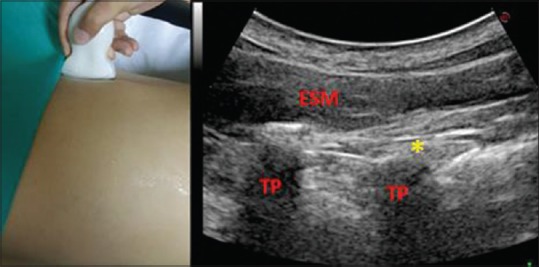
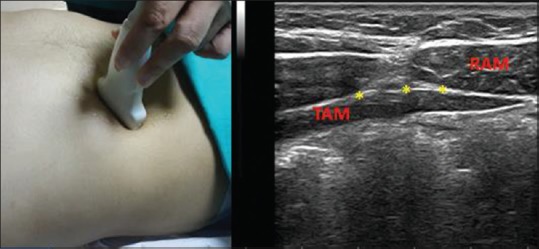
Oblique subcostal transversus abdominis plane block (OSTAP) is a recently described regional anesthetic technique used in upper abdominal surgeries such as laparoscopic cholecystectomy (LC). Erector spinae plane block (ESPB) has also been reported for postoperative analgesia in LC.
We aimed to compare the effectiveness of OSTAP and ESPB in providing postoperative analgesia in patients undergoing these surgeries.
This study was designed as a double-blinded, prospective, randomized, efficiency study in a tertiary university hospital, postoperative recovery room, and ward.
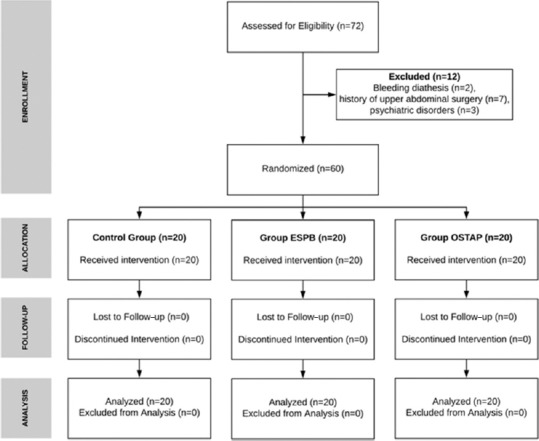
A total of 72 patients were recruited and 60 patients were randomized into three equal groups (ESPB, OSTAP, and control group). Pain intensity between groups was compared using Numeric Rating Scale (NRS) scores. In addition, consumption of paracetamol and tramadol and additional rescue analgesic requirement were measured. Standard multimodal analgesia was performed in all groups, while ESPB block was also performed in Group ESPB and OSTAP block was also performed in group OSTAP.
Descriptive statistics were expressed as mean ± standard deviation. Independent -test, Mann-Whitney U-test, Chi-square test, Fisher's exact test, Shapiro-Wilk test, one-way ANOVA, and Tukey's analysis were used for statistical analysis.
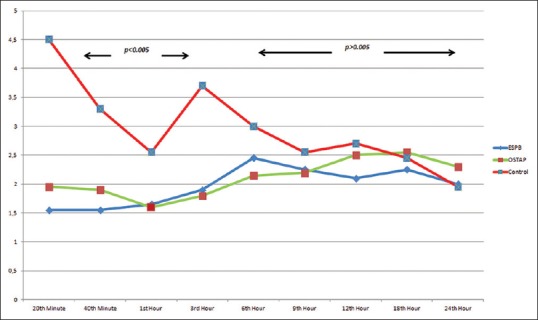
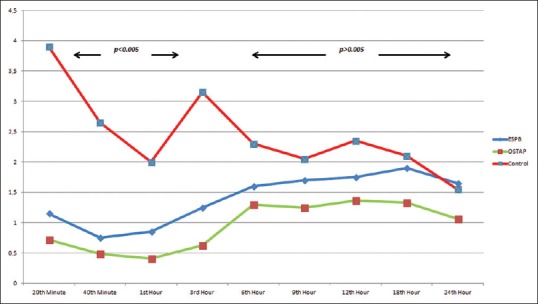
NRS was lower in block groups during the first 3 h. There was no difference in NRS scores at other hours. Analgesic consumption and rescue analgesic requirement were lower in groups ESPB and OSTAP when compared to those of control group. Block groups were similar.
Bilateral ultrasound-guided ESPB and OSTAP performed at the end of LC lead to akin analgesia requirement and improve the quality of multimodal analgesia.
斜肋下腹横肌平面阻滞(OSTAP)是一种最近描述的区域麻醉技术,用于上腹部手术,如腹腔镜胆囊切除术(LC)。竖脊肌平面阻滞(ESPB)也已被报道用于LC术后镇痛。
我们旨在比较OSTAP和ESPB在这些手术患者中提供术后镇痛的效果。
本研究设计为在一所三级大学医院、术后恢复室和病房进行的双盲、前瞻性、随机、效率研究。
共招募72例患者,60例患者被随机分为三组(ESPB组、OSTAP组和对照组),每组20例。使用数字评分量表(NRS)评分比较各组之间的疼痛强度。此外,测量对乙酰氨基酚和曲马多的消耗量以及额外的急救镇痛需求。所有组均采用标准的多模式镇痛,而ESPB组进行ESPB阻滞,OSTAP组进行OSTAP阻滞。
描述性统计以均数±标准差表示。采用独立样本t检验、Mann-Whitney U检验、卡方检验、Fisher精确检验、Shapiro-Wilk检验、单因素方差分析和Tukey分析进行统计分析。
在前3小时,阻滞组的NRS较低。其他时间点的NRS评分无差异。与对照组相比,ESPB组和OSTAP组的镇痛药物消耗量和急救镇痛需求较低。阻滞组之间相似。
在LC结束时进行双侧超声引导下的ESPB和OSTAP可产生相似的镇痛需求,并提高多模式镇痛的质量。