Ghadban Rugheed, Enezate Tariq, Payne Joshua, Allaham Haytham, Halawa Ahmad, Fong Hee Kong, Abdullah Obai, Aggarwal Kul
Division of Cardiology, Department of Internal Medicine, University of Missouri, Columbia, Missouri, USA.
Department of Internal Medicine, University of Missouri, Columbia, Missouri, USA.
Heart Asia. 2019 Mar 19;11(1):e011142. doi: 10.1136/heartasia-2018-011142. eCollection 2019.
Morphine is widely used for pain control in patients with acute coronary syndrome (ACS). Several studies have questioned the safety of morphine in this setting with a concern of interaction with and reduced efficacy of antiplatelet agents.
This study aims to systematically review the safety of morphine use in ACS.
MEDLINE, EMBASE and the Cochrane Central Register of Controlled Trials were queried from inception through April 2018. Studies comparing morphine to nonmorphine use in ACS were included. Study endpoints included: in-hospital myocardial infarction (MI), all-cause mortality, stroke, major bleeding, minor bleeding and dyspnoea.
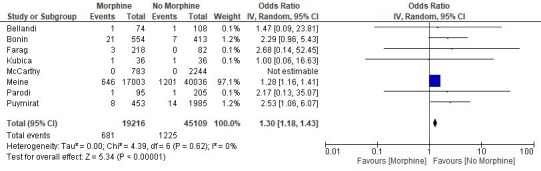
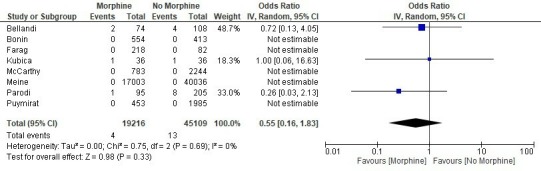
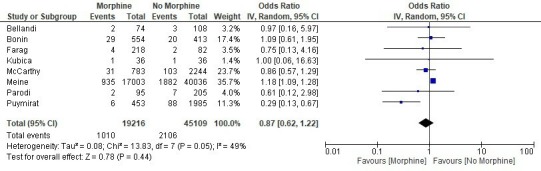
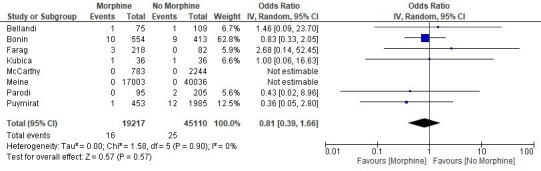
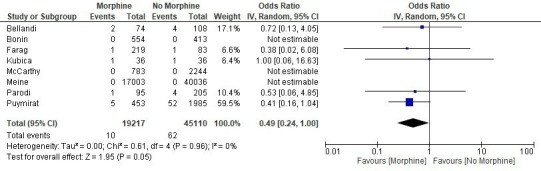
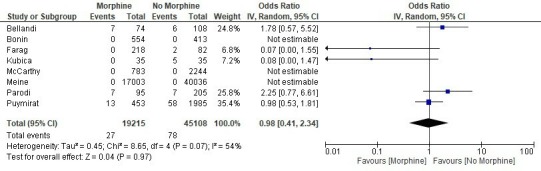
A total of 64 323 patients with ACS were included from eight studies, seven of which were observational studies and one was a randomised controlled trial. The use of morphine was associated with increased risk of in-hospital recurrent MI (OR 1.30, 95% CI 1.18 to 1.43, p < 0.00001). There was, however, no significant difference in terms of all-cause mortality (OR 0.87, 95% CI 0.62 to 1.22, p = 0.44), stroke (OR 0.81, 95% CI 0.39 to 1.66, p = 0.57), major bleeding (OR 0.49, 95% CI 0.24 to 1.00, p = 0.05), minor bleeding (OR 0.98, 95% CI 0.41 to 2.34, p = 0.97), or dyspnoea (OR 0.55, 95% CI 0.16 to 1.83, p = 0.33).
The use of morphine for pain control in ACS was associated with an increased risk of in-hospital recurrent MI. Randomised clinical trials are needed to further investigate the safety of morphine in ACS.
吗啡广泛用于急性冠状动脉综合征(ACS)患者的疼痛控制。多项研究对吗啡在此种情况下的安全性提出质疑,担心其与抗血小板药物相互作用并降低抗血小板药物疗效。
本研究旨在系统评价ACS患者使用吗啡的安全性。
检索MEDLINE、EMBASE和Cochrane对照试验中心注册库,检索时间从建库至2018年4月。纳入比较ACS患者使用吗啡与不使用吗啡的研究。研究终点包括:住院期间心肌梗死(MI)、全因死亡率、卒中、大出血、小出血和呼吸困难。
八项研究共纳入64323例ACS患者,其中七项为观察性研究,一项为随机对照试验。使用吗啡与住院期间复发性MI风险增加相关(OR 1.30,95%CI 1.18至1.43,p<0.00001)。然而,在全因死亡率(OR 0.87,95%CI 0.62至1.22,p = 0.44)、卒中(OR 0.81,95%CI 0.39至1.66,p = 0.57)、大出血(OR 0.49,95%CI 0.24至1.00,p = 0.05)、小出血(OR 0.98,95%CI 0.41至2.34,p = 0.97)或呼吸困难(OR 0.55,95%CI 0.16至1.83,p = 0.33)方面无显著差异。
ACS患者使用吗啡控制疼痛与住院期间复发性MI风险增加相关。需要进行随机临床试验进一步研究ACS患者使用吗啡的安全性。