Faculty of Medicine and Health Technology, Tampere University, Finland.
Department of Future Technologies, University of Turku, Finland.
FEBS Open Bio. 2019 Jul;9(7):1204-1211. doi: 10.1002/2211-5463.12647. Epub 2019 Jun 11.
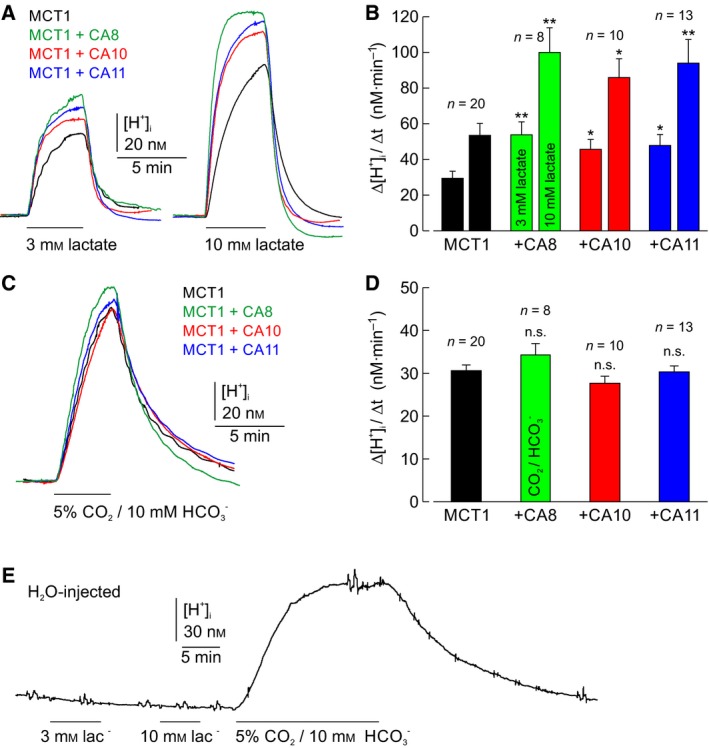
Carbonic anhydrases (CA) catalyze the reversible hydration of CO to protons and bicarbonate and thereby play a fundamental role in the epithelial acid/base transport mechanisms serving fluid secretion and absorption for whole-body acid/base regulation. The three carbonic anhydrase-related proteins (CARPs) VIII, X, and XI, however, are catalytically inactive. Previous work has shown that some CA isoforms noncatalytically enhance lactate transport through various monocarboxylate transporters (MCT). Therefore, we examined whether the catalytically inactive CARPs play a role in lactate transport. Here, we report that CARP VIII, X, and XI enhance transport activity of the MCT MCT1 when coexpressed in Xenopus oocytes, as evidenced by the rate of rise in intracellular H+ concentration detected using ion-sensitive microelectrodes. Based on previous studies, we suggest that CARPs may function as a 'proton antenna' for MCT1, to drive proton-coupled lactate transport across the cell membrane.
碳酸酐酶(CA)催化 CO 的可逆水合作用,生成质子和碳酸氢根,从而在为全身酸碱调节服务的上皮酸碱转运机制中发挥基本作用。然而,三种碳酸酐酶相关蛋白(CARPs)VIII、X 和 XI 是无催化活性的。先前的工作表明,一些 CA 同工酶通过各种单羧酸转运蛋白(MCT)非催化地增强乳酸盐转运。因此,我们研究了无催化活性的 CARPs 是否在乳酸盐转运中发挥作用。在这里,我们报告 CARP VIII、X 和 XI 增强了 Xenopus 卵母细胞中 MCT MCT1 的转运活性,这可以通过使用离子敏感微电极检测到的细胞内 H+浓度上升速率来证明。基于先前的研究,我们认为 CARPs 可能作为 MCT1 的“质子天线”,驱动质子偶联的乳酸盐穿过细胞膜的转运。