Huberty Jennifer, Eckert Ryan, Larkey Linda, Kurka Jonathan, Rodríguez De Jesús Sue A, Yoo Wonsuk, Mesa Ruben
College of Health Solutions, Arizona State University, Phoenix, AZ, United States.
Mays Cancer Center, University of Texas Health MD Anderson, San Antonio, TX, United States.
JMIR Form Res. 2019 Apr 29;3(2):e12662. doi: 10.2196/12662.
Myeloproliferative neoplasm (MPN) patients often report high symptom burden that persists despite the best available pharmacologic therapy. Meditation has gained popularity in recent decades as a way to manage cancer patient symptoms.
The aim of this study was to examine the feasibility of 2 different consumer-based meditation smartphone apps in MPN patients and to examine the limited efficacy of smartphone-based meditation on symptoms compared with an educational control group.
Patients (n=128) were recruited nationally through organizational partners and social media. Eligible and consented patients were enrolled into 1 of 4 groups, 2 of which received varying orders of 2 consumer-based apps (10% Happier and Calm) and 2 that received one of the apps alone for the second 4 weeks of the 8-week intervention after an educational control condition. Participants were asked to perform 10 min of meditation per day irrespective of the app and the order in which they received the apps. Feasibility outcomes were measured at weeks 5 and 9 with a Web-based survey. Feasibility outcomes were acceptability, demand, and limited efficacy for depression, anxiety, pain intensity, sleep disturbance, sexual function, quality of life, global health, and total symptom burden.
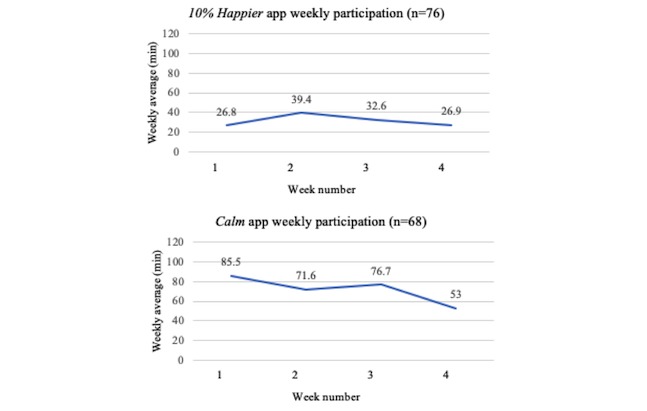
A total of 128 patients were enrolled across all 4 groups, with 73.4% (94/128) patients completing the intervention. Of the participants who completed the 10% Happier app, 61% (46/76) enjoyed it, 66% (50/76) were satisfied with the content, and 77% (59/76) would recommend to others. Of those who completed the Calm app, 83% (56/68) enjoyed it, 84% (57/68) were satisfied with the content, and 97% (66/68) would recommend to others. Of those who completed the educational control, 91% (56/61) read it, 87% (53/61) enjoyed it, and 71% (43/61) learned something. Participants who completed the 10% Happier app averaged 31 (SD 33) min/week; patients completing the Calm app averaged 71 (SD 74) min/week. 10% Happier app participants saw small effects on anxiety (P<.001 d=-0.43), depression (P=.02; d=-0.38), sleep disturbance (P=.01; d=-0.40), total symptom burden (P=.13; d=-0.27), and fatigue (P=.06; d=-0.30), and moderate effects on physical health (P<.001; d=0.52). Calm app participants saw small effects on anxiety (P=.29; d=-0.22), depression (P=.09; d=-0.29), sleep disturbance (P=.002; d=-0.47), physical health (P=.005; d=0.44), total symptom burden (P=.13; d=-0.27), and fatigue (P=.13; d=-0.27). Educational control participants (n=61) did not have effects on any patient-reported outcome except for a moderate effect on physical health (P<.001; d=0.77).
Delivering meditation via the Calm app is feasible and scored higher in terms of feasibility when compared with the 10% Happier app. The Calm app will be used to implement a randomized controlled trial, testing the effects of meditation on symptom burden in MPNs.
ClinicalTrials.gov NCT03726944; https://clinicaltrials.gov/ct2/show/NCT03726944 (Archived by WebCite at http://www.webcitation.org/77MVdFJwM).
骨髓增殖性肿瘤(MPN)患者常报告症状负担重,即便采用了最佳可用药物治疗,症状仍持续存在。近几十年来,冥想作为一种管理癌症患者症状的方法越来越受欢迎。
本研究旨在探讨两款基于消费者的冥想智能手机应用程序在MPN患者中的可行性,并与教育对照组相比,研究基于智能手机的冥想对症状的有限疗效。
通过组织合作伙伴和社交媒体在全国范围内招募患者(n = 128)。符合条件并同意参与的患者被分为4组中的1组,其中2组接受两款基于消费者的应用程序(“10%更快乐”和“平静”)的不同顺序使用,另外2组在8周干预的后4周接受教育对照条件后单独使用其中一款应用程序。无论应用程序及使用顺序如何,参与者均被要求每天进行10分钟的冥想。在第5周和第9周通过基于网络的调查测量可行性结果。可行性结果包括可接受性、需求以及对抑郁、焦虑、疼痛强度、睡眠障碍、性功能、生活质量、整体健康和总症状负担的有限疗效。
所有4组共招募了128名患者,73.4%(94/128)的患者完成了干预。在完成“10%更快乐”应用程序的参与者中,61%(46/76)喜欢它,66%(50/76)对内容满意,77%(59/76)会向他人推荐。在完成“平静”应用程序的参与者中,83%(56/68)喜欢它,84%(57/68)对内容满意,97%(66/68)会向他人推荐。在完成教育对照的参与者中,91%(56/61)阅读了它,87%(53/61)喜欢它,71%(43/61)学到了一些东西。完成“10%更快乐”应用程序的参与者平均每周使用31(标准差33)分钟;完成“平静”应用程序的患者平均每周使用71(标准差74)分钟。使用“10%更快乐”应用程序的参与者在焦虑(P <.001;d = -0.43)、抑郁(P =.02;d = -0.38)、睡眠障碍(P =.01;d = -0.40)、总症状负担(P =.13;d = -0.27)和疲劳(P =.06;d = -0.30)方面有小的改善,在身体健康方面有中等程度的改善(P <.001;d = 0.52)。使用“平静”应用程序的参与者在焦虑(P =.29;d = -0.22)、抑郁(P =.09;d = -0.29)、睡眠障碍(P =.002;d = -0.47)、身体健康(P =.005;d = 0.44)、总症状负担(P =.13;d = -0.27)和疲劳(P =.13;d = -0.27)方面有小的改善。教育对照参与者(n = 61)除了在身体健康方面有中等程度的改善(P <.001;d = 0.77)外,对任何患者报告的结果均无影响。
通过“平静”应用程序提供冥想是可行的,与“10%更快乐”应用程序相比,在可行性方面得分更高。“平静”应用程序将用于开展一项随机对照试验,测试冥想对MPN症状负担的影响。
ClinicalTrials.gov NCT03726944;https://clinicaltrials.gov/ct2/show/NCT03726944(由WebCite存档于http://www.webcitation.org/77MVdFJwM)
