Metaxa Athina Marina, Liverpool Shaun, Eisenstadt Mia, Pollard John, Carlsson Courtney
Nuffield Department of Primary Care Health Sciences, University of Oxford, Oxford, United Kingdom.
Faculty of Health, Social Care and Medicine, Edge Hill University, Ormskirk, United Kingdom.
JMIR Form Res. 2025 Jan 23;9:e68031. doi: 10.2196/68031.
With growing evidence suggesting that levels of emotional well-being have been decreasing globally over the past few years, demand for easily accessible, convenient, and affordable well-being and mental health support has increased. Although mental health apps designed to tackle this demand by targeting diagnosed conditions have been shown to be beneficial, less research has focused on apps aiming to improve emotional well-being. There is also a dearth of research on well-being apps structured around users' lived experiences and emotional patterns and a lack of integration of real-world evidence of app usage. Thus, the potential benefits of these apps need to be evaluated using robust real-world data.
This study aimed to explore usage patterns and preliminary outcomes related to mental health and well-being among users of an app (Paradym; Paradym Ltd) designed to promote emotional well-being and positive mental health.
This is a pre-post, single-arm evaluation of real-world data provided by users of the Paradym app. Data were provided as part of optional built-in self-assessments that users completed to test their levels of depression (Patient Health Questionnaire-9), anxiety (Generalized Anxiety Disorder Questionnaire-7), life satisfaction (Satisfaction With Life Scale), and overall well-being (World Health Organization-5 Well-Being Index) when they first started using the app and at regular intervals following initial usage. Usage patterns, including the number of assessments completed and the length of time between assessments, were recorded. Data were analyzed using within-subjects t tests, and Cohen d estimates were used to measure effect sizes.
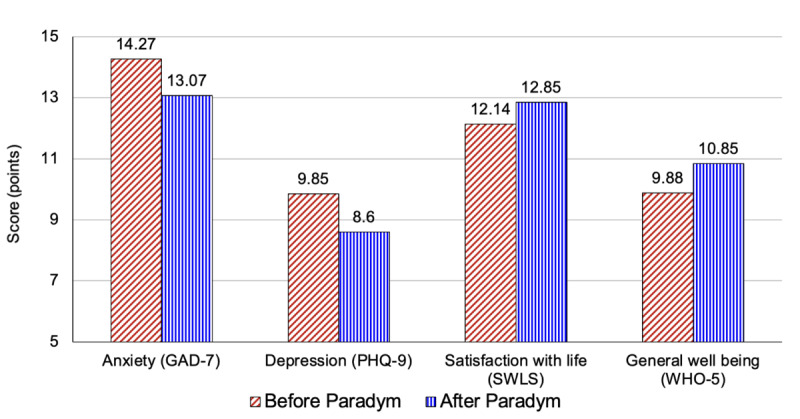
A total of 3237 app users completed at least 1 self-assessment, and 787 users completed a follow-up assessment. The sample was diverse, with 2000 users (61.8%) being located outside of the United States. At baseline, many users reported experiencing strong feelings of burnout (677/1627, 41.6%), strong insecurities (73/211, 34.6%), and low levels of thriving (140/260, 53.8%). Users also experienced symptoms of depression (mean 9.85, SD 5.55) and anxiety (mean 14.27, SD 6.77) and reported low levels of life satisfaction (mean 12.14, SD 7.42) and general well-being (mean 9.88, SD 5.51). On average, users had been using the app for 74 days when they completed a follow-up assessment. Following app usage, small but significant improvements were reported across all outcomes of interest, with anxiety and depression scores improving by 1.20 and 1.26 points on average, respectively, and life satisfaction and well-being scores improving by 0.71 and 0.97 points, respectively.
This real-world data analysis and evaluation provided positive preliminary evidence for the Paradym app's effectiveness in improving mental health and well-being, supporting its use as a scalable intervention for emotional well-being, with potential applications across diverse populations and settings, and encourages the use of built-in assessments in mental health app research.
越来越多的证据表明,在过去几年中全球范围内的情绪幸福感水平一直在下降,对易于获取、方便且经济实惠的幸福感和心理健康支持的需求也随之增加。尽管旨在通过针对已确诊病症来满足这一需求的心理健康应用程序已被证明有益,但较少有研究关注旨在改善情绪幸福感的应用程序。关于围绕用户生活经历和情绪模式构建的幸福感应用程序的研究也很匮乏,并且缺乏应用程序使用的真实世界证据的整合。因此,需要使用可靠的真实世界数据来评估这些应用程序的潜在益处。
本研究旨在探索一款旨在促进情绪幸福感和积极心理健康的应用程序(Paradym;Paradym有限公司)的用户的使用模式以及与心理健康和幸福感相关的初步结果。
这是一项对Paradym应用程序用户提供的真实世界数据进行的前后单臂评估。数据作为用户完成的可选内置自我评估的一部分提供,用于在他们首次开始使用应用程序时以及首次使用后的定期时间测试他们的抑郁水平(患者健康问卷 - 9)、焦虑水平(广泛性焦虑症问卷 - 7)、生活满意度(生活满意度量表)和总体幸福感(世界卫生组织 - 5幸福感指数)。记录使用模式,包括完成的评估数量和评估之间的时间长度。使用受试者内t检验进行数据分析,并使用科恩d估计值来测量效应大小。
共有3237名应用程序用户完成了至少1次自我评估,787名用户完成了后续评估。样本具有多样性,2000名用户(61.8%)位于美国境外。在基线时,许多用户报告经历强烈的倦怠感(677/1627,41.6%)、强烈的不安全感(73/211,34.6%)以及低水平的蓬勃发展(140/260,53.8%)。用户还经历了抑郁症状(平均9.85,标准差5.55)和焦虑症状(平均14.27,标准差6.77),并报告生活满意度(平均12.14,标准差7.42)和总体幸福感(平均9.88,标准差5.51)较低。平均而言,用户在完成后续评估时已使用该应用程序74天。使用该应用程序后,所有感兴趣的结果均报告了虽小但显著的改善,焦虑和抑郁得分分别平均提高了1.20分和1.26分,生活满意度和幸福感得分分别提高了0.71分和0.97分。
这项真实世界数据分析和评估为Paradym应用程序在改善心理健康和幸福感方面的有效性提供了积极的初步证据,支持将其用作情绪幸福感的可扩展干预措施,具有在不同人群和环境中的潜在应用,并鼓励在心理健康应用程序研究中使用内置评估。
