Department of Radiology and Biomedical Imaging, Yale School of Medicine, New Haven, CT, United States of America; Department of Radiology and Biomedical Imaging, University of California, San Francisco, CA, United States of America.
Department of Radiology and Biomedical Imaging, University of California, San Francisco, CA, United States of America.
Neuroimage Clin. 2019;23:101831. doi: 10.1016/j.nicl.2019.101831. Epub 2019 Apr 24.
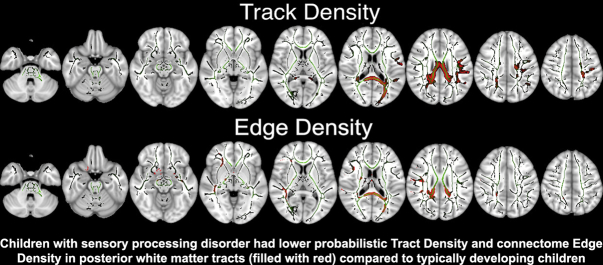
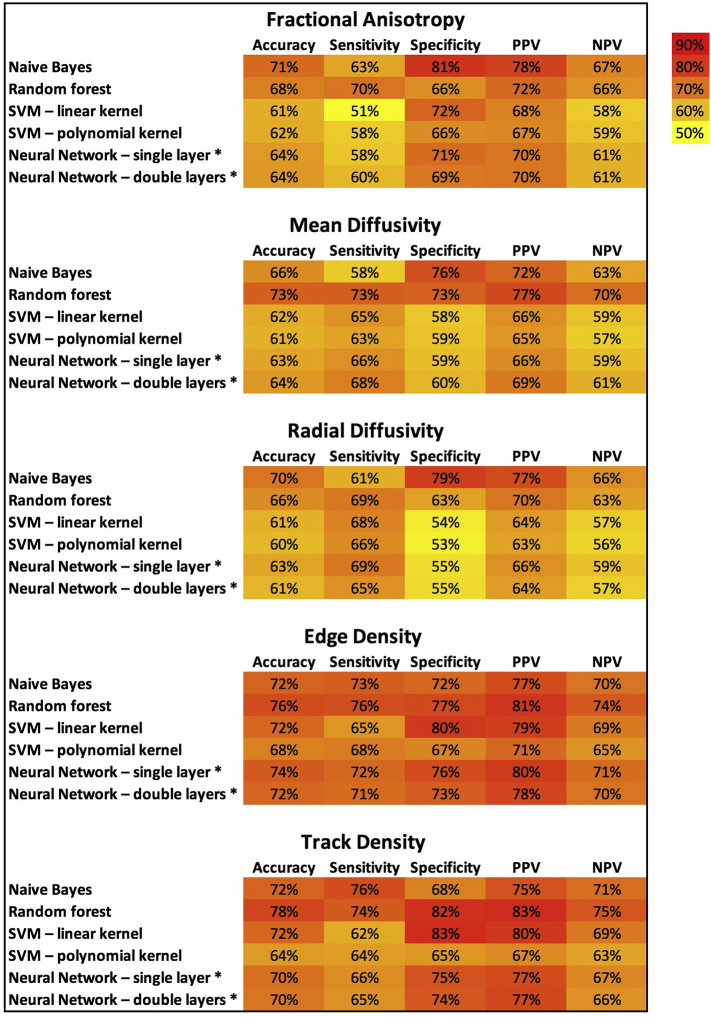
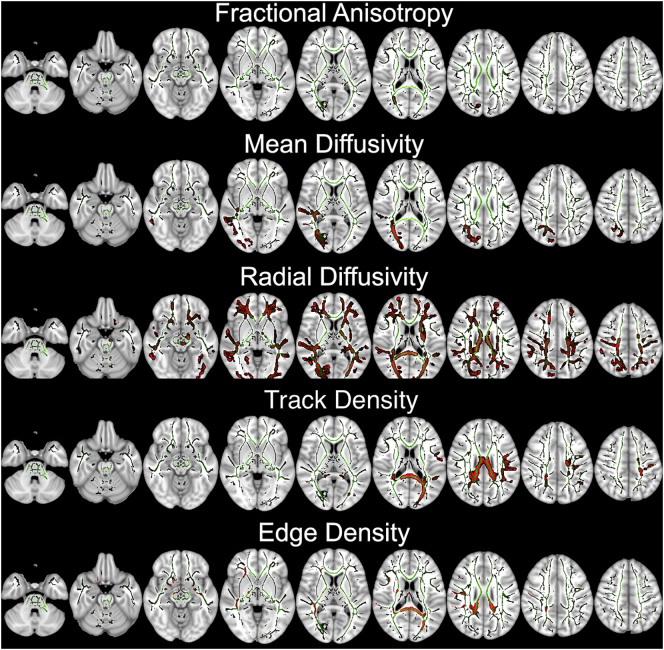
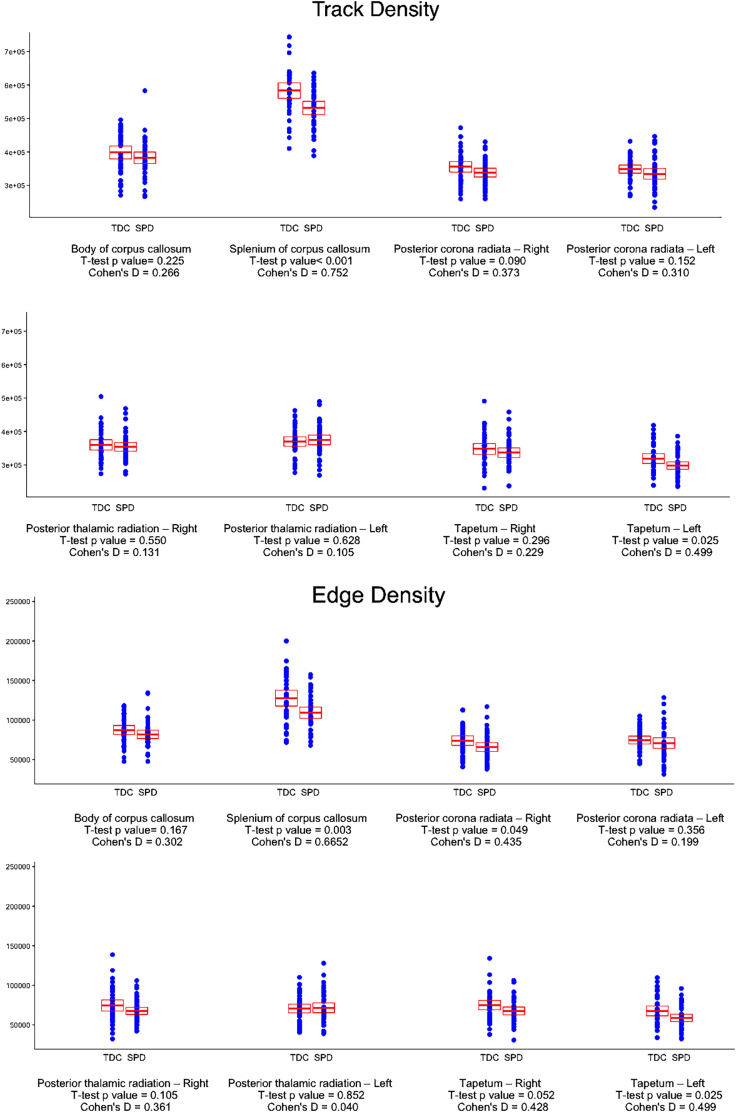
The "sensory processing disorder" (SPD) refers to brain's inability to organize sensory input for appropriate use. In this study, we determined the diffusion tensor imaging (DTI) microstructural and connectivity correlates of SPD, and apply machine learning algorithms for identification of children with SPD based on DTI/tractography metrics. A total of 44 children with SPD and 41 typically developing children (TDC) were prospectively recruited and scanned. In addition to fractional anisotropy (FA), mean diffusivity (MD), and radial diffusivity (RD), we applied probabilistic tractography to generate edge density (ED) and track density (TD) from DTI maps. For identification of children with SPD, accurate classification rates from a combination of DTI microstructural (FA, MD, AD, and RD), connectivity (TD) and connectomic (ED) metrics with different machine learning algorithms - including naïve Bayes, random forest, support vector machine, and neural networks - were determined. In voxel-wise analysis, children with SPD had lower FA, ED, and TD but higher MD and RD compared to TDC - predominantly in posterior white matter tracts including posterior corona radiata, posterior thalamic radiation, and posterior body and splenium of corpus callosum. In stepwise penalized logistic regression, the only independent variable distinguishing children with SPD from TDC was the average TD in the splenium (p < 0.001). Among different combinations of machine learning algorithms and DTI/connectivity metrics, random forest models using tract-based TD yielded the highest accuracy in classification of SPD - 77.5% accuracy, 73.8% sensitivity, and 81.6% specificity. Our findings demonstrate impaired microstructural and connectivity/connectomic integrity in children with SPD, predominantly in posterior white matter tracts, and with reduced TD of the splenium of corpus callosum as the most distinctive pattern. Applying machine learning algorithms, these connectivity metrics can be used to devise novel imaging biomarkers for neurodevelopmental disorders.
“感觉处理障碍”(SPD)是指大脑无法组织感觉输入以进行适当使用。在这项研究中,我们确定了 SPD 的弥散张量成像(DTI)微观结构和连通性相关性,并应用机器学习算法根据 DTI/束追踪指标识别 SPD 儿童。总共前瞻性招募了 44 名 SPD 儿童和 41 名典型发育儿童(TDC)并对其进行了扫描。除了各向异性分数(FA)、平均扩散度(MD)和径向扩散度(RD),我们还应用概率束追踪从 DTI 图谱生成边缘密度(ED)和轨迹密度(TD)。为了识别 SPD 儿童,我们使用不同的机器学习算法(包括朴素贝叶斯、随机森林、支持向量机和神经网络),从 DTI 微观结构(FA、MD、AD 和 RD)、连通性(TD)和连接组学(ED)指标的组合中确定了准确的分类率。在体素水平分析中,与 TDC 相比,SPD 儿童的 FA、ED 和 TD 较低,但 MD 和 RD 较高 - 主要在后脑白质束中,包括后放射冠、后丘脑辐射以及胼胝体后体和压部。在逐步惩罚逻辑回归中,唯一能区分 SPD 儿童和 TDC 儿童的独立变量是胼胝体压部的平均 TD(p<0.001)。在不同的机器学习算法和 DTI/连通性指标组合中,基于束追踪 TD 的随机森林模型在 SPD 的分类中具有最高的准确性 - 77.5%的准确性、73.8%的敏感性和 81.6%的特异性。我们的研究结果表明, SPD 儿童存在微观结构和连通性/连接组学完整性受损,主要在后脑白质束中,胼胝体压部的 TD 减少是最具特征性的模式。应用机器学习算法,这些连通性指标可用于设计神经发育障碍的新型成像生物标志物。