Beijing Neurosurgical Institute, Beijing Tiantan Hospital, Capital Medical University, Beijing 100050, China.
Beijing Neurosurgical Institute, Beijing Tiantan Hospital, Capital Medical University, Beijing 100050, China; Department of Neurosurgery, Beijing Tiantan Hospital, Capital Medical University, Beijing 100050, China.
Neuroimage Clin. 2019;23:101835. doi: 10.1016/j.nicl.2019.101835. Epub 2019 Apr 22.
To investigate the association between proton magnetic resonance spectroscopy (H-MRS) metabolic features and the grade of gliomas, and to establish a machine-learning model to predict the glioma grade.
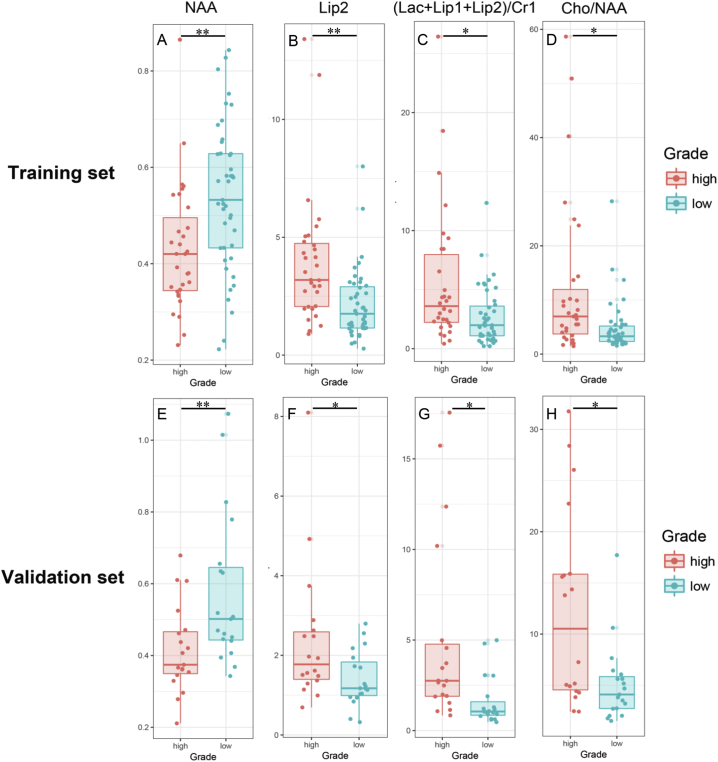
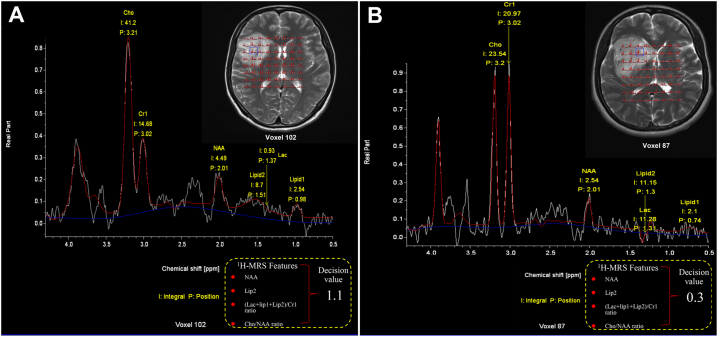
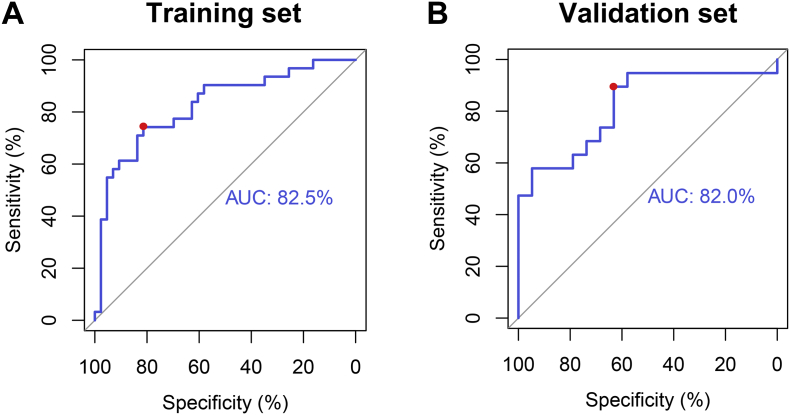
This study included 112 glioma patients who were divided into the training (n = 74) and validation (n = 38) sets based on the time of hospitalization. Twenty-six metabolic features were extracted from the preoperative H-MRS image. The Student's t-test was conducted to screen for differentially expressed features between low- and high-grade gliomas (WHO grades II and III/IV, respectively). Next, the minimum Redundancy Maximum Relevance (mRMR) algorithm was performed to further select features for a support vector machine (SVM) classifier building. Performance of the predictive model was evaluated both in the training and validation sets using ROC curve analysis.
Among the extracted H-MRS metabolic features, thirteen features were differentially expressed. Four features were further selected as grade-predictive imaging signatures using the mRMR algorithm. The predictive performance of the machine-learning model measured by the AUC was 0.825 and 0.820 in the training and validation sets, respectively. This was better than the predictive performances of individual metabolic features, the best of which was 0.812.
H-MRS metabolic features could help in predicting the grade of gliomas. The machine-learning model achieved a better prediction performance in grading gliomas than individual features, indicating that it could complement the traditionally used metabolic features.
探讨质子磁共振波谱(H-MRS)代谢特征与脑胶质瘤分级的关系,并建立机器学习模型预测脑胶质瘤分级。
本研究纳入了 112 例脑胶质瘤患者,根据住院时间分为训练集(n=74)和验证集(n=38)。从术前 H-MRS 图像中提取 26 个代谢特征。采用 Student's t 检验筛选低级别和高级别脑胶质瘤(WHO 分级 II 级和 III/IV 级)之间差异表达的代谢特征。然后,采用最小冗余最大相关性(mRMR)算法进一步选择支持向量机(SVM)分类器构建的特征。使用 ROC 曲线分析在训练集和验证集中评估预测模型的性能。
在提取的 H-MRS 代谢特征中,有 13 个特征差异表达。采用 mRMR 算法进一步选择 4 个特征作为分级预测的影像学标志物。机器学习模型的预测性能通过 AUC 测量,在训练集和验证集中分别为 0.825 和 0.820,优于单个代谢特征的预测性能,其中最佳的预测性能为 0.812。
H-MRS 代谢特征可用于预测脑胶质瘤的分级。机器学习模型在分级胶质瘤方面的预测性能优于单个特征,表明它可以补充传统的代谢特征。