Bresciani Giulia, Ditsiou Angeliki, Cilibrasi Chiara, Vella Viviana, Rea Federico, Schiavon Marco, Cavallesco Narciso Giorgio, Giamas Georgios, Zatelli Maria Chiara, Gagliano Teresa
Section of Endocrinology and Internal Medicine, Department of Medical Sciences, University of Ferrara, Ferrara, Italy.
Department of Biochemistry and Biomedicine, School of Life Sciences, University of Sussex, Brighton, UK.
Endocr Connect. 2019 Jun 1;8(6):680-690. doi: 10.1530/EC-19-0192.
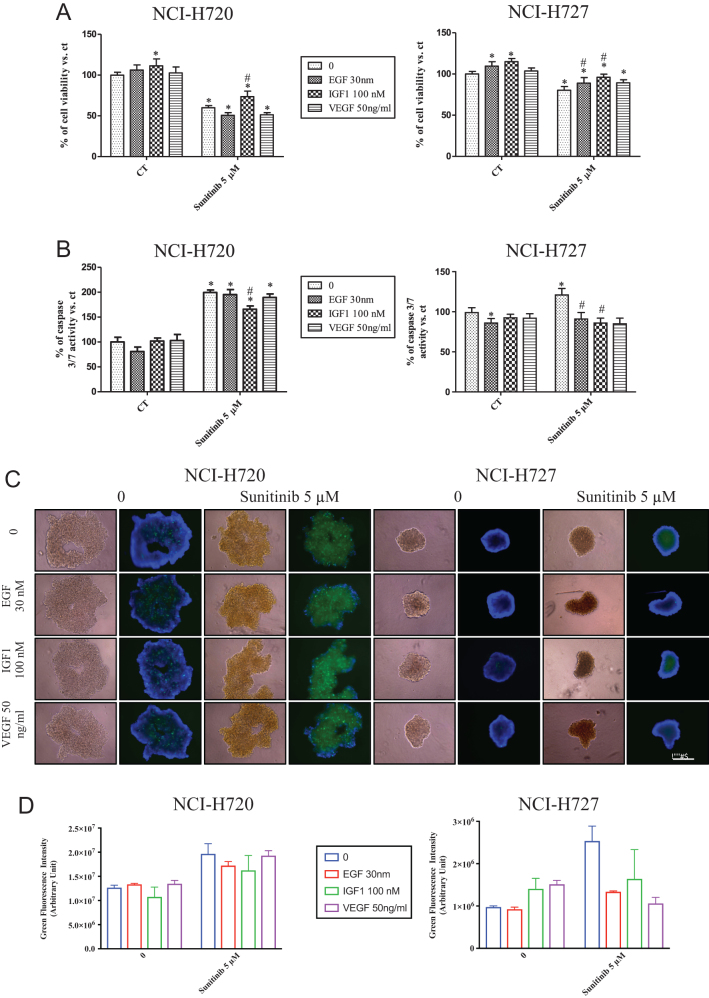
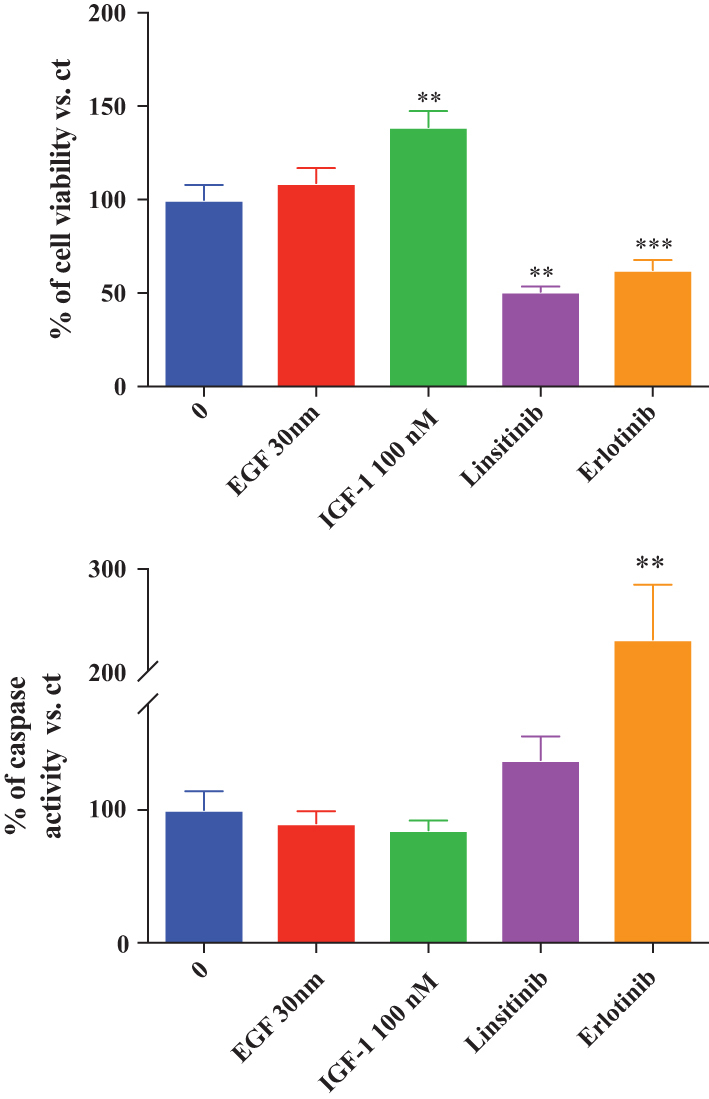
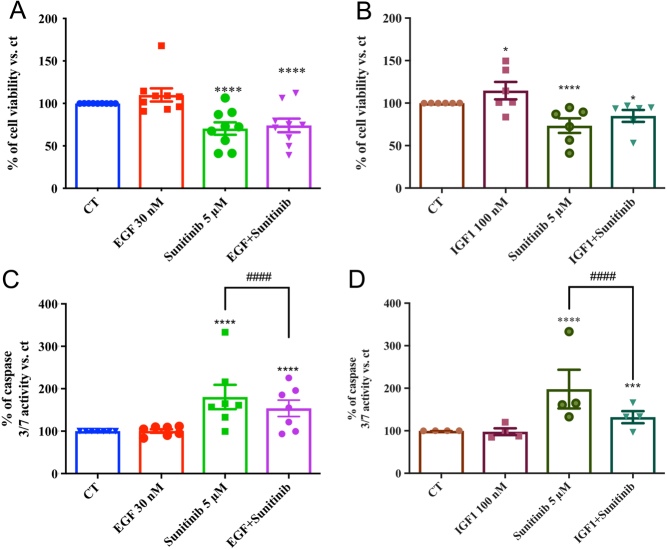
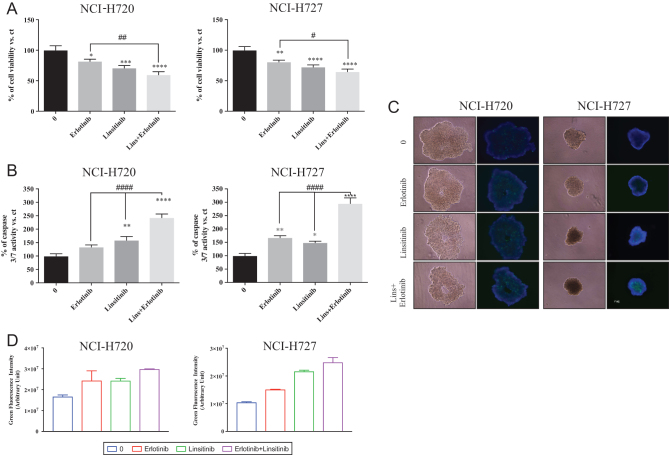
Broncho-pulmonary neuroendocrine neoplasms (BP-NENs) are neoplasms orphan of an efficient therapy. Available medical treatments derived from clinical trials are not specific for the management of this malignancy. Sunitinib is a multi-receptor tyrosine-kinases (RTKs) inhibitor that has already shown its efficacy in NENs, but there are no available data about its action in BP-NENs. Therefore, our aim was to understand the effects of RTKs inhibition promoted by sunitinib in order to evaluate new putative targets useful in malignancy treatment. Since our results underlined a role for EGFR and IGF1R in modulating sunitinib antiproliferative action, we investigated the effects of erlotinib, an EGFR inhibitor, and linsitinib, an IGF1R inhibitor, in order to understand their function in regulating cells behaviour. Cell viability and caspase activation were evaluated on two immortalised human BP-NEN cell lines and primary cultures. Our results showed that after treatment with sunitinib and/or IGF1, EGF and VEGF, the antiproliferative effect of sunitinib was counteracted by EGF and IGF1 but not by VEGF. Therefore, we evaluated with AlphaScreen technology the phosphorylated EGFR and IGF1R levels in primary cultures treated with sunitinib and/or EGF and IGF1. Results showed a decrease of p-IGF1R after treatment with sunitinib and an increase after co-treatment with IGF1. Then, we assessed cell viability and caspase activation on BP-NEN cell lines after treatment with linsitinib and/or erlotinib. Results demonstrate that these two agents have a stronger antiproliferative effect compared to sunitinib. In conclusion, our results suggest that IGF1R and EGF1R could represent putative molecular targets in BP-NENs treatment.
支气管肺神经内分泌肿瘤(BP-NENs)是缺乏有效治疗方法的肿瘤。来自临床试验的现有医学治疗方法对这种恶性肿瘤的管理并不具有特异性。舒尼替尼是一种多受体酪氨酸激酶(RTKs)抑制剂,已在神经内分泌肿瘤中显示出疗效,但尚无关于其在BP-NENs中作用的可用数据。因此,我们的目的是了解舒尼替尼促进的RTKs抑制作用的效果,以评估对恶性肿瘤治疗有用的新的潜在靶点。由于我们的结果强调了表皮生长因子受体(EGFR)和胰岛素样生长因子1受体(IGF1R)在调节舒尼替尼抗增殖作用中的作用,我们研究了EGFR抑制剂厄洛替尼和IGF1R抑制剂林西替尼的效果,以了解它们在调节细胞行为中的功能。在两种永生化的人BP-NEN细胞系和原代培养物上评估细胞活力和半胱天冬酶激活情况。我们的结果表明,在用舒尼替尼和/或胰岛素样生长因子1(IGF1)、表皮生长因子(EGF)和血管内皮生长因子(VEGF)处理后,EGF和IGF1可抵消舒尼替尼的抗增殖作用,但VEGF不能。因此,我们用AlphaScreen技术评估了用舒尼替尼和/或EGF及IGF1处理的原代培养物中磷酸化EGFR和IGF1R的水平。结果显示,用舒尼替尼处理后p-IGF1R水平降低,与IGF1共同处理后升高。然后,我们评估了用林西替尼和/或厄洛替尼处理后BP-NEN细胞系的细胞活力和半胱天冬酶激活情况。结果表明,这两种药物比舒尼替尼具有更强的抗增殖作用。总之,我们的结果表明,IGF1R和EGF1R可能是BP-NENs治疗中的潜在分子靶点。