UCD Conway Institute, University College Dublin, Belfield, Dublin 4, Ireland.
School of Medicine, University College Dublin, Belfield, Dublin 4, Ireland.
Cells. 2019 Apr 26;8(5):384. doi: 10.3390/cells8050384.
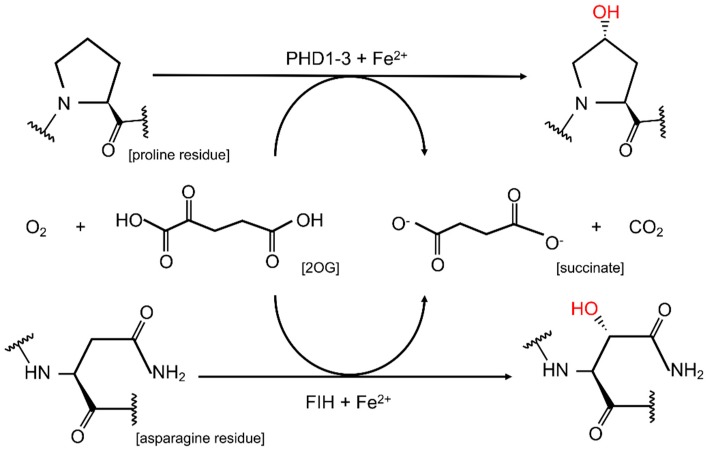
All metazoans that utilize molecular oxygen (O) for metabolic purposes have the capacity to adapt to hypoxia, the condition that arises when O demand exceeds supply. This is mediated through activation of the hypoxia-inducible factor (HIF) pathway. At physiological oxygen levels (normoxia), HIF-prolyl hydroxylases (PHDs) hydroxylate proline residues on HIF-α subunits leading to their destabilization by promoting ubiquitination by the von-Hippel Lindau (VHL) ubiquitin ligase and subsequent proteasomal degradation. HIF-α transactivation is also repressed in an O-dependent way due to asparaginyl hydroxylation by the factor-inhibiting HIF (FIH). In hypoxia, the O-dependent hydroxylation of HIF-α subunits by PHDs and FIH is reduced, resulting in HIF-α accumulation, dimerization with HIF-β and migration into the nucleus to induce an adaptive transcriptional response. Although HIFs are the canonical substrates for PHD- and FIH-mediated protein hydroxylation, increasing evidence indicates that these hydroxylases may also have alternative targets. In addition to PHD-conferred alterations in protein stability, there is now evidence that hydroxylation can affect protein activity and protein/protein interactions for alternative substrates. PHDs can be pharmacologically inhibited by a new class of drugs termed prolyl hydroxylase inhibitors which have recently been approved for the treatment of anemia associated with chronic kidney disease. The identification of alternative targets of HIF hydroxylases is important in order to fully elucidate the pharmacology of hydroxylase inhibitors (PHI). Despite significant technical advances, screening, detection and verification of alternative functional targets for PHDs and FIH remain challenging. In this review, we discuss recently proposed non-HIF targets for PHDs and FIH and provide an overview of the techniques used to identify these.
所有利用分子氧(O)进行代谢的后生动物都有适应缺氧的能力,当 O 需求超过供应时就会出现这种情况。这是通过激活缺氧诱导因子(HIF)途径来介导的。在生理氧水平(常氧)下,HIF-脯氨酰羟化酶(PHD)羟化 HIF-α亚基上的脯氨酸残基,通过促进 von-Hippel Lindau(VHL)泛素连接酶的泛素化和随后的蛋白酶体降解来导致其不稳定。HIF-α反式激活也以 O 依赖性方式受到抑制,因为因子抑制 HIF(FIH)通过天冬酰胺羟化。在缺氧条件下,PHD 和 FIH 对 HIF-α亚基的 O 依赖性羟化减少,导致 HIF-α积累,与 HIF-β二聚化并迁移到核内诱导适应性转录反应。尽管 HIF 是 PHD 和 FIH 介导的蛋白羟化的典型底物,但越来越多的证据表明这些羟化酶也可能有替代靶标。除了 PHD 赋予的蛋白稳定性改变外,现在有证据表明羟化作用还可以影响替代底物的蛋白活性和蛋白/蛋白相互作用。PHD 可被一类新的药物即脯氨酰羟化酶抑制剂药理学抑制,这些抑制剂最近已被批准用于治疗与慢性肾病相关的贫血。确定 HIF 羟化酶的替代靶标对于充分阐明羟化酶抑制剂(PHI)的药理学非常重要。尽管取得了重大技术进步,但 PHD 和 FIH 的替代功能靶标的筛选、检测和验证仍然具有挑战性。在这篇综述中,我们讨论了最近提出的 PHD 和 FIH 的非 HIF 靶标,并概述了用于识别这些靶标的技术。