Brabec Daniel, Campbell James, Arthur Frank, Casada Mark, Tilley Dennis, Bantas Sotiris
USDA, Agricultural Research Service, Center for Grain and Animal Health Research, 1515 College Avenue, Manhattan, KS 66505, USA.
Centaur Analytics, Inc., 1923 Eastman Avenue, Suite 200, Ventura, CA 93003, USA.
Insects. 2019 Apr 27;10(5):121. doi: 10.3390/insects10050121.
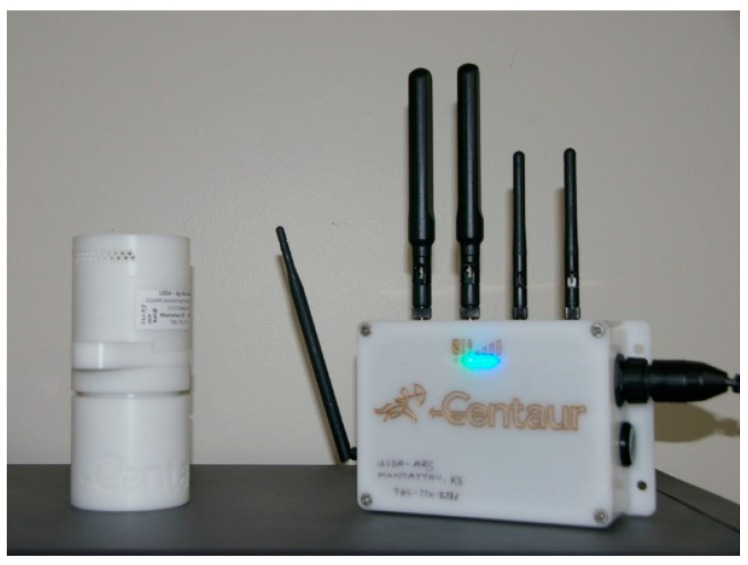
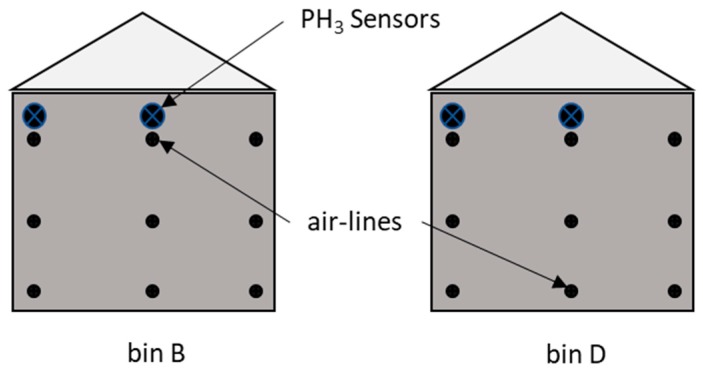
Fumigation of grain bins with phosphine tablets is one method of insect control for stored products. Monitoring the concentration of the toxic gas at many locations over several days for a given structure or container can be challenging. In this study, a commercially-available system that wirelessly measures phosphine was evaluated in small-scale and large-scale tests. Small-scale testing was performed to study the repeatability and accuracy of the sensors. The wireless sensors were within 30 ppm of each other, over a range of 700 ppm phosphine. Large-scale testing evaluated the system during the fumigation of wheat stored in 7 m diameter, 120 metric ton, steel grain bins. As a reference, monitoring lines were distributed at several positions and depths in the bin in order to sample phosphine gas concentrations. A series of three fumigation trials were performed, with each lasting for over six days. The wireless devices collected local phosphine concentrations and temperatures every two hours without assistance from personnel. Although the fumigation trials were significantly different in terms of patterns in gas concentration over time, the two sampling methods gave similar trendlines. However, the automated data provided a more detailed picture of the fumigation process. This information may help fumigation managers to better evaluate fumigations and assure successful insect control.
用磷化铝片剂对粮仓进行熏蒸是控制储存产品虫害的一种方法。对于给定的结构或容器,在数天内对多个位置的有毒气体浓度进行监测可能具有挑战性。在本研究中,对一种可无线测量磷化氢的商用系统进行了小规模和大规模测试。进行小规模测试以研究传感器的重复性和准确性。在700 ppm磷化氢范围内,无线传感器之间的误差在30 ppm以内。大规模测试在直径7米、容量120公吨的钢制小麦储存粮仓熏蒸过程中对该系统进行了评估。作为参考,在粮仓的几个位置和深度分布了监测线,以便对磷化氢气体浓度进行采样。进行了一系列三次熏蒸试验,每次试验持续超过六天。无线设备每两小时自动收集局部磷化氢浓度和温度,无需人员协助。尽管熏蒸试验在气体浓度随时间变化的模式上有显著差异,但两种采样方法给出了相似的趋势线。然而,自动数据提供了更详细的熏蒸过程情况。这些信息可能有助于熏蒸管理人员更好地评估熏蒸效果并确保成功控制虫害。