Arrhythmia Department, Fuwai Hospital Chinese Academy of Medical Sciences, Shenzhen, 518057, Guangdong, China.
Cardiovascular Department, Guangdong Cardiovascular Institute, Guangdong General Hospital & Guangdong Academy of Medical Sciences, Guangzhou, 510010, China.
BMC Cardiovasc Disord. 2019 Apr 29;19(1):100. doi: 10.1186/s12872-019-1082-7.
Persistent left superior vena cava (PLSVC) is a rare congenital vascular anomaly. Permanent pacemaker implantation (PPI) in patients with PLSVC can be challenging because of the venous anomalies. We reported a case series of patients with PLSVC who underwent PPI with double active fixation leads.
From January 2012 to July 2016, 9 patients (three male and six females, mean age 68 ± 11 years) with PLSVC who received a dual-chamber pacemaker with double active fixation leads were enrolled retrospectively in this observational study. The indications for pacemaker implantation were symptomatic third-degree atrioventricular block in one and sick sinus syndrome in eight patients.
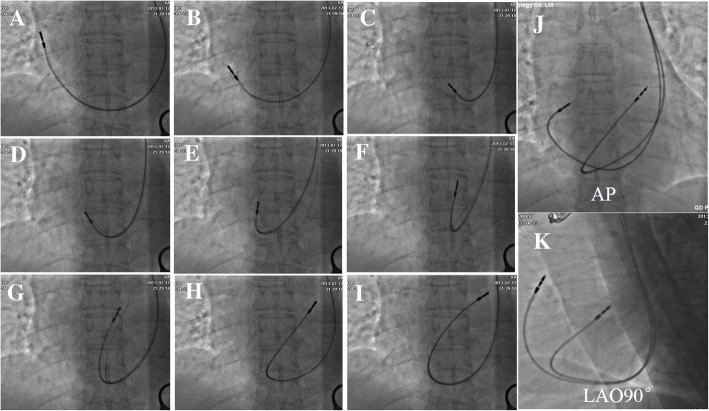
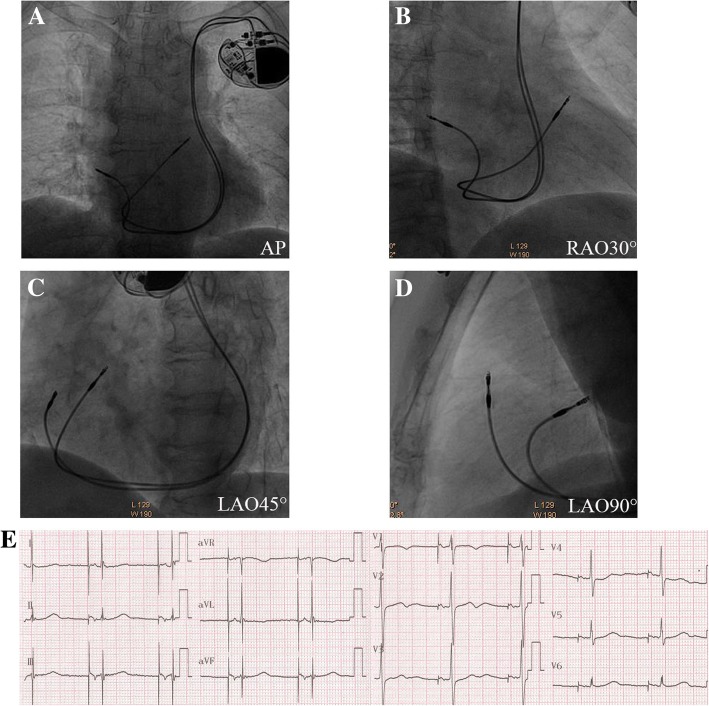
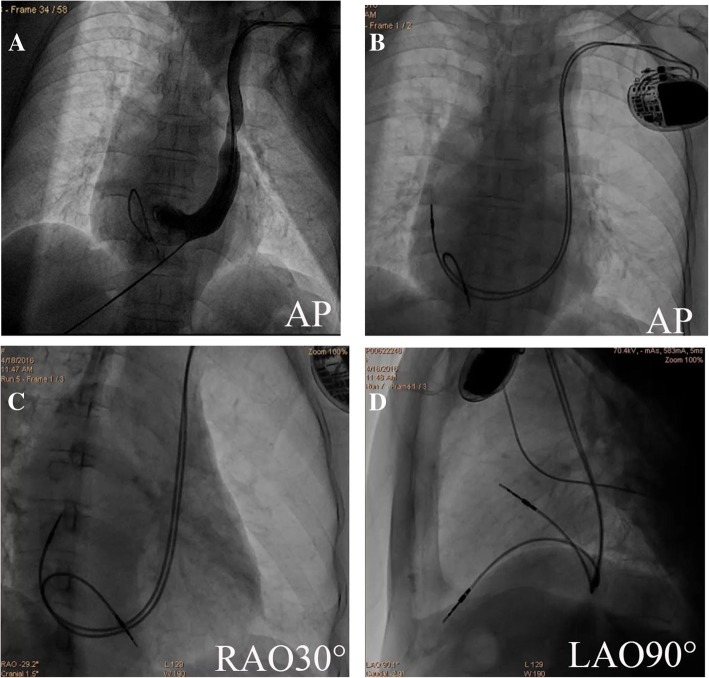
PPI were implanted successfully in all 9 patients. Successful positioning of the ventricular leads at the right ventricular outflow tract (RVOT) septum with a "C" shaped stylet was achieved in 7 patients (77.8%). In the remaining two cases, the ventricular leads were placed in the right ventricular apex and the inferior free wall of the sub-tricuspid annulus. The atrial leads were placed at the lateral wall of the right atrium in all patients. Procedure time and fluoroscopy time were 85.3 ± 11.3 min and 4.5 ± 1.1 min respectively. During a mean follow-up of 4 years, no complications were observed and pacing parameters did not change significantly.
PPI through PLSVC may be technically feasible, safe, and effective. Double active fixation leads may be standard for patients with PLSVC and most of the ventricular leads could be placed at the RVOT septum.
永存左上腔静脉(PLSVC)是一种罕见的先天性血管畸形。由于静脉异常,PLSVC 患者的永久性心脏起搏器植入(PPI)可能具有挑战性。我们报告了一组接受双主动固定导线 PPI 的 PLSVC 患者的病例系列。
从 2012 年 1 月至 2016 年 7 月,回顾性纳入 9 例(3 名男性和 6 名女性,平均年龄 68±11 岁)接受双腔起搏器和双主动固定导线的 PLSVC 患者。PPI 的适应证为 1 例三度房室传导阻滞症状性和 8 例病态窦房结综合征。
所有 9 例患者均成功植入 PPI。7 例患者(77.8%)使用“C”形塑形导丝成功将心室导线定位于右心室流出道(RVOT)间隔。在另外 2 例中,心室导线放置在右心室心尖和三尖瓣下环的下壁。所有患者的心房导线均置于右心房侧壁。手术时间和透视时间分别为 85.3±11.3min 和 4.5±1.1min。在平均 4 年的随访期间,未观察到并发症,起搏参数无明显变化。
通过 PLSVC 进行 PPI 在技术上是可行的、安全的和有效的。双主动固定导线可能是 PLSVC 患者的标准治疗方法,大多数心室导线可放置在 RVOT 间隔。