Department of Orthopedics, Hospital del Mar, Passeitg Marítim 25-29, 08003, Barcelona, Spain.
Department of Orthopedics, Hospital d'Igualada, Consorci Sanitari l'Anoia, Barcelona, Spain.
J Orthop Surg Res. 2019 Apr 29;14(1):116. doi: 10.1186/s13018-019-1157-2.
There is a growing patient interest in being involved in the decision-making process. However, little information is provided on how this information should be structured. Does it make a difference, in patient treatment decision-making, whether information is given based on the benefits or on the side effects in rotator cuff disorders?
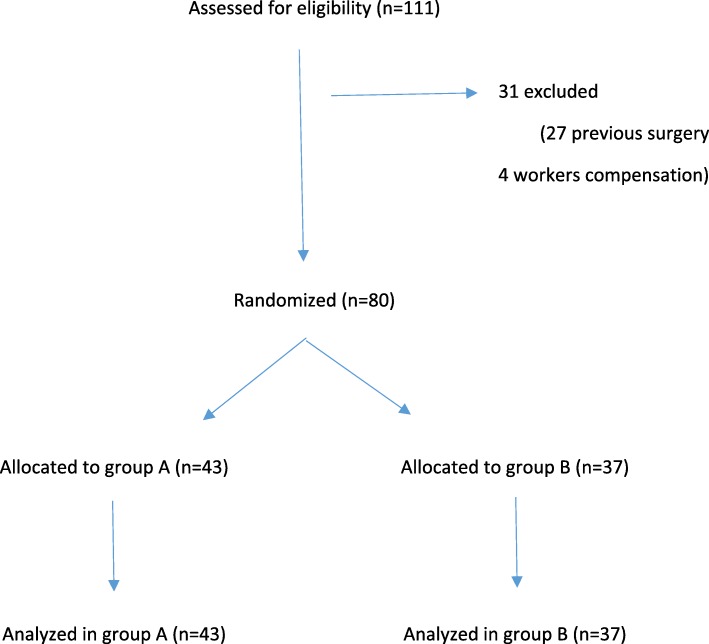
It is a prospective randomized study that includes patients diagnosed with rotator cuff tears. Patients were randomly allocated to either group A (benefit-inform) or group B (side effect-inform) and were asked to answer the following questions based on their assigned group: Group A: Your doctor informs you that you have a rotator cuff tear and states that if he/she surgically repairs your cuff tear you will improve and that the cuff remains healed at the 2-year follow-up in 71% of the cases where surgery is done. Would you choose surgery? Yes or No Group B: Your doctor informs you that you have a rotator cuff tear and that if he/she surgically repairs your cuff tear you will improve and that the cuff is torn again at 2-year follow-up in 29% of the cases where surgery is done. Would you choose surgery? Yes or No Age, gender, the shoulder affected and the functional status assessed through the Constant score were also recorded.
80 patients were randomized (43 to group A and 37 to group B). The patients assigned to group A (benefit) accepted surgery significantly more frequently than those assigned to group B (complication) (P = 0.000). In group A, 36 of 43 (84%) accepted surgery, compared to 17 of 37 (46%) in group B.
The way that information on rotator cuff disorders is provided strongly influences patients' treatment decisions.
ClinicalTrials.gov, NCT03205852 . Registered 29 June 2017. Retrospectively registered.
患者越来越希望参与决策过程。然而,关于如何构建信息,目前几乎没有相关信息。在肩袖疾病的治疗决策中,基于益处还是基于副作用提供信息,是否会对患者的治疗决策产生影响?
这是一项前瞻性随机研究,纳入了被诊断为肩袖撕裂的患者。患者被随机分配到 A 组(益处告知)或 B 组(副作用告知),并根据其所属组别回答以下问题:A 组:您的医生告知您患有肩袖撕裂,如果他/她对您的肩袖撕裂进行手术修复,您的病情将得到改善,并且在 2 年的随访中,71%的手术病例中肩袖保持愈合。您会选择手术吗?是或否。B 组:您的医生告知您患有肩袖撕裂,如果他/她对您的肩袖撕裂进行手术修复,您的病情将得到改善,但在 2 年的随访中,29%的手术病例中肩袖再次撕裂。您会选择手术吗?是或否。还记录了患者的年龄、性别、受影响的肩膀以及通过 Constant 评分评估的功能状态。
80 名患者被随机分配(43 名至 A 组,37 名至 B 组)。分配至 A 组(益处)的患者明显比分配至 B 组(并发症)的患者更频繁地选择手术(P=0.000)。在 A 组中,43 名患者中有 36 名(84%)接受了手术,而在 B 组中,37 名患者中有 17 名(46%)接受了手术。
提供肩袖疾病信息的方式强烈影响患者的治疗决策。
ClinicalTrials.gov,NCT03205852。于 2017 年 6 月 29 日注册。回顾性注册。