Department of Anesthesiology, Xiangya Hospital, Central South University, 87 Xiangya Road, Changsha, 410008, Hunan, China.
BMC Anesthesiol. 2019 May 1;19(1):61. doi: 10.1186/s12871-019-0729-3.
Urosepsis is a catastrophic complication, which can easily develop into septic shock and lead to death if not diagnosed early and effectively treated in time. However, there is a lack of evidence on the risk factors and outcomes in calculous pyonephrosis patients. Therefore, this study was conducted to identify risk factors and outcomes of intra- and postoperative urosepsis in this particular population.
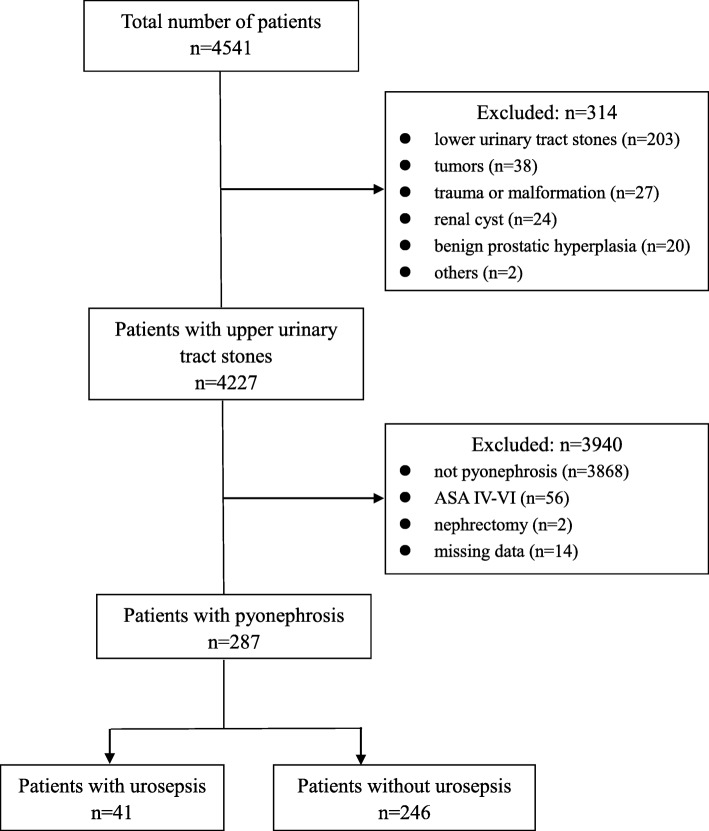
Clinical data of 287 patients with calculous pyonephrosis were collected. In the univariate and multivariate analysis, all patients were divided into urosepsis group and non-urosepsis group. The diagnosis of urosepsis was mainly on the basis of the criteria of American College of Chest Physicians (ACCP)/Society of Critical Care Medicine (SCCM). Patient characteristics and outcomes data were analyzed, and risk factors were assessed by binary logistic regression analysis.
Of 287 patients, 41 (14.3%) acquired urosepsis. Univariate analysis showed that white blood cell (WBC > 10*10^9/L) before surgery (P = 0.027), surgery types (P = 0.009), hypotension during surgery (P < 0.001) and urgent surgery (P < 0.001) were associated with intra- and postoperative urosepsis for calculous pyonephrosis patients. In multivariate analysis, hypotension during surgery and urgent surgery were closely related to intra- and postoperative urosepsis. Outcome analysis suggested that patients developing urosepsis had a longer intensive care unit (ICU) stay and postoperative hospital stay and higher mortality.
Hypotension during surgery and urgent surgery were risk factors of intra- and postoperative urosepsis for calculous pyonephrosis patients, which may lead to a prolonged ICU stay, postoperative hospital stay and higher mortality.
尿脓毒症是一种灾难性的并发症,如果不能早期诊断和及时有效治疗,很容易发展为感染性休克并导致死亡。然而,对于结石性脓肾患者,缺乏关于其风险因素和结局的证据。因此,本研究旨在确定该特定人群中术中及术后尿脓毒症的风险因素和结局。
收集了 287 例结石性脓肾患者的临床资料。在单因素和多因素分析中,所有患者均分为尿脓毒症组和非尿脓毒症组。尿脓毒症的诊断主要基于美国胸科医师学会/重症监护医学会(ACCP/SCCM)的标准。分析患者的特征和结局数据,并通过二项逻辑回归分析评估风险因素。
287 例患者中,41 例(14.3%)发生尿脓毒症。单因素分析显示,术前白细胞计数(WBC > 10*10^9/L)(P=0.027)、手术类型(P=0.009)、术中低血压(P<0.001)和急诊手术(P<0.001)与结石性脓肾患者的术中及术后尿脓毒症有关。多因素分析显示,术中低血压和急诊手术与术中及术后尿脓毒症密切相关。结局分析表明,发生尿脓毒症的患者 ICU 住院时间和术后住院时间较长,死亡率较高。
术中低血压和急诊手术是结石性脓肾患者术中及术后尿脓毒症的危险因素,可能导致 ICU 住院时间、术后住院时间延长和死亡率升高。