Sydney School of Public Health, Faculty of Medicine and Health,
Centre for Transplant and Renal Research, and.
J Am Soc Nephrol. 2019 Jun;30(6):1061-1072. doi: 10.1681/ASN.2018121232. Epub 2019 Apr 30.
In patients with CKD, the risk of developing colorectal cancer is high and outcomes are poor. Screening using fecal immunochemical testing (FIT) is effective in reducing mortality from colorectal cancer, but performance characteristics of FIT in CKD are unknown.
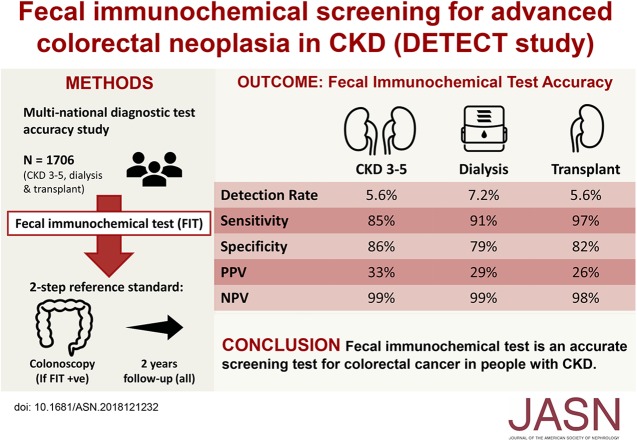
To determine the detection rates and performance characteristics of FIT for advanced colorectal neoplasia (ACN) in patients with CKD, we used FIT to prospectively screen patients aged 35-74 years with CKD (stages 3-5 CKD, dialysis, and renal transplant) from 11 sites in Australia, New Zealand, Canada, and Spain. All participants received clinical follow-up at 2 years. We used a two-step reference standard approach to estimate disease status.
Overall, 369 out of 1706 patients who completed FIT (21.6%) tested positive; 323 (87.5%) underwent colonoscopies. A total of 1553 (91.0%) completed follow-up; 82 (4.8%) had died and 71 (4.2%) were lost. The detection rate of ACN using FIT was 6.0% (5.6%, 7.4%, and 5.6% for stages 3-5 CKD, dialysis, and transplant). Sensitivity, specificity, and positive and negative predictive values of FIT for ACN were 0.90, 0.83, 0.30, and 0.99, respectively. Of participants who underwent colonoscopy, five (1.5%) experienced major colonoscopy-related complications, including bowel perforation and major bleeding.
FIT appears to be an accurate screening test for patients with CKD, such that a negative test may rule out the diagnosis of colorectal cancer within 2 years. However, the risk of major complications from work-up colonoscopy are at least ten-fold higher than in the general population.
在慢性肾脏病(CKD)患者中,结直肠癌的发病风险较高,预后较差。粪便免疫化学检测(FIT)筛查可有效降低结直肠癌死亡率,但 FIT 在 CKD 患者中的表现特征尚不清楚。
为了确定 FIT 在 CKD 患者中用于检测晚期结直肠肿瘤(ACN)的检出率和性能特征,我们使用 FIT 前瞻性筛查了来自澳大利亚、新西兰、加拿大和西班牙 11 个地点的年龄在 35-74 岁的 CKD(3-5 期 CKD、透析和肾移植)患者。所有参与者在 2 年内接受临床随访。我们采用两步参考标准方法来估计疾病状态。
总体而言,1706 名完成 FIT 的患者中有 369 名(21.6%)检测结果阳性;323 名(87.5%)接受了结肠镜检查。共有 1553 名(91.0%)完成了随访;82 名(4.8%)死亡,71 名(4.2%)失访。FIT 检测 ACN 的检出率为 6.0%(3-5 期 CKD、透析和移植分别为 5.6%、7.4%和 5.6%)。FIT 检测 ACN 的敏感性、特异性、阳性预测值和阴性预测值分别为 0.90、0.83、0.30 和 0.99。在接受结肠镜检查的患者中,有 5 名(1.5%)发生了 5 例主要与结肠镜检查相关的并发症,包括肠穿孔和大出血。
FIT 似乎是 CKD 患者的一种准确筛查试验,阴性检测结果可在 2 年内排除结直肠癌的诊断。然而,与一般人群相比,结肠镜检查的主要并发症风险至少高出 10 倍。