Department of Molecular Microbiology & Immunology, Oregon Health & Science University, Portland, Oregon, USA.
Department of Molecular Microbiology & Immunology, Oregon Health & Science University, Portland, Oregon, USA
mBio. 2019 Apr 30;10(2):e00656-19. doi: 10.1128/mBio.00656-19.
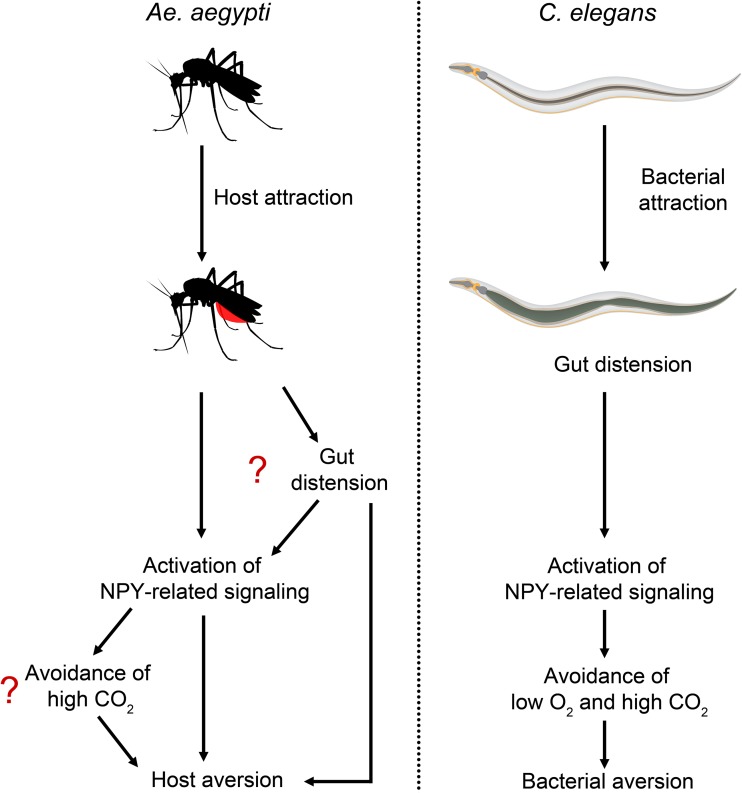
Female mosquitoes bite human hosts to obtain a blood meal and, in the process, act as vectors for many disease-causing viruses, including the dengue, chikungunya, yellow fever, and Zika viruses. After a complete meal, the female mosquitoes lose attraction to their hosts for several days. New research shows that pharmacological activation of neuropeptide Y-like receptor (NPYLR) signaling elicits host aversion in female mosquitoes. This behavior of mosquitoes shows remarkable similarities to a bacterial-aversion behavior of the nematode Feeding on pathogenic bacteria causes bloating of the gut in that leads to activation of NPYLR signaling and bacterial aversion. Several studies suggest that this newly discovered mechanism underlying foraging may be conserved across a large number of species. A better understanding of the regulation of NPYLR signaling pathways could provide molecular targets for the control of eating behaviors in different animals, including human-disease vectors.
雌性蚊子以吸食人血为食,并在这一过程中充当了许多致病病毒的载体,其中包括登革热、基孔肯雅热、黄热病和寨卡病毒。饱餐一顿后,雌性蚊子会在数天内失去对宿主的吸引力。一项新的研究表明,神经肽 Y 样受体(NPYLR)信号的药理学激活会引起雌性蚊子对宿主的厌恶。这种蚊子的行为与线虫对细菌的厌恶行为惊人地相似——进食致病性细菌会导致线虫肠道膨胀,从而激活 NPYLR 信号并引起对细菌的厌恶。多项研究表明,这种新发现的觅食机制可能在大量物种中保守存在。更好地理解 NPYLR 信号通路的调控可能为控制不同动物(包括人类疾病载体)的摄食行为提供分子靶标。