Byambajav Tsogt-Ochir, Bira Namdag, Choijamts Gotov, Davaadorj Duger, Gantuya Boldbaatar, Sarantuya Tserenchimed, Sarantuya Gidaagaya, Enkhtsetseg Altangerel, Erdenetsogt Dungubat, Battulga Adiyasuren, Tserentogtokh Tegshee, Matsuhisa Takeshi, Yamaoka Yoshio, Oyuntsetseg Khasag
Department of Gastroenterology and Hepatology, School of Medicine, Mongolian National University of Medical Sciences, Ulaanbaatar, Mongolia.
Department of Pharmacology, Otoch Manramba University of Mongolia, Ulaanbaatar, Mongolia.
Front Pharmacol. 2019 Apr 16;10:394. doi: 10.3389/fphar.2019.00394. eCollection 2019.
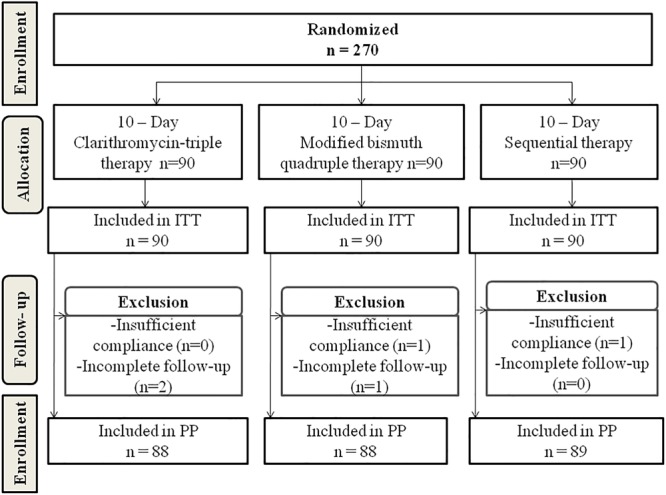
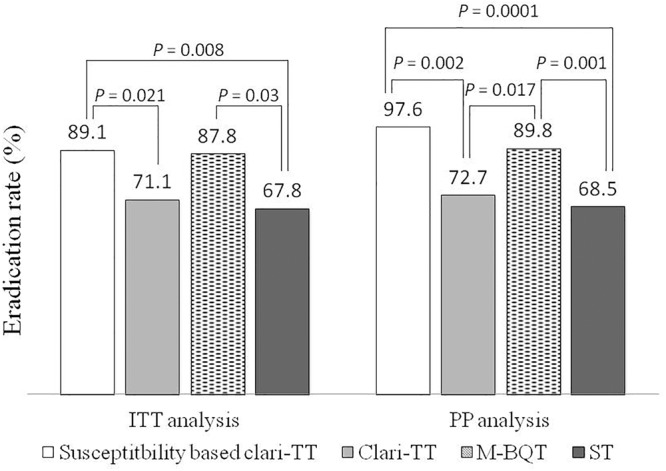
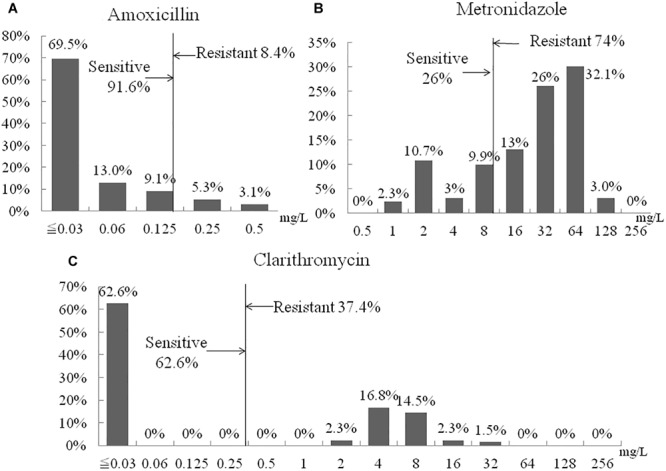
Mongolia has a high prevalence of infection and gastric cancer. We conducted a prospective, randomized, single-blind study to evaluate the efficacy of common regimens in Mongolia and to obtain specimens for susceptibility testing. Empiric treatments: 270 patients with confirmed infection were randomized to receive 10 days clarithromycin-triple therapy (Clari-TT) ( = 90), modified bismuth quadruple therapy (M-BQT) ( = 90), or sequential therapy (ST) ( = 90). A second group of 46 patients received susceptibility-based Clari-TT. was cultured from 131 patients and susceptibility testing was performed. eradication was confirmed by stool antigen 4 weeks after the therapy. Intention-to-treat (ITT) analysis cure rates were 71.1% (95% CI = 61.7-80.5%) for Clari-TT, 87.8% (95% CI = 81-94.6%) for M-BQT, 67.8% (95% CI = 58.1-77.5%) for ST vs. 89.1% (95% CI = 86-98.2%) for susceptibility-based Clari-TT. Per-protocol (PP) analysis results for these therapies were 72.7% (63.4-82%), 89.8% (83.5-96.1%), 68.5% (58.8-78.2%), and 97.6% (89.5-99.8%), respectively. Among 131 cultured , resistance rates to amoxicillin, clarithromycin, and metronidazole were 8.4, 37.4, and 74%, respectively. In Mongolia, the prevalence of resistance is high requiring bismuth quadruple therapy or susceptibility-based therapy to obtain acceptable cure rates.
蒙古国幽门螺杆菌感染及胃癌的患病率较高。我们开展了一项前瞻性、随机、单盲研究,以评估蒙古国常用治疗方案的疗效,并获取标本进行药敏试验。经验性治疗:270例确诊幽门螺杆菌感染的患者被随机分为三组,分别接受为期10天的克拉霉素三联疗法(Clari-TT)(n = 90)、改良铋剂四联疗法(M-BQT)(n = 90)或序贯疗法(ST)(n = 90)。第二组46例患者接受基于药敏结果的克拉霉素三联疗法。从131例患者中培养出幽门螺杆菌并进行药敏试验。治疗4周后通过粪便抗原检测确认幽门螺杆菌根除情况。意向性分析(ITT)显示,Clari-TT组的治愈率为71.1%(95%CI = 61.7 - 80.5%),M-BQT组为87.8%(95%CI = 81 - 94.6%),ST组为67.8%(95%CI = 58.1 - 77.5%),而基于药敏结果的克拉霉素三联疗法组为89.1%(95%CI = 86 - 98.2%)。这些疗法的符合方案分析(PP)结果分别为72.7%(63.4 - 82%)、89.8%(83.5 - 96.1%)、68.5%(58.8 - 78.2%)和97.6%(89.5 - 99.8%)。在131例培养出的幽门螺杆菌中,对阿莫西林、克拉霉素和甲硝唑的耐药率分别为8.4%、37.4%和74%。在蒙古国,幽门螺杆菌耐药率较高,需要采用铋剂四联疗法或基于药敏结果的疗法才能获得可接受的治愈率。