Virili Camilla, Stramazzo Ilaria, Santaguida Maria Giulia, Bruno Giovanni, Brusca Nunzia, Capriello Silvia, Cellini Miriam, Severi Carola, Gargano Lucilla, Centanni Marco
Department of Medico-Surgical Sciences and Biotechnologies, Sapienza University of Rome, Latina, Italy.
Endocrinology Unit, Santa Maria Goretti Hospital, AUSL Latina, Latina, Italy.
Front Endocrinol (Lausanne). 2019 Apr 16;10:233. doi: 10.3389/fendo.2019.00233. eCollection 2019.
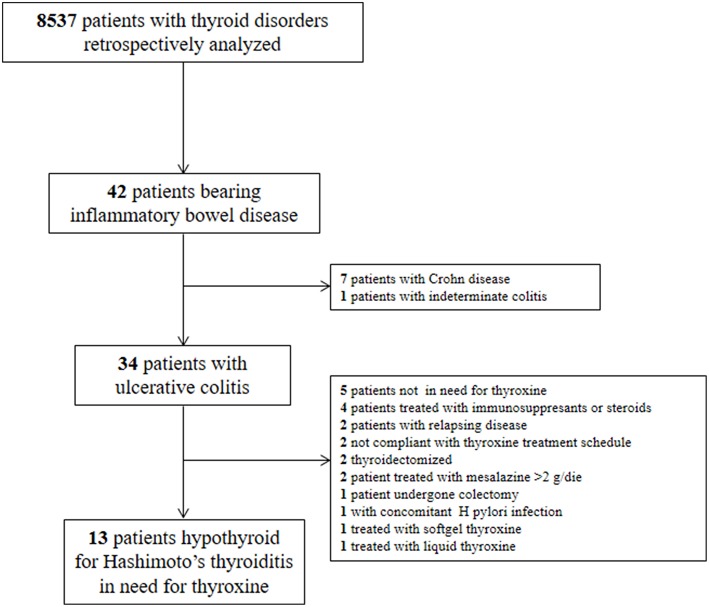
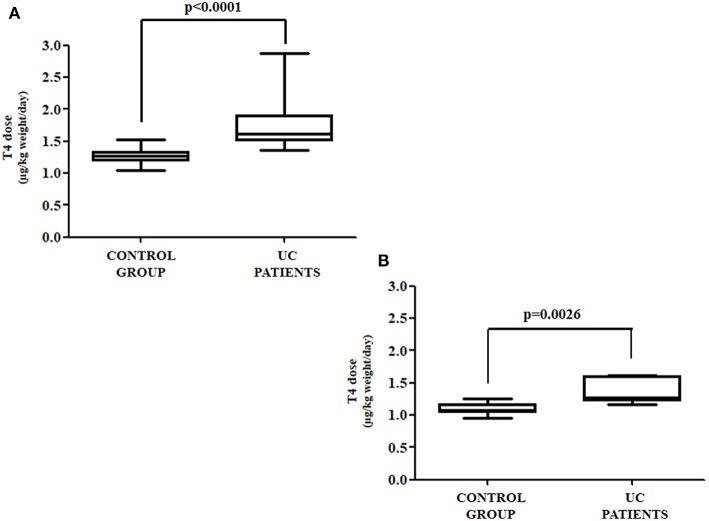
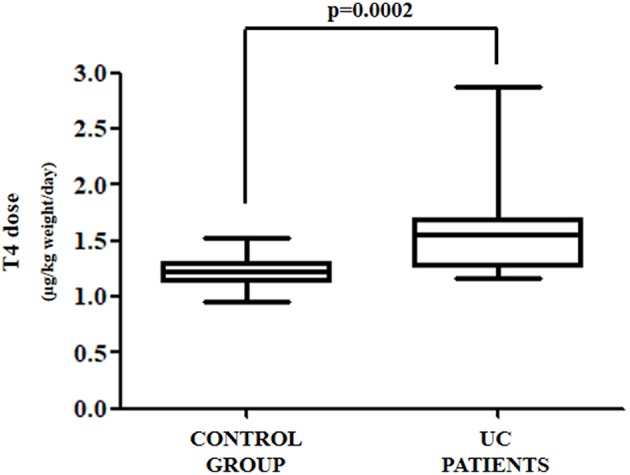
Thyroxine absorption takes place at the small intestine level and several disorders affecting this intestinal tract lead to thyroxine malabsorption. An increased need for thyroxine has also been observed in gastric disorders due to variations in drug dissolution and/or in its ionization status. Ulcerative colitis (UC) is an inflammatory bowel disease that has been postulated as a potential cause of the increased need for thyroxine, but there is a lack of evidence on this topic. This study is aimed at measuring the thyroxine requirement in hypothyroid patients with UC. Among 8,573 patients with thyroid disorders consecutively seen in our referral center from 2010 to 2017, we identified 34 patients with a definite diagnosis of UC. Thirteen of them were hypothyroid (12 F/1 M; median age = 53 years), bearing UC during the remission phase and in need for thyroxine treatment, thus representing the study group. The dose of T4 required by UC patients has been compared to the one observed in 51 similarly treated age- and weight-matched patients, compliant with treatment and clearly devoid of any gastrointestinal and /or pharmacological interference. To reach the target serum TSH, the dose of thyroxine had to be increased in twelve out of thirteen (92%) hypothyroid patients with ulcerative colitis. The median thyroxine dose required by UC patients was 1.54 μg/kg weight/day, that is 26% higher than the control patients, to reach a similar TSH (1.23 μg/kg weight/day; = 0.0002). Since half of our study group consisted of patients aged over 60 years old, we analyzed the effect of age on the subdivision in two classes. Six out of seven (86%) adult patients (<60 years) required more T4 than those in the respective control group (1.61 vs. 1.27 μg/kg weight/day; +27%; < 0.0001). An increased dose (+17%; = 0.0026) but to a lesser extent, was also observed in all patients over 60 years, as compared to the control group. In almost all hypothyroid patients with UC, the therapeutic dose of thyroxine is increased. Therefore, ulcerative colitis, even during clinical remission, should be included among the gastrointestinal causes of an increased need for oral thyroxine.
甲状腺素在小肠部位吸收,多种影响肠道的疾病会导致甲状腺素吸收不良。由于药物溶解和/或离子化状态的变化,在胃部疾病中也观察到对甲状腺素的需求增加。溃疡性结肠炎(UC)是一种炎症性肠病,被认为是甲状腺素需求增加的潜在原因,但关于这一话题缺乏证据。本研究旨在测量患有UC的甲状腺功能减退患者的甲状腺素需求量。在2010年至2017年于我们的转诊中心连续就诊的8573例甲状腺疾病患者中,我们确定了34例确诊为UC的患者。其中13例为甲状腺功能减退患者(12例女性/1例男性;中位年龄 = 53岁),处于UC缓解期且需要甲状腺素治疗,因此构成研究组。将UC患者所需的T4剂量与51例年龄和体重匹配、依从治疗且明显无任何胃肠道和/或药物干扰的类似治疗患者中观察到的剂量进行了比较。为达到目标血清促甲状腺激素(TSH)水平,13例患有溃疡性结肠炎的甲状腺功能减退患者中有12例(92%)需要增加甲状腺素剂量。UC患者所需的甲状腺素中位剂量为1.54μg/(kg体重/天),比对照组高26%,以达到相似的TSH水平(1.23μg/(kg体重/天);P = 0.0002)。由于我们研究组中有一半患者年龄超过60岁,我们分析了年龄对分为两类的影响。7例成年患者(<60岁)中有6例(86%)比各自对照组需要更多的T4(1.61 vs. 1.27μg/(kg体重/天);增加27%;P < 0.0001)。与对照组相比,60岁以上的所有患者也观察到剂量增加(增加17%;P = 0.0026),但程度较小。在几乎所有患有UC的甲状腺功能减退患者中,甲状腺素治疗剂量都会增加。因此,即使在临床缓解期,溃疡性结肠炎也应被列为口服甲状腺素需求增加的胃肠道原因之一。