Mandel Samantha R, Langan Susan, Mathioudakis Nestoras Nicolas, Sidhaye Aniket R, Bashura Holly, Bie Jun Y, Mackay Periwinkle, Tucker Cynthia, Demidowich Andrew P, Simonds William F, Jha Smita, Ebenuwa Ifechukwude, Kantsiper Melinda, Howell Eric E, Wachter Patricia, Golden Sherita Hill, Zilbermint Mihail
Department of Biology, New York University, New York, NY, USA.
Division of Endocrinology, Diabetes, and Metabolism, Johns Hopkins University School of Medicine, Baltimore, MD, USA.
J Community Hosp Intern Med Perspect. 2019 Apr 12;9(2):64-73. doi: 10.1080/20009666.2019.1593782. eCollection 2019 Apr.
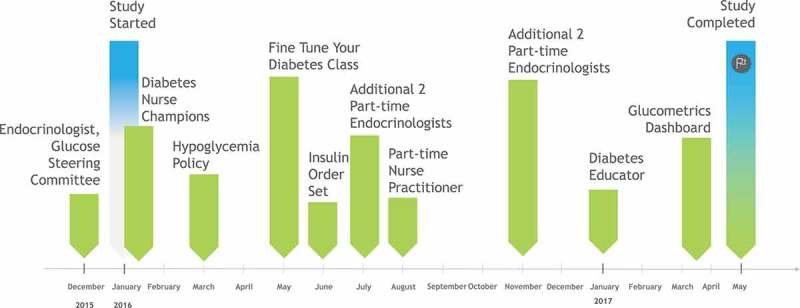
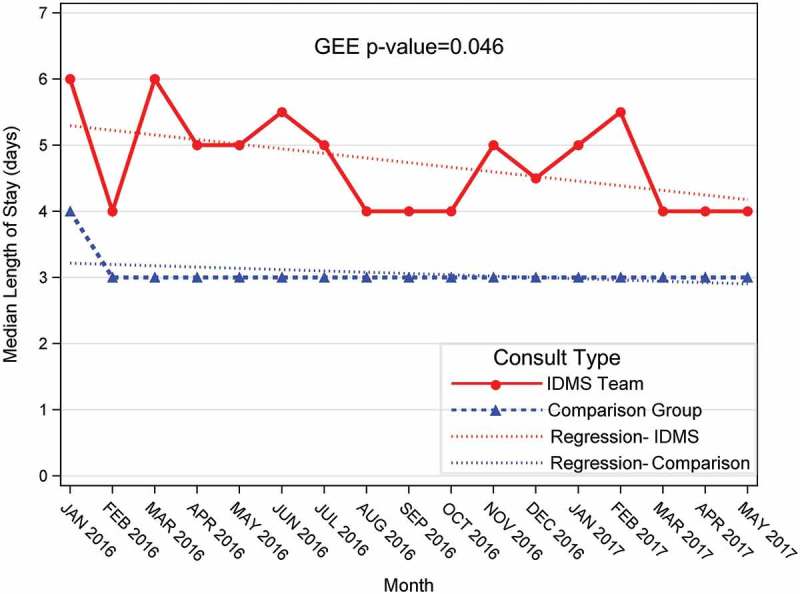
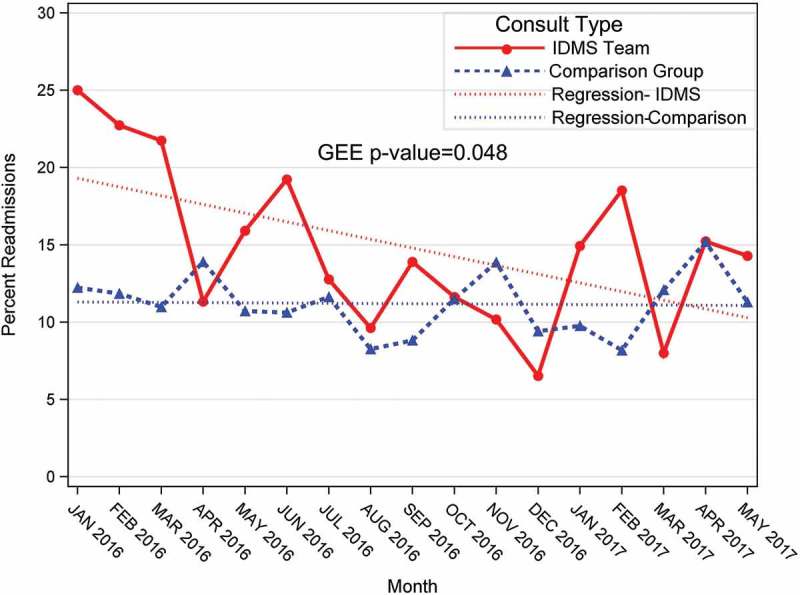
: Hospitalized patients with diabetes are at risk of complications and longer length of stay (LOS). Inpatient Diabetes Management Services (IDMS) are known to be beneficial; however, their impact on patient care measures in community, non-teaching hospitals, is unknown. : To evaluate whether co-managing patients with diabetes by the IDMS team reduces LOS and 30-day readmission rate (30DR). : This retrospective quality improvement cohort study analyzed LOS and 30DR among patients with diabetes admitted to a community hospital. The IDMS medical team consisted of an endocrinologist, nurse practitioner, and diabetes educator. The comparison group consisted of hospitalized patients with diabetes under standard care of attending physicians (mostly internal medicine-trained hospitalists). The relationship between study groups and outcome variables was assessed using Generalized Estimating Equation models. : 4,654 patients with diabetes (70.8 ± 0.2 years old) were admitted between January 2016 and May 2017. The IDMS team co-managed 18.3% of patients, mostly with higher severity of illness scores (p < 0.0001). Mean LOS in patients co-managed by the IDMS team decreased by 27%. Median LOS decreased over time in the IDMS group (p = 0.046), while no significant decrease was seen in the comparison group. Mean 30DR in patients co-managed by the IDMS decreased by 10.71%. Median 30DR decreased among patients co-managed by the IDMS (p = 0.048). : In a community hospital setting, LOS and 30DR significantly decreased in patients co-managed by a specialized diabetes team. These changes may be translated into considerable cost savings.
糖尿病住院患者有发生并发症及住院时间延长的风险。住院糖尿病管理服务(IDMS)已知有益;然而,其对社区非教学医院患者护理措施的影响尚不清楚。
评估IDMS团队共同管理糖尿病患者是否能降低住院时间(LOS)和30天再入院率(30DR)。
这项回顾性质量改进队列研究分析了一家社区医院收治的糖尿病患者的住院时间和30天再入院率。IDMS医疗团队由一名内分泌科医生、执业护士和糖尿病教育工作者组成。对照组由在主治医生(大多是内科培训的住院医生)的标准护理下的糖尿病住院患者组成。使用广义估计方程模型评估研究组与结局变量之间的关系。
2016年1月至2017年5月期间,收治了4654例糖尿病患者(70.8±0.2岁)。IDMS团队共同管理了18.3%的患者,这些患者大多病情严重程度评分较高(p<0.0001)。IDMS团队共同管理的患者的平均住院时间减少了27%。IDMS组的住院时间中位数随时间下降(p=0.046),而对照组未见显著下降。IDMS共同管理的患者的平均30天再入院率下降了10.71%。IDMS共同管理的患者中30天再入院率中位数下降(p=0.048)。
在社区医院环境中,由专业糖尿病团队共同管理的患者的住院时间和30天再入院率显著降低。这些变化可能转化为可观的成本节约。