Department of Pediatrics, Himalayan Institute of Medical Sciences, Swami Rama Himalayan University, Dehradun, India.
Division of Palliative Care, Cancer Research Institute, HimalayanInstitute of Medical Sciences, Dehradun, India.
Support Care Cancer. 2020 Jan;28(1):303-308. doi: 10.1007/s00520-019-04806-0. Epub 2019 May 1.
To analyse the preference of end of life care place in paediatric oncology patients, and to understand the end of life care needs and regrets among the care givers.
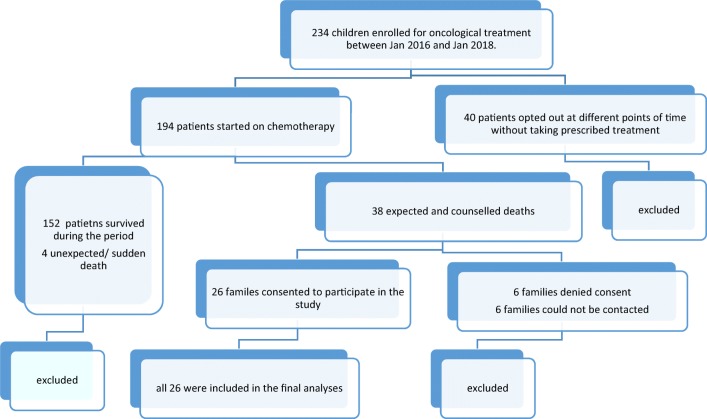
This was an observational qualitative study. Parents of in-curable paediatric malignancy patients who died during the years 2016-2018 were interviewed using a pre-formed open-ended questionnaire. Fears during the last phase of child's life, most disturbing symptoms, choice of end of life care plan, regret of care givers and reasons for such choices were noted and analysed.
Twenty six families were interviewed. A median of 3 months of discordance was noted between declaration of in-curability and acceptance of the same by the family. During terminal months, pain (84.62%) was described as the most bothersome symptom followed by respiratory distress (73.08%). Eighteen families (69%) opted for home-based terminal care, 8 (31%) for hospital-based terminal care. Regret of choice was noted in 62.5% families of the hospital-based care group (separation from home environment being the main reason) and 38.89% of the home-based care group (lack of access to health care personnel and pain medication being the main reasons).
Home-based care is the preferred option for end of life care by the care givers. Lack of community-based terminal care support system and availability of analgesics are the main areas to work on in India.
分析儿科肿瘤患者临终关怀地点的偏好,并了解照顾者的临终关怀需求和遗憾。
这是一项观察性定性研究。对 2016 年至 2018 年期间患有不治之症的儿科恶性肿瘤患者死亡的父母进行了访谈,使用预先制定的开放式问卷进行了访谈。记录并分析了患儿生命最后阶段的恐惧、最困扰的症状、临终关怀计划的选择、照顾者的遗憾以及做出这些选择的原因。
对 26 个家庭进行了访谈。家庭接受不治之症的时间与宣布不治之症之间存在 3 个月的中位数差异。在临终前的几个月中,疼痛(84.62%)被描述为最困扰的症状,其次是呼吸困难(73.08%)。18 个家庭(69%)选择家庭为基础的临终关怀,8 个家庭(31%)选择医院为基础的临终关怀。在医院为基础的护理组中有 62.5%的家庭对选择表示遗憾(主要原因是与家庭环境分离),而在家庭为基础的护理组中有 38.89%的家庭对选择表示遗憾(主要原因是缺乏医疗保健人员和止痛药)。
家庭护理是照顾者临终关怀的首选。印度主要需要解决社区为基础的临终关怀支持系统不足和镇痛药可用性的问题。