Department of Emergency and Critical Care Medicine, Faculty of Medicine, University of Tsukuba, Tsukuba, Ibaraki, Japan.
Department of Adult Health Nursing, School of Nursing, Sapporo City University, Sapporo, Japan.
BMC Psychol. 2019 May 2;7(1):27. doi: 10.1186/s40359-019-0303-2.
Previous studies have shown a relationship between delirium and depressive symptoms after cardiac surgery with distress personalities linking to negative surgical outcomes. The aim of the present study is to further investigate the association between patients with Type D (distressed) personality with regards to delirium after cardiac surgery.
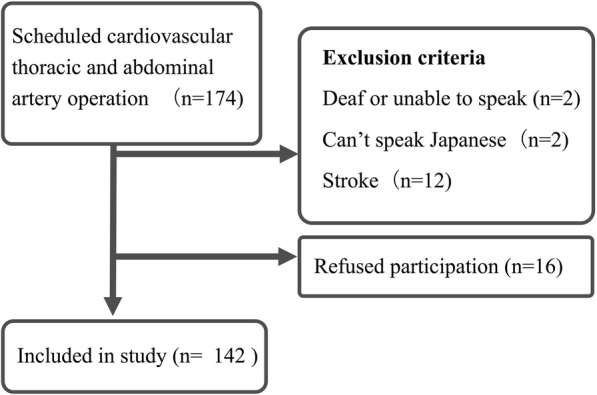
We conducted a consecutive-sample observational cohort pilot study with an estimated 142 patients needed. Enrollment criteria included patients aged ≥18 years who were undergoing planned cardiovascular, thoracic and abdominal artery surgery between October 2015 to August 2016 at the University of Tsukuba Hospital, Japan. All patients were screened by Type-D Personality Scale-14 (DS14) as well as the Hospital Anxiety and Depression Scale (HADS) the day before surgery. Following surgery, daily data was collected during recovery and included severity of organ dysfunction, sedative/analgesic exposure and other relevant information. We then evaluated the association between Type D personality and delirium/coma days (DCDs) during the 7-day study period. We applied regression and mediation modeling for this study.
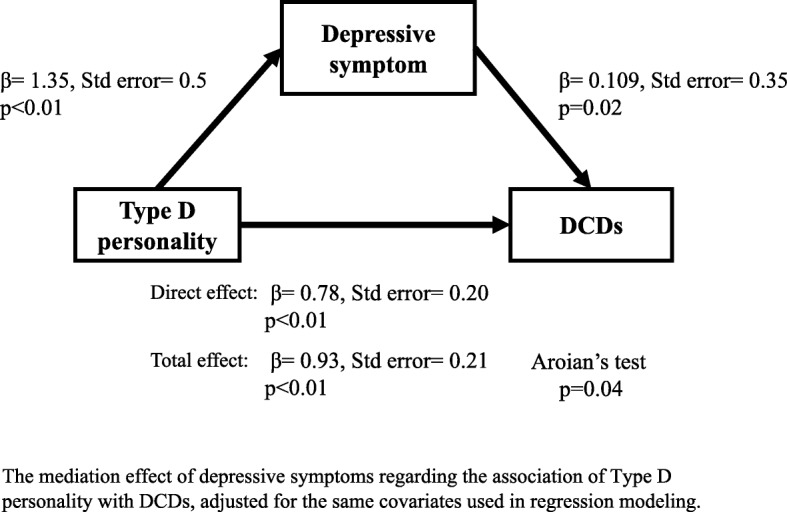
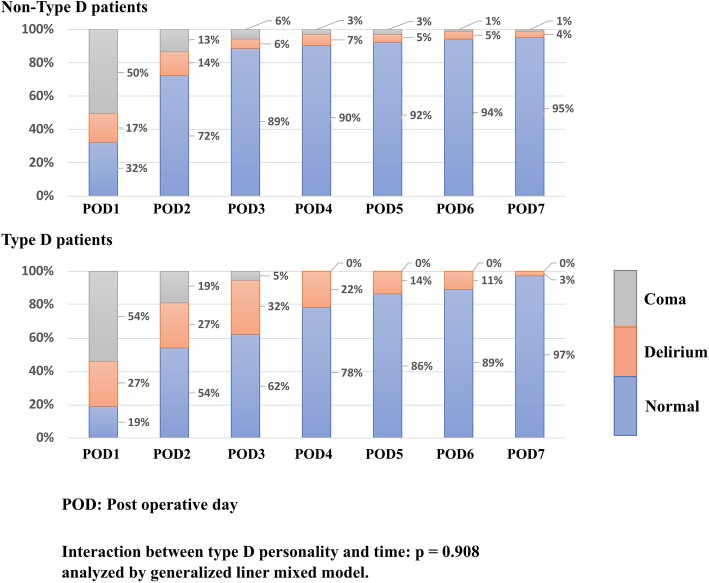
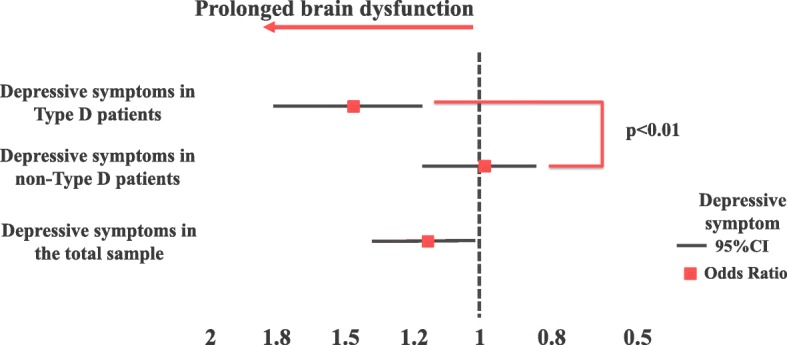
A total of 142 patients were enrolled in the present study and the total prevalence of delirium was found to be 34% and 26% of the patients were Type D. Non-Type D personality patients experienced an average of 1.3 DCDs during the week after surgery while Type D patients experienced 2.1 days over the week after surgery. Multivariate analysis showed that Type D personality was significantly associated with increased DCDs (OR:2.8, 95%CI:1.3-6.1) after adjustment for depressive symptoms and clinical variables. Additionally, there was a significant Type D x depression interaction effect (OR:1.7, 95% CI:1.2-2.2), and depressive symptoms were associated with DCDs in Type D patients, but not in non-Type D patients. Mediation modeling showed that depressive symptoms partially mediated the association of Type D personality with DCDs (Aroian test =0.04).
Type D personality is a prognostic predictor for prolonged acute brain dysfunction (delirium/coma) in cardiovascular patients independent from depressive symptoms and Type D personality-associated depressive symptoms increase the magnitude of acute brain dysfunction.
先前的研究表明,心脏手术后谵妄与抑郁症状之间存在关联,具有困扰人格的患者与负面手术结果相关。本研究旨在进一步探讨心脏手术后具有 D 型(困扰)人格的患者与谵妄之间的关系。
我们进行了一项连续样本观察性队列研究,预计需要 142 名患者。纳入标准包括年龄≥18 岁、2015 年 10 月至 2016 年 8 月在日本筑波大学医院接受计划心血管、胸腹部动脉手术的患者。所有患者在手术前一天均通过 D 型人格量表-14(DS14)和医院焦虑抑郁量表(HADS)进行筛查。手术后,在恢复期间每天收集数据,包括器官功能障碍严重程度、镇静/镇痛暴露和其他相关信息。然后,我们评估了 D 型人格与 7 天研究期间谵妄/昏迷天数(DCDs)之间的关系。我们为此研究应用了回归和中介模型。
本研究共纳入 142 名患者,谵妄总患病率为 34%,26%的患者为 D 型。非 D 型人格患者在手术后一周内平均经历 1.3 天的 DCDs,而 D 型患者在手术后一周内经历 2.1 天。多变量分析表明,在调整抑郁症状和临床变量后,D 型人格与 DCDs 的增加显著相关(OR:2.8,95%CI:1.3-6.1)。此外,还存在 D 型 x 抑郁的显著交互效应(OR:1.7,95%CI:1.2-2.2),并且抑郁症状与 D 型患者的 DCDs 相关,但与非 D 型患者无关。中介模型表明,抑郁症状部分介导了 D 型人格与 DCDs 的关联(Aroian 检验=0.04)。
D 型人格是心血管患者急性脑功能障碍(谵妄/昏迷)的预后预测因子,与抑郁症状无关,与 D 型人格相关的抑郁症状增加了急性脑功能障碍的程度。