Department of Psychology, Oklahoma State University, Stillwater, OK, United States of America.
Department of Psychology, Oklahoma State University, Stillwater, OK, United States of America.
Eat Behav. 2019 Apr;33:91-96. doi: 10.1016/j.eatbeh.2019.04.004. Epub 2019 Apr 23.
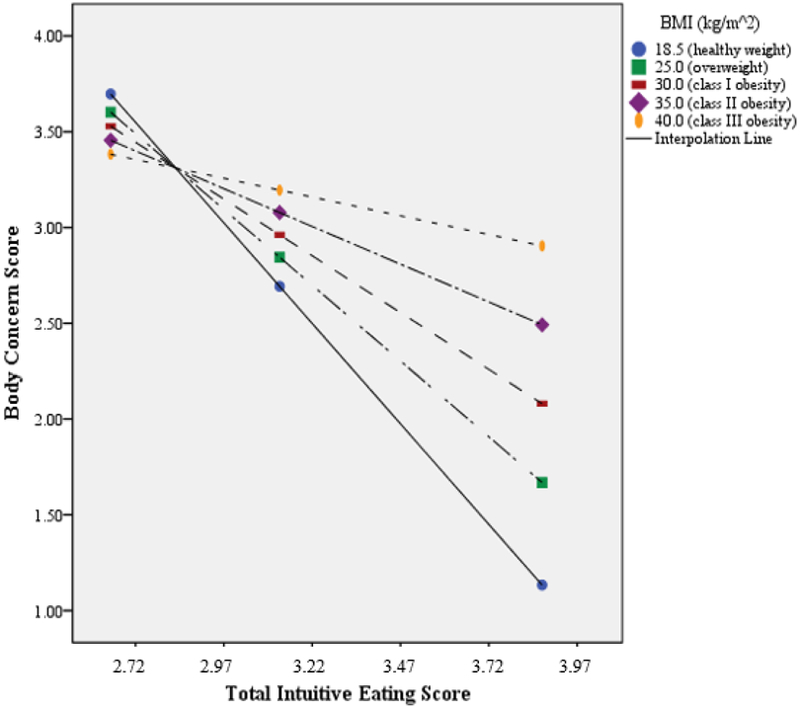
Intuitive eating (IE) is a pattern of adaptive eating that has been associated with positive psychosocial and physical factors (e.g., positive body image, lower body mass index; BMI). However, BMI has also been negatively associated with body image. Our goal was to evaluate whether IE is uniquely associated with body image, independent of objective weight status (measured BMI). Further, as a secondary aim, this study analyzed potential moderators (BMI, sex, race-ethnicity) in the IE-body image relationship. Data from 136 adults (34 ± 15 years old, 74% female, 56% Caucasian) were analyzed. BMI was objectively measured in-lab. IE was measured with the Intuitive Eating Scale-2. Body image was measured as a Body Concern composite created using the Eating Disorder Examination-Questionnaire (EDE-Q 6.0) Weight and Shape Concern subscales. Demographic factors and covariates were measured via self-report. Regressions revealed that, after controlling for BMI and covariates, Total IE was uniquely associated with Body Concern (β = -0.463, p < .001), as were two of the IE subscales: Unconditional Permission to Eat (Unconditional Permission; β = -0.320, p < .001) and Eating for Physical Rather than Emotional Reasons (Physical Reasons; β = -0.408, p < .001). BMI was also found to be a significant moderator between IE and Body Concern for Total IE (b = 0.071, p = .017), Unconditional Permission (b = 0.067, p = .001), and Physical Reasons (b = 0.038, p = .021), with the negative association between IE and Body Concern being strongest for healthy weight individuals. Greater IE was associated with lower body image concern across the weight spectrum, though this relationship was strongest for healthy weight individuals and attenuated as BMI increased.
直觉饮食(IE)是一种适应性的饮食模式,与积极的心理社会和身体因素有关(例如,积极的身体形象、较低的体重指数;BMI)。然而,BMI 也与身体形象呈负相关。我们的目标是评估 IE 是否与身体形象有关,而与客观体重状况(测量的 BMI)无关。此外,作为次要目标,本研究分析了 IE-身体形象关系中的潜在调节因素(BMI、性别、种族-民族)。分析了 136 名成年人的数据(34±15 岁,74%女性,56%白种人)。在实验室中客观测量 BMI。使用直觉饮食量表-2 测量 IE。身体形象是使用饮食失调检查问卷(EDE-Q 6.0)的体重和形状关注子量表创建的身体关注综合指标来衡量的。通过自我报告测量人口统计学因素和协变量。回归显示,在控制 BMI 和协变量后,总 IE 与身体关注呈显著负相关(β=-0.463,p<0.001),IE 的两个分量表也是如此:无条件进食许可(无条件许可;β=-0.320,p<0.001)和出于身体原因而不是情绪原因进食(身体原因;β=-0.408,p<0.001)。还发现 BMI 是 IE 与身体关注之间的重要调节因素,对于总 IE(b=0.071,p=0.017)、无条件许可(b=0.067,p=0.001)和身体原因(b=0.038,p=0.021),IE 与身体关注之间的负相关在健康体重个体中最强。在整个体重范围内,IE 越高,身体形象关注越低,但这种关系在健康体重个体中最强,随着 BMI 的增加而减弱。