Poiré Xavier, Labopin Myriam, Polge Emmanuelle, Forcade Edouard, Ganser Arnold, Volin Liisa, Michallet Mauricette, Blaise Didier, Yakoub-Agha Ibrahim, Maertens Johan, Espiga Carlos Richard, Cornelissen Jan, Finke Jürgen, Mohty Mohamad, Esteve Jordi, Nagler Arnon
Section of Hematology, Cliniques Universitaires St-Luc, Brussels, Belgium
Acute Leukemia Working Party of the EBMT.
Haematologica. 2020 Jan 31;105(2):414-423. doi: 10.3324/haematol.2019.216168. Print 2020.
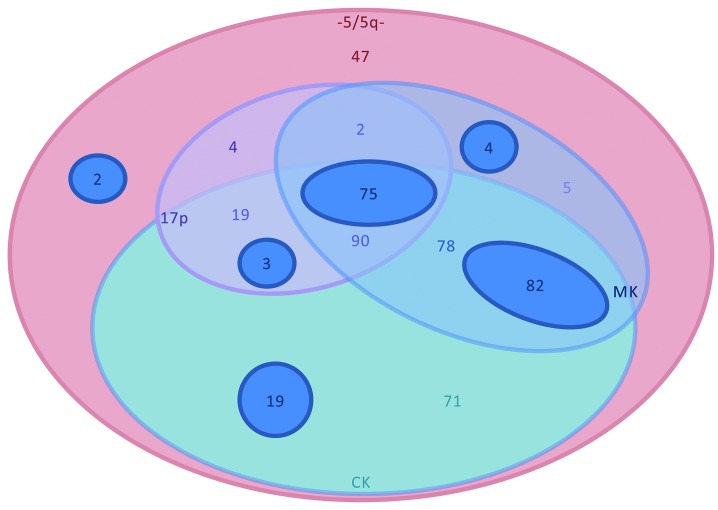
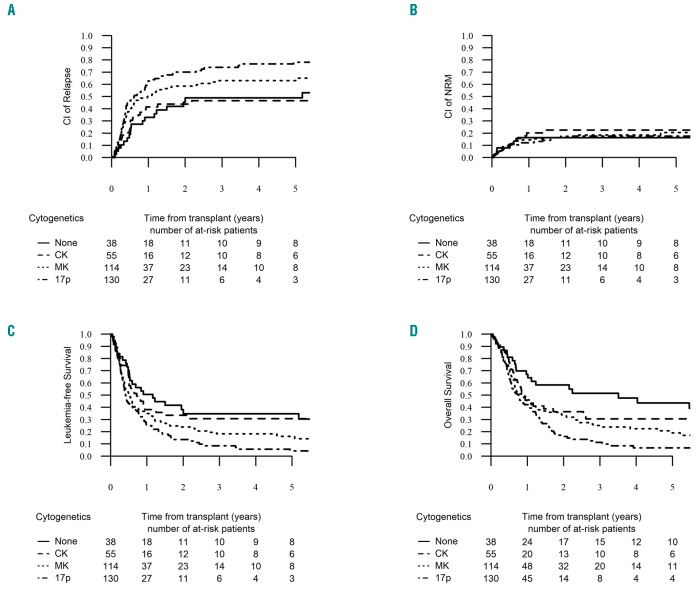
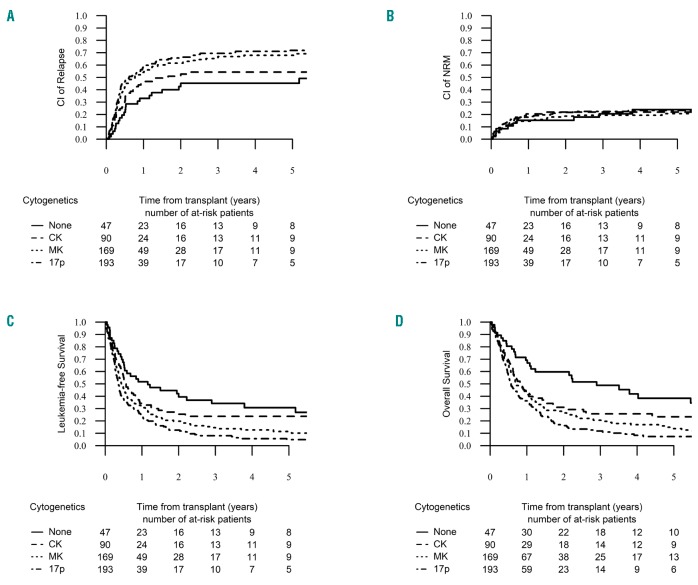
Deletion 5q or monosomy 5 (-5/5q-) in acute myeloid leukemia (AML) is a common high-risk feature that is referred to allogeneic stem cell transplantation. However, -5/5q- is frequently associated with other high-risk cytogenetic aberrations such as complex karyotype, monosomal karyotype, monosomy 7 (-7), or 17p abnormalities (abn (17p)), the significance of which is unknown. In order to address this question, we studied adult patients with AML harboring -5/5q- having their first allogeneic transplantation between 2000 and 2015. Five hundred and one patients with -5/5q- have been analyzed. Three hundred and thirty-eight patients (67%) were in first remission and 142 (28%) had an active disease at time of allogeneic transplantation. The 2-year probabilities of overall survival and leukemia-free survival were 27% and 20%, respectively. The 2-year probability of treatment-related mortality was 20%. We identified four different cytogenetic groups according to additional abnormalities with prognostic impact: -5/5q- without complex karyotype, monosomal karyotype or abn(17p), -5/5q- within a complex karyotype, -5/5q- within a monosomal karyotype and the combination of -5/5q- with abn(17p). In multivariate analysis, factors associated with worse overall survival and leukemia-free survival across the four groups were active disease, age, monosomal karyotype, and abn(17p). The presence of -5/5q- without monosomal karyotype or abn(17p) was associated with a significantly better survival rate while -5/5q- in conjunction with monosomal karyotype or abn(17p) translated into a worse outcome. The patients harboring the combination of -5/5q- with abn(17p) showed very limited benefit from allogeneic transplantation.
急性髓系白血病(AML)中的5号染色体长臂缺失(del 5q)或5号染色体单体性(-5/5q-)是一种常见的高危特征,通常会进行异基因干细胞移植。然而,-5/5q-常与其他高危细胞遗传学异常相关,如复杂核型、单倍体核型、7号染色体单体性(-7)或17号染色体短臂异常(abn(17p)),但其意义尚不清楚。为了解决这个问题,我们研究了2000年至2015年间首次接受异基因移植的携带-5/5q-的成年AML患者。共分析了501例-5/5q-患者。338例(67%)患者处于首次缓解期,142例(28%)在异基因移植时患有活动性疾病。总生存和无白血病生存的2年概率分别为27%和20%。治疗相关死亡率的2年概率为20%。我们根据具有预后影响的其他异常情况确定了四个不同的细胞遗传学组:无复杂核型、单倍体核型或abn(17p)的-5/5q-,复杂核型内的-5/5q-,单倍体核型内的-5/5q-以及-5/5q-与abn(17p)的组合。多因素分析显示,四组中与总生存和无白血病生存较差相关的因素为活动性疾病、年龄、单倍体核型和abn(17p)。不存在单倍体核型或abn(17p)的-5/5q-患者生存率显著更高,而与单倍体核型或abn(17p)同时存在的-5/5q-则预后更差。携带-5/5q-与abn(17p)组合的患者从异基因移植中获益非常有限。