Division of Cancer Epidemiology and Genetics, National Cancer Institute, National Institutes of Health, Department of Health and Human Services, Bethesda, MD, USA.
Department of Internal Medicine, Pontifical Catholic University of Chile, Santiago, Chile.
Cancer Res Treat. 2019 Jul;51(3):841-850. doi: 10.4143/crt.2019.151. Epub 2019 May 3.
Autoimmunity is an alternative etiology of gastric inflammation, the initiating event in the gastric carcinogenic cascade. This mechanism may be an increasingly important cause of gastric cancer with the waning prevalence of its primary etiologic factor, chronic Helicobacter pylori infection.
PubMed and EMBASE were searched up to September 2018. Autoimmunity and 96 specific manifestations were considered for associations with gastric cancer risk. Random effects analysis was used to calculate pooled relative risk estimates (RR) and 95% confidence intervals (CI).
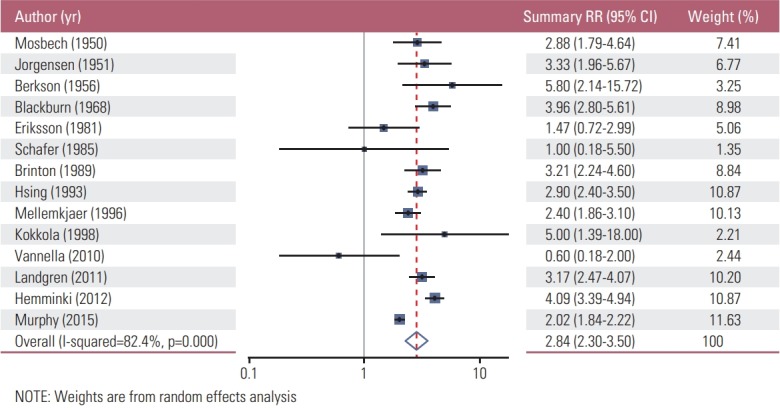
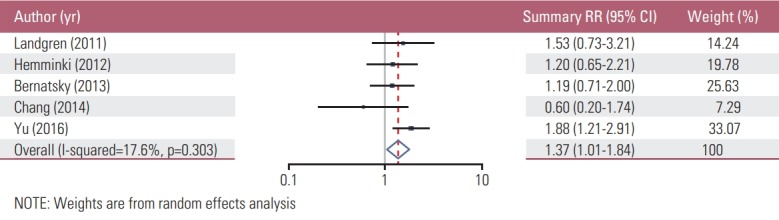
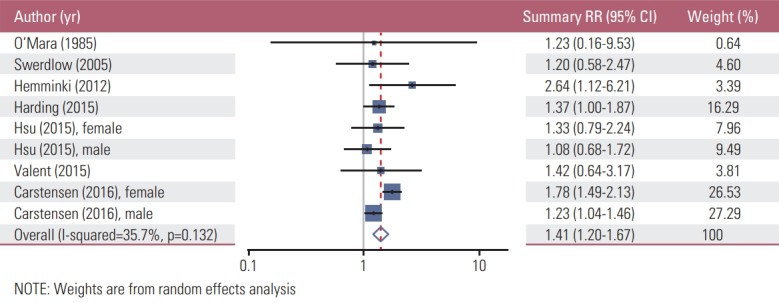
We found a total of 52 observational studies representing 30 different autoimmune diseases. Overall, the presence of an autoimmune condition was associated with a gastric cancer pooled RR of 1.37 (95% CI, 1.24 to 1.52). Among the 24 autoimmune conditions with two or more independent reports, nine were significantly associated with increased gastric cancer risk: dermatomyositis (RR, 3.69; 95% CI, 1.74 to 7.79), pernicious anemia (RR, 2.84; 95% CI, 2.30 to 3.50), Addison disease (RR, 2.11; 95% CI, 1.26 to 3.53), dermatitis herpetiformis (RR, 1.74; 95% CI, 1.02 to 2.97; n=3), IgG4-related disease (RR, 1.69; 95% CI, 1.00 to 2.87), primary biliary cirrhosis (RR, 1.64; 95% CI, 1.13 to 2.37), diabetes mellitus type 1 (RR, 1.41; 95% CI, 1.20 to 1.67), systemic lupus erythematosus (RR, 1.37; 95% CI, 1.01 to 1.84), and Graves disease (RR, 1.27; 95% CI, 1.06 to 1.52).
Our analysis documents the wide range of autoimmune diseases associated with gastric cancer. These associations may reflect unreported links between these conditions and autoimmune gastritis. Further studies are warranted to investigate potential causal mechanisms.
自身免疫是胃炎症的另一种病因,也是胃癌发生级联反应的起始事件。随着慢性幽门螺杆菌感染这一主要病因的流行率下降,这种机制可能成为胃癌的一个越来越重要的病因。
检索了 PubMed 和 EMBASE 数据库,截至 2018 年 9 月。我们考虑了自身免疫和 96 种具体表现与胃癌风险的关联。采用随机效应分析计算了汇总相对风险估计值(RR)和 95%置信区间(CI)。
我们共发现了 52 项观察性研究,代表了 30 种不同的自身免疫性疾病。总体而言,存在自身免疫性疾病与胃癌的 pooled RR 为 1.37(95% CI,1.24 至 1.52)。在有两个或更多独立报告的 24 种自身免疫性疾病中,有 9 种与胃癌风险增加显著相关:皮肌炎(RR,3.69;95% CI,1.74 至 7.79)、恶性贫血(RR,2.84;95% CI,2.30 至 3.50)、Addison 病(RR,2.11;95% CI,1.26 至 3.53)、疱疹样皮炎(RR,1.74;95% CI,1.02 至 2.97;n=3)、IgG4 相关疾病(RR,1.69;95% CI,1.00 至 2.87)、原发性胆汁性肝硬化(RR,1.64;95% CI,1.13 至 2.37)、1 型糖尿病(RR,1.41;95% CI,1.20 至 1.67)、系统性红斑狼疮(RR,1.37;95% CI,1.01 至 1.84)和格雷夫斯病(RR,1.27;95% CI,1.06 至 1.52)。
我们的分析记录了与胃癌相关的广泛自身免疫性疾病。这些关联可能反映了这些疾病与自身免疫性胃炎之间未被报道的联系。需要进一步研究以调查潜在的因果机制。