Mahynski Nathan A, Pretti Evan, Shen Vincent K, Mittal Jeetain
Chemical Sciences Division, National Institute of Standards and Technology, Gaithersburg, MD, 20899-8320, USA.
Department of Chemical and Biomolecular Engineering, Lehigh University, 111 Research Drive, Bethlehem, PA, 18015-4791, USA.
Nat Commun. 2019 May 2;10(1):2028. doi: 10.1038/s41467-019-10031-4.
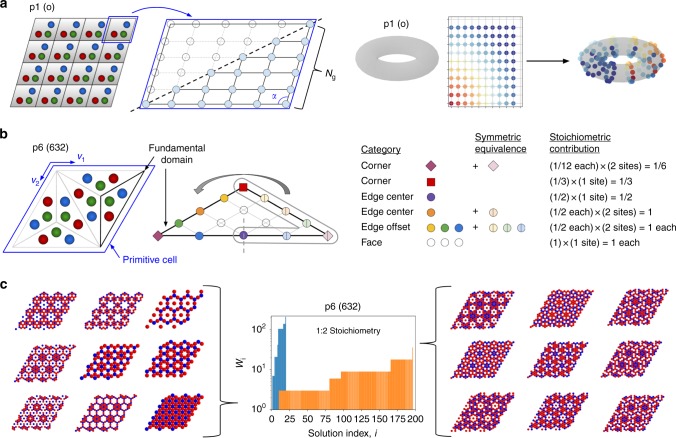
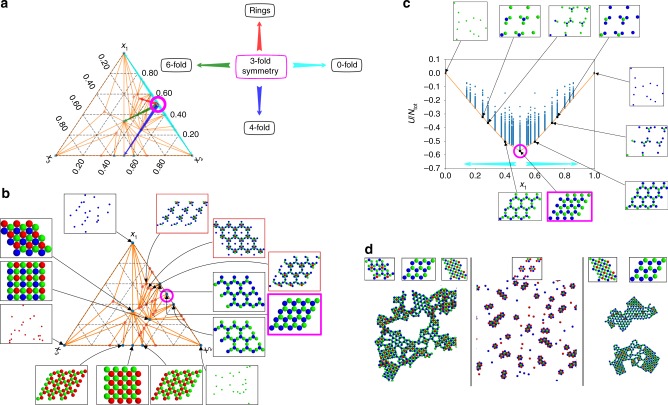
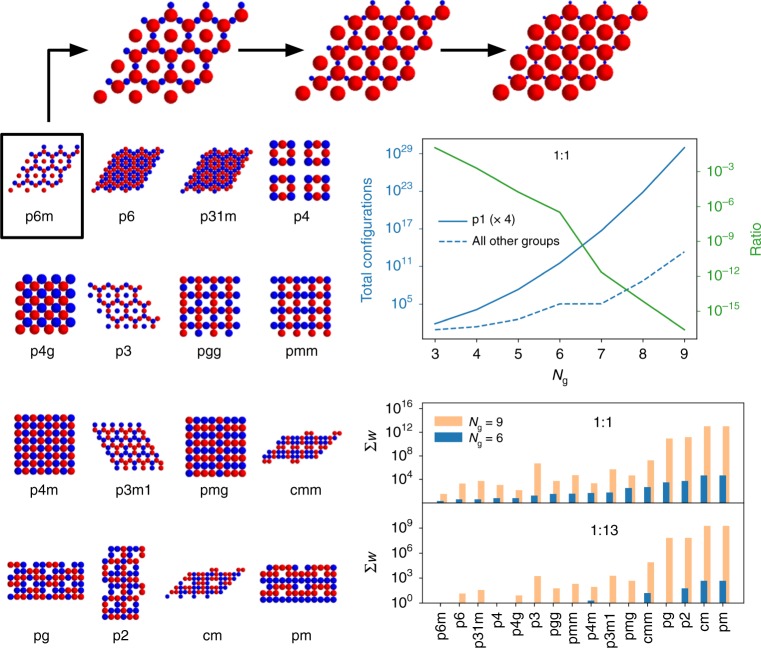
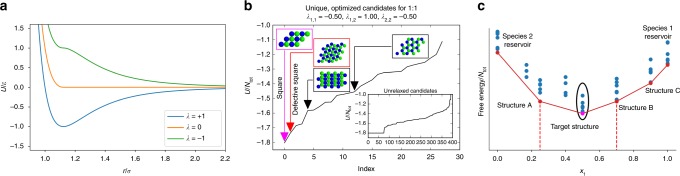
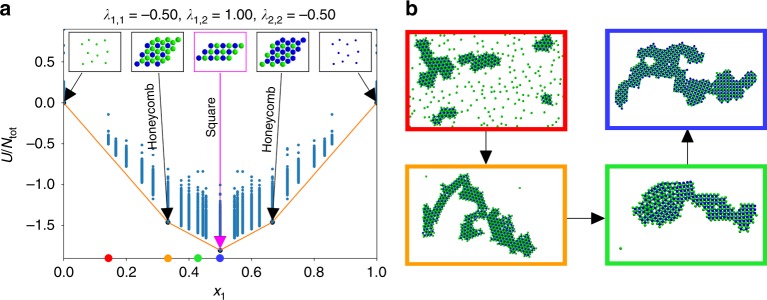
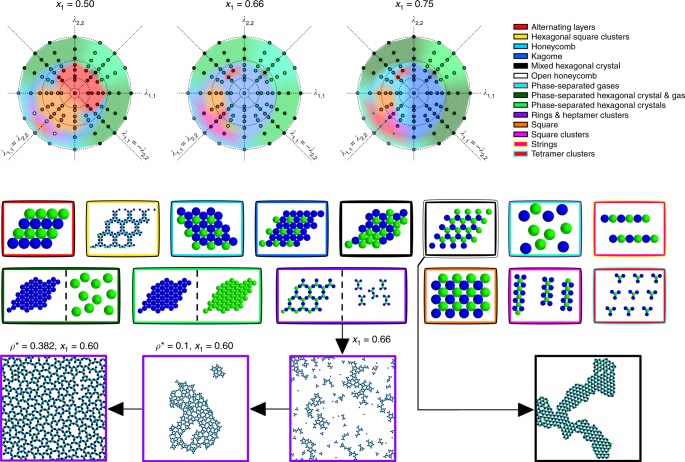
We demonstrate a method based on symmetry to predict the structure of self-assembling, multicomponent colloidal mixtures. This method allows us to feasibly enumerate candidate structures from all symmetry groups and is many orders of magnitude more computationally efficient than combinatorial enumeration of these candidates. In turn, this permits us to compute ground-state phase diagrams for multicomponent systems. While tuning the interparticle potentials to produce potentially complex interactions represents the conventional route to designing exotic lattices, we use this scheme to demonstrate that simple potentials can also give rise to such structures which are thermodynamically stable at moderate to low temperatures. Furthermore, for a model two-dimensional colloidal system, we illustrate that lattices forming a complete set of 2-, 3-, 4-, and 6-fold rotational symmetries can be rationally designed from certain systems by tuning the mixture composition alone, demonstrating that stoichiometric control can be a tool as powerful as directly tuning the interparticle potentials themselves.
我们展示了一种基于对称性的方法来预测自组装多组分胶体混合物的结构。该方法使我们能够切实可行地从所有对称群中枚举候选结构,并且在计算效率上比这些候选结构的组合枚举高出许多个数量级。相应地,这使我们能够计算多组分系统的基态相图。虽然调整粒子间势以产生潜在的复杂相互作用是设计奇异晶格的传统方法,但我们使用该方案来证明简单的势也能产生在中低温下热力学稳定的此类结构。此外,对于一个二维胶体模型系统,我们说明了通过仅调整混合物组成就能从某些系统合理设计出具有完整的二倍、三倍、四倍和六倍旋转对称性的晶格,这表明化学计量控制可以是一种与直接调整粒子间势本身一样强大的工具。