Prapiska Fauriski Febrian, Warli Syah Mirsya
Department of Urology, University of Sumatera Utara Hospital, Medan, Indonesia.
Open Access Maced J Med Sci. 2019 Apr 14;7(7):1170-1173. doi: 10.3889/oamjms.2019.219. eCollection 2019 Apr 15.
Penile cancer accounts for 0.4-0.6% of all malignancy in men in Europe and the United States of America. It also accounts for 10% of all malignancy in men in some Asian, South American, and African countries. P53 protein has the function to regulate apoptosis in the cell cycle. Therefore, the presence of p53 in cells may indicate higher proliferative activity of the cells as a feedback mechanism, indicating disease progression.
This study aims to identify the association between p53 expression and survival rate in penile cancer patients.
This study was a retrospective observational analytic study. This study was conducted in Pathology Anatomy Laboratory Faculty of the Medicine University of Sumatera Utara/Haji Adam Malik Hospital/University of Sumatera Utara Hospital to assess p53 expression. This study was conducted from January 2018 to December 2018.
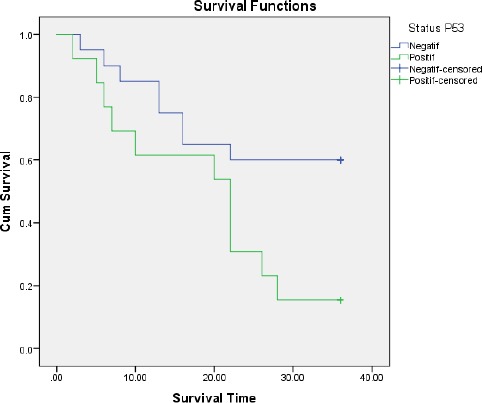
The total subjects in this study were 33 with the mean age of 50.79 ± 10.62. Based on clinical stage, patients in this study are divided into 11 patients (33.3%) in stage T II and 22 patients (66.7%) in stage T III/T IV. P53 expression was positive in 13 patients (35.3%). There were 19 patients (57.6) alive and 14 patients (42.4%) deceased. Statistical analysis using chi-square showed that there was an association between p53 expression and mortality (p = 0.011). In the Kaplan-Meier Curve for 3-year overall survival based on p53 expression, the survival rate in 36 months in the p53 positive group is 18%, while in p53 negative group, the survival rate was 60%. The survival rate based on p53 status was significantly different (p = 0.025).
There is a significant association between p53 expression and mortality in penile cancer patients. In conclusion, p53 expression in penile cancer cells examined by immunohistochemistry may show prognostic values in the disease progression.
阴茎癌在欧洲和美国男性所有恶性肿瘤中占0.4 - 0.6%。在一些亚洲、南美和非洲国家,它在男性所有恶性肿瘤中也占10%。P53蛋白具有调控细胞周期中细胞凋亡的功能。因此,细胞中p53的存在可能作为一种反馈机制表明细胞具有更高的增殖活性,提示疾病进展。
本研究旨在确定阴茎癌患者中p53表达与生存率之间的关联。
本研究为回顾性观察分析研究。该研究在北苏门答腊大学医学院病理解剖实验室/哈芝·亚当·马利克医院/北苏门答腊大学医院进行,以评估p53表达。研究于2018年1月至2018年12月进行。
本研究的总受试者为33例,平均年龄50.79±10.62岁。根据临床分期,本研究中的患者分为T II期11例(33.3%)和T III/T IV期22例(66.7%)。13例患者(35.3%)p53表达呈阳性。19例患者(57.6%)存活,14例患者(42.4%)死亡。使用卡方检验的统计分析表明,p53表达与死亡率之间存在关联(p = 0.011)。在基于p53表达的3年总生存Kaplan - Meier曲线中,p53阳性组36个月时的生存率为18%,而p53阴性组的生存率为60%。基于p53状态的生存率有显著差异(p = 0.025)。
阴茎癌患者中p53表达与死亡率之间存在显著关联。总之,通过免疫组织化学检测阴茎癌细胞中的p53表达可能在疾病进展中显示出预后价值。