Abe Yushi, Ogasawara Sachiko, Akiba Jun, Naito Yoshiki, Kondo Reiichiro, Nakamura Ken, Kusukawa Jingo, Yano Hirohisa
Department of Pathology Kurume University School of Medicine Kurume Japan.
Dental and Oral Medical Center Kurume University School of Medicine Kurume Japan.
Clin Exp Dent Res. 2019 Mar 4;5(2):160-169. doi: 10.1002/cre2.166. eCollection 2019 Apr.
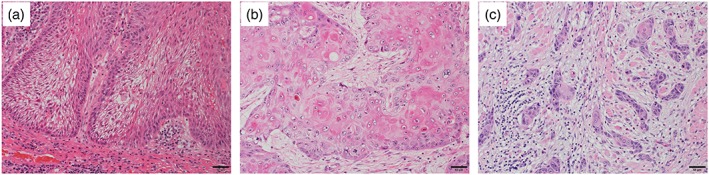
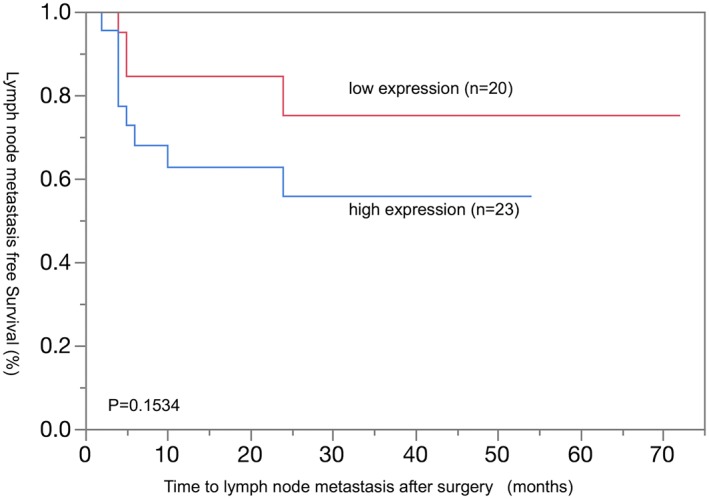
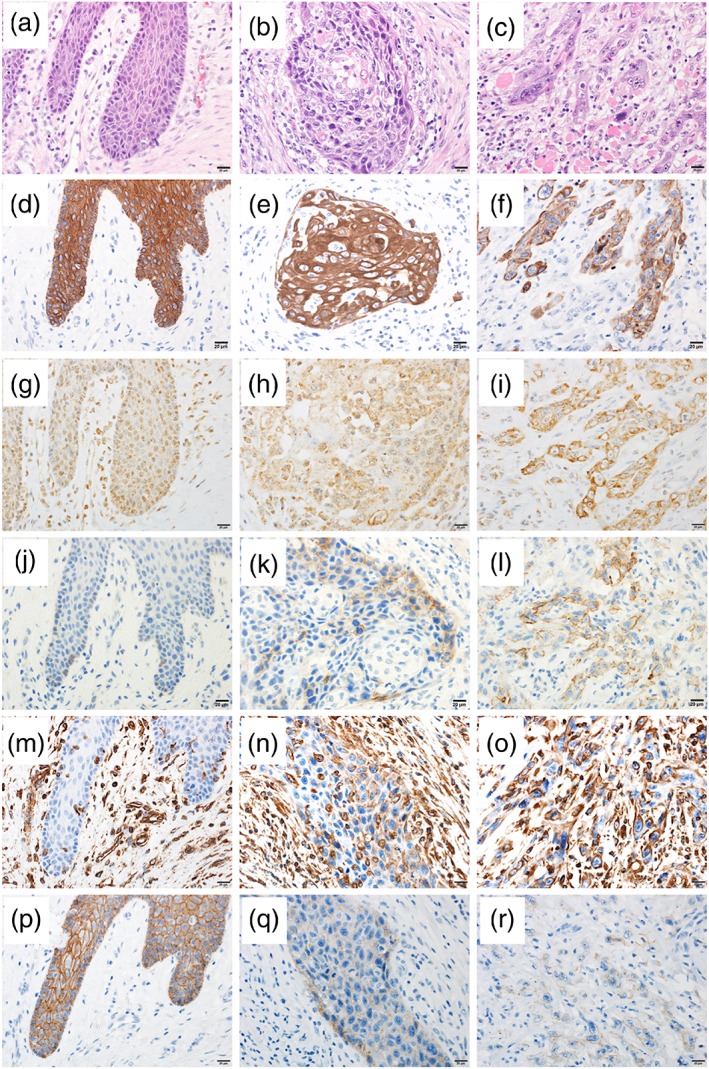
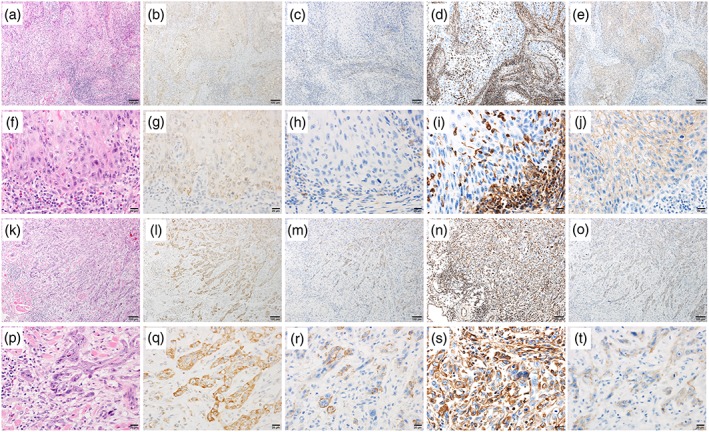
Regulator of G-protein signaling (RGS) 5 acts as a GTPase-activating protein to negatively regulate G-protein signaling. RGS5 is reportedly related to the invasion and metastasis of cancers, such as nonsmall lung cancer and hepatocellular carcinoma. We examined RGS5 expression and its relationship with invasion in squamous cell carcinoma (SCC) of the tongue. For immunohistochemical analysis of RGS5, we used SCC tissues of the tongue obtained from 43 patients. We examined the relationship between RGS5 expression in the deepest point of invasion and clinicopathological features. Because the invasion and metastasis of cancers are related to epithelial-mesenchymal transition (EMT), we carried out staining for N-cadherin, vimentin, and E-cadherin to examine the relationship between EMT and RGS5. RGS5 expression in the deepest point of invasion in SCC of the tongue was observed in 32 cases (75%). Immunohistochemical analysis revealed a significant correlation between RGS5 expression in the aggressive invasion pattern, invasion depth, and lymphovascular invasion. Kaplan-Meier analysis revealed that high RGS5 expression was associated with postoperative early lymph node metastasis. Further, a significant positive correlation was observed between RGS5 and N-cadherin ( = 0.0003) and vimentin ( < 0.0001). In contrast, E-cadherin and RGS5 or vimentin were significantly negatively correlated ( < 0.0001-0.005). The findings indicate that RGS5 expression is related to tumor invasion and EMT in SCC of the tongue and that RGS5 may predict postoperative early lymph node metastasis. Therefore, RGS5 may be a useful prognostic biomarker of the surgically resected SCC and a potential target of molecular therapy for treating SCC of the tongue.
G蛋白信号调节因子(RGS)5作为一种GTP酶激活蛋白,对G蛋白信号进行负向调节。据报道,RGS5与癌症的侵袭和转移有关,如非小细胞肺癌和肝细胞癌。我们研究了RGS5在舌鳞状细胞癌(SCC)中的表达及其与侵袭的关系。为了对RGS5进行免疫组织化学分析,我们使用了从43例患者获得的舌SCC组织。我们研究了侵袭最深点的RGS5表达与临床病理特征之间的关系。由于癌症的侵袭和转移与上皮-间质转化(EMT)有关,我们对N-钙黏蛋白、波形蛋白和E-钙黏蛋白进行染色,以研究EMT与RGS5之间的关系。在32例(75%)舌SCC侵袭最深点观察到RGS5表达。免疫组织化学分析显示,RGS5在侵袭性侵袭模式、侵袭深度和淋巴管侵袭中的表达之间存在显著相关性。Kaplan-Meier分析显示,高RGS5表达与术后早期淋巴结转移相关。此外,RGS5与N-钙黏蛋白(=0.0003)和波形蛋白(<0.0001)之间观察到显著正相关。相比之下,E-钙黏蛋白与RGS5或波形蛋白显著负相关(<0.0001-0.005)。这些发现表明,RGS5表达与舌SCC中的肿瘤侵袭和EMT有关,并且RGS5可能预测术后早期淋巴结转移。因此,RGS5可能是手术切除的SCC的有用预后生物标志物,也是治疗舌SCC的分子治疗的潜在靶点。