Cardiovascular Research Institute, Yonsei University College of Medicine, Seoul, Korea.
Severance Integrative Research Institute for Cerebral and Cardiovascular Diseases, Yonsei University Health System, Seoul, Korea.
PLoS One. 2019 May 3;14(5):e0215604. doi: 10.1371/journal.pone.0215604. eCollection 2019.
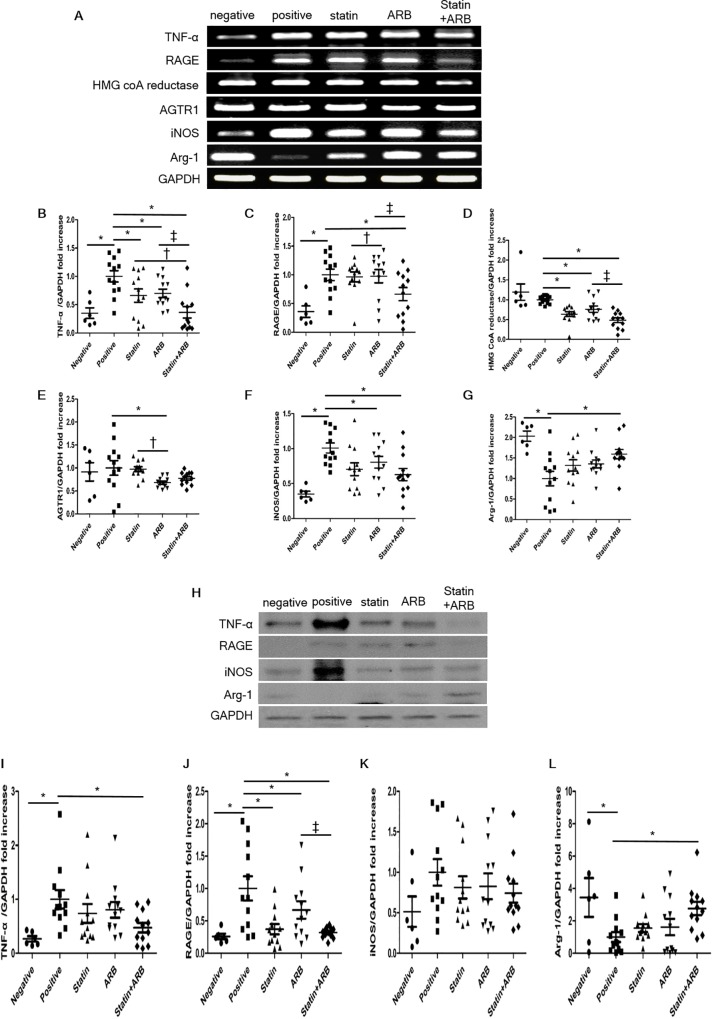
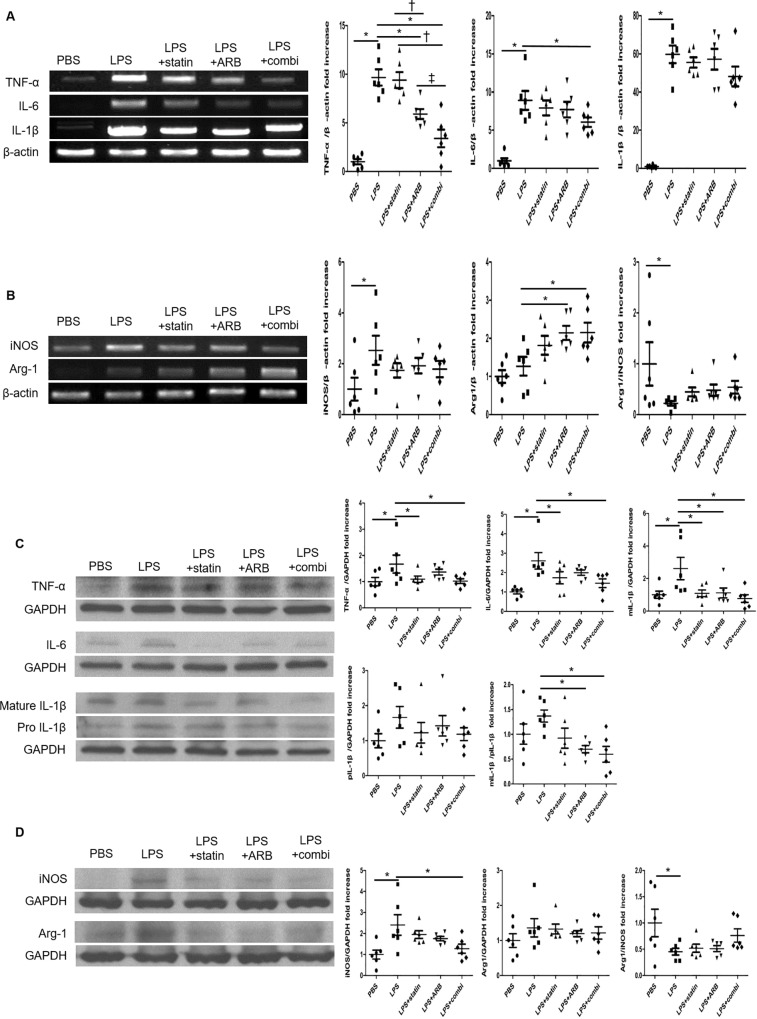
Although the atheroprotective effects of statins and angiotensin II receptor blockers (ARBs) are well-established, little is known about their additive effects, especially during the early period of atherosclerosis. The aim of this study was to investigate whether combination of a statin and an ARB exerts synergistic anti-atherosclerotic effects, and to elucidate the mechanisms of combined effects.
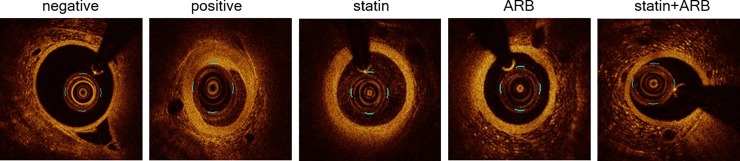
Atherosclerotic plaques were developed in arteries of 23 rabbits using a high-cholesterol diet (HCD) and intra-arterial balloon inflation. Rabbits received one of five different treatment strategies for 4 weeks: positive control [n = 5, HCD]; negative control [n = 3, regular chow diet]; statin [n = 5, HCD and rosuvastatin 10 mg]; ARB [n = 5, HCD and olmesartan 20 mg]; and combination [n = 5, HCD and statin+ARB].
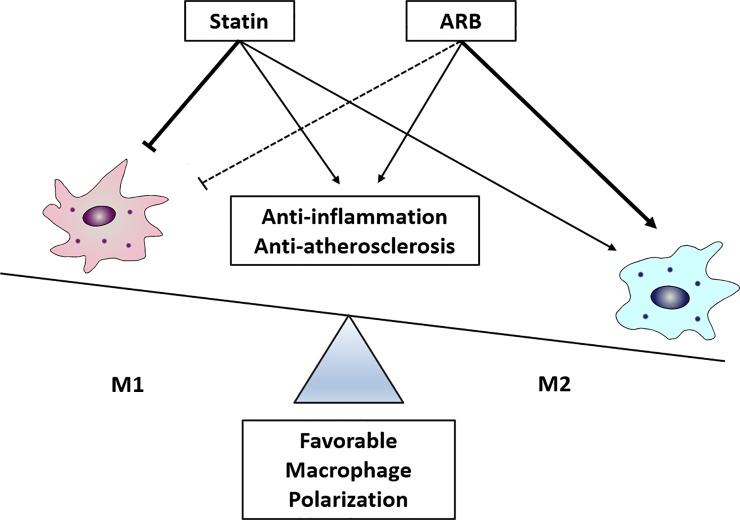
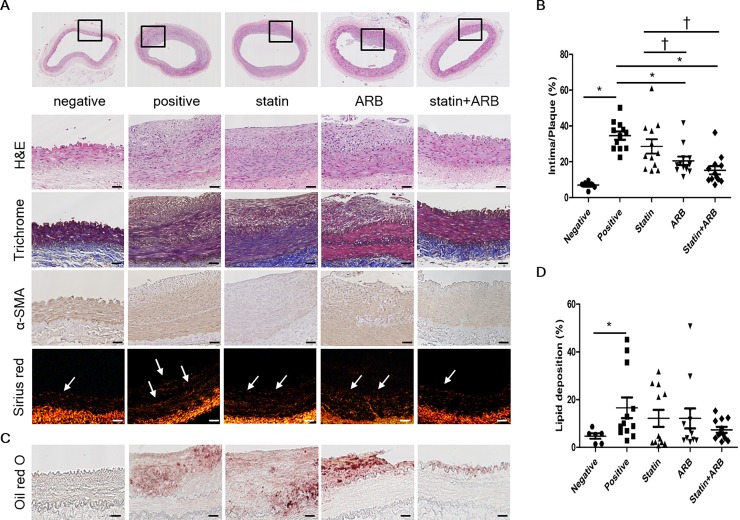
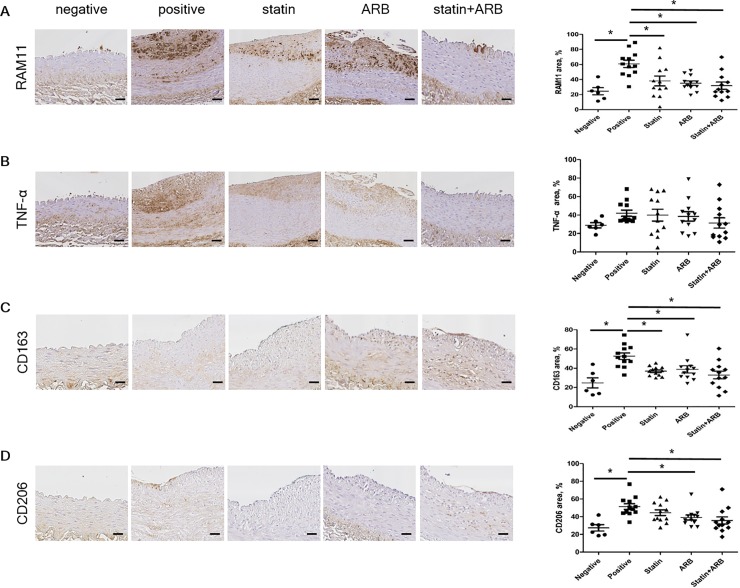
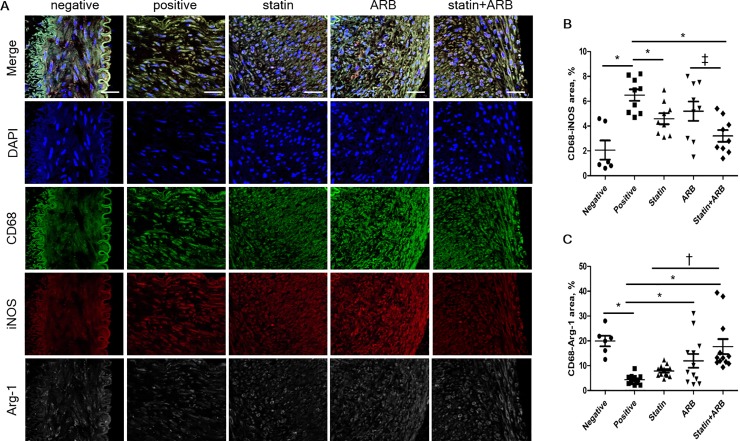
Histological analysis demonstrated that development of atherosclerotic plaques was inhibited more in combination group than in statin group (P = 0.001). Although macrophage infiltration identified by RAM11 staining was not significantly different between combination and individual treatment groups (31.76±4.84% [combination] vs. 38.11±6.53% [statin; P = 0.35] or 35.14±2.87% [ARB; P = 0.62]), the relative proportion of pro-inflammatory M1-macrophages was significantly lower in combination group than in ARB group (3.20±0.47% vs. 5.20±0.78%, P = 0.02). Furthermore, M2-macrophage polarization was higher in combination group than in statin group (17.70±3.04% vs. 7.86±0.68%, P = 0.001).
Combination treatment with a statin and an ARB produced synergistic protective effects for atherosclerosis initiation and progression, which may be attributed to modulation of macrophage characteristics in the early period of atherosclerosis.
尽管他汀类药物和血管紧张素 II 受体阻滞剂(ARB)具有明确的抗动脉粥样硬化作用,但它们的协同作用知之甚少,特别是在动脉粥样硬化的早期阶段。本研究旨在探讨他汀类药物和 ARB 的联合应用是否具有协同抗动脉粥样硬化作用,并阐明其作用机制。
采用高胆固醇饮食(HCD)和动脉内球囊扩张术在 23 只兔子的动脉中形成动脉粥样硬化斑块。兔子接受了 5 种不同治疗策略中的 1 种,共 4 周:阳性对照组(n = 5,HCD);阴性对照组(n = 3,常规饮食);他汀组(n = 5,HCD+瑞舒伐他汀 10mg);ARB 组(n = 5,HCD+奥美沙坦 20mg);联合组(n = 5,HCD+他汀+ARB)。
组织学分析表明,联合组的动脉粥样硬化斑块形成受到的抑制作用明显强于他汀组(P = 0.001)。尽管 RAM11 染色显示的巨噬细胞浸润在联合组和各单药治疗组之间无显著差异(31.76±4.84%[联合组] vs. 38.11±6.53%[他汀组;P = 0.35]或 35.14±2.87%[ARB 组;P = 0.62]),但联合组中促炎 M1 型巨噬细胞的相对比例明显低于 ARB 组(3.20±0.47% vs. 5.20±0.78%,P = 0.02)。此外,联合组中 M2 型巨噬细胞极化程度明显高于他汀组(17.70±3.04% vs. 7.86±0.68%,P = 0.001)。
他汀类药物和 ARB 的联合治疗对动脉粥样硬化的起始和进展具有协同保护作用,这可能归因于在动脉粥样硬化的早期阶段对巨噬细胞特征的调节。