Lee Seung Hwan, Shin Hee Sup, Oh Inho
Department of Neurosurgery, Kyung Hee University Hospital at Gangdong, College of Medicine, Kyung Hee University, Seoul, Korea.
Department of Neurosurgery, Veterans Health Service Medical Center, Seoul, Korea.
J Korean Neurosurg Soc. 2021 Sep;64(5):693-704. doi: 10.3340/jkns.2020.0303. Epub 2021 May 14.
Endovascular mechanical thrombectomy (MT) has been regarded as one of the standard treatments for acute ischemic stroke caused by large vessel occlusion. Despite the wide use of stent retrievers for MT, arterial intimal damage caused when deployed stent is pulled has been a certain disadvantage. We hypothesized that statin could protect and stabilize vessel damage after endovascular MT using a stent retriever. In this animal study, we observed the protective effects of the statins towards MT-induced vessel wall injury.
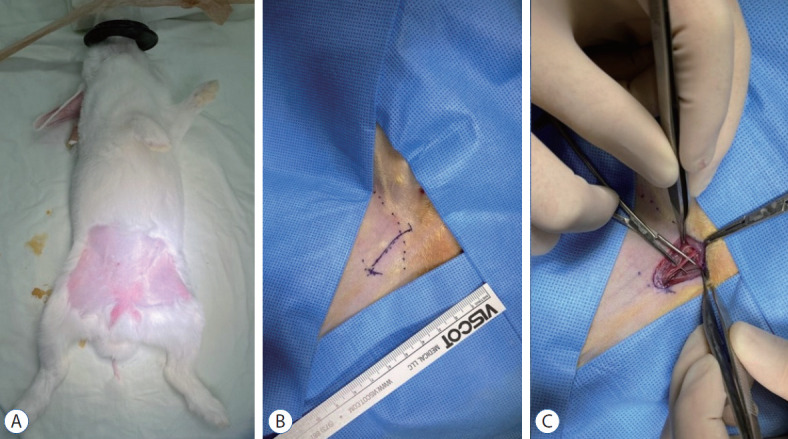
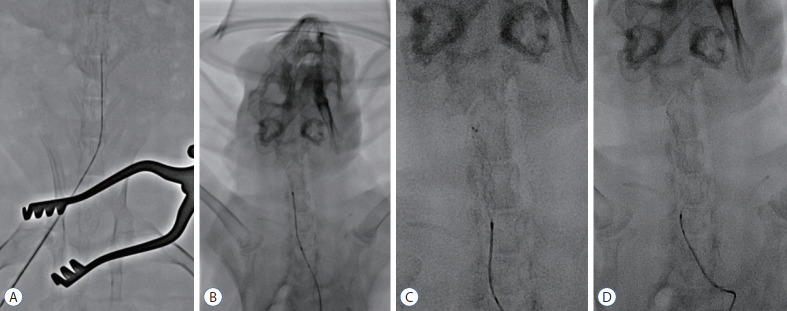
Twenty-eight carotid arteries of fourteen rabbits were used in the experiments with MT using stent retriever. We divided the rabbits into four groups as follows : group 1, negative control; group 2, positive control; group 3, statin before MT; and group 4, statin after MT. After MT procedures, we harvested the carotid arteries and performed histomorphological and immunohistochemical analyses.
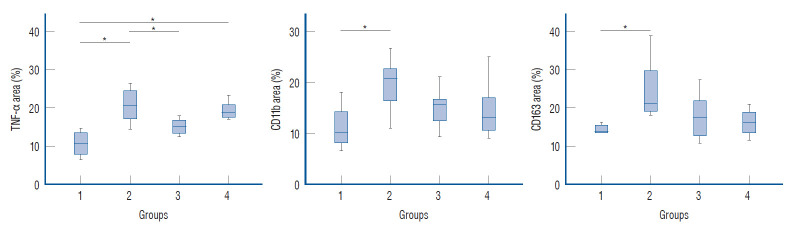
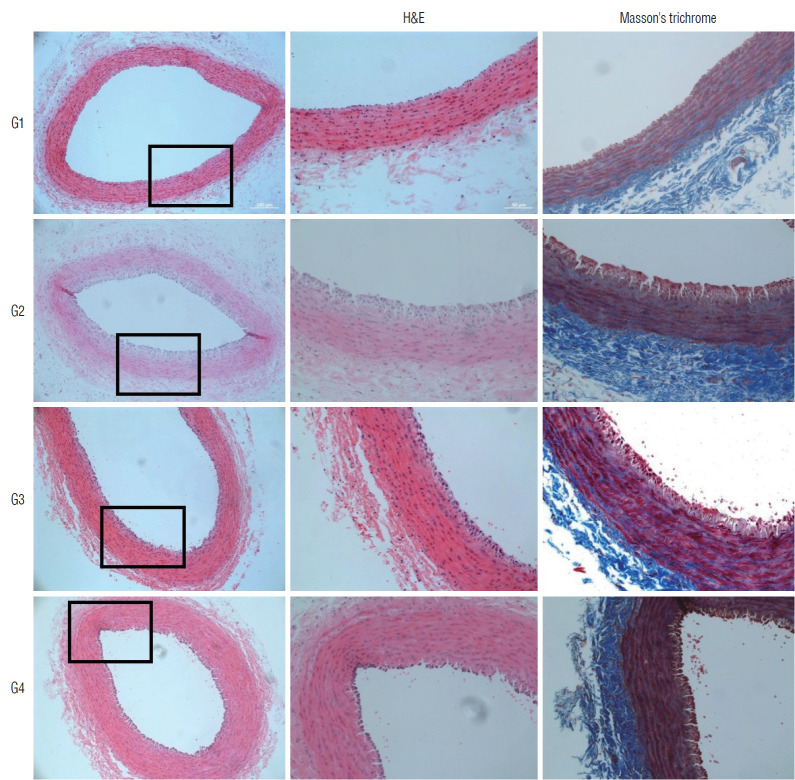
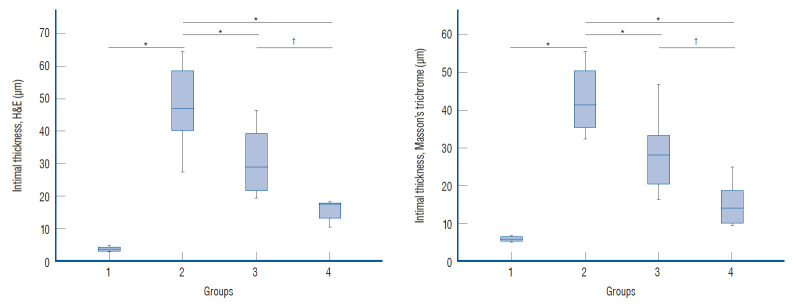
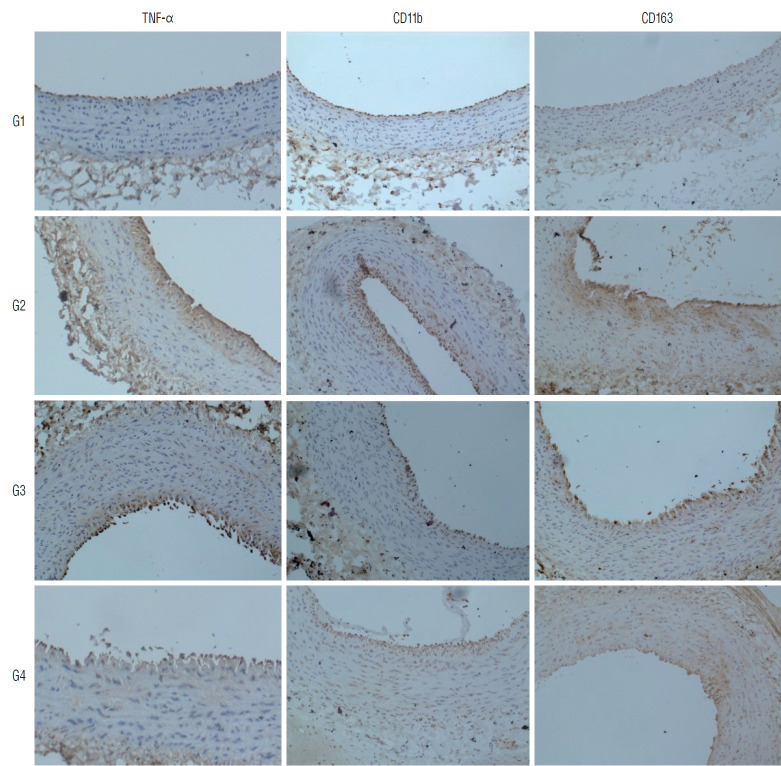
In histomorphological analysis with hematoxylin and eosin and Masson's trichrome stain, significant intimal thickening (p<0.05) was observed in the positive control (group 2), compared to in the negative control (group 1). Intimal thickening was improved in the statin-administered groups (groups 3 and 4 vs. group 2, p<0.05). We also observed that statin administration after MT (group 4) resulted in a more effective decrease in intimal thickness than statin administration before MT (group 3) (p<0.05). We performed immunohistochemical analysis with the antibodies for tumor necrosis factor-alpha (TNF-α), cluster of differentiation (CD)11b, and CD163. In contrast to the negative control (group 1), the stained percentage areas of all immunological markers were markedly increased in the positive control (group 2) (p<0.05). Based on statin administration, the percentage area of TNF-α staining was significantly reduced (p<0.05) in group 3, compared to the positive control group (group 2). However, significant differences were not observed for CD11b and CD163 staining. In group 4, no significant differences were observed for TNF-α, CD11b, and CD163 staining (p≥0.05). The differences in the percentage areas of the different markers between the statin-administered groups (groups 3 and 4) were also not revealed.
We presented that statin administration before and after MT exerted protective effects towards vessel wall injury. The efficacy of statins was greater post-administration than pre-administration. Thus, statin administration in routine prescriptions in the peri-procedural period is strongly advised.
血管内机械取栓术(MT)已被视为治疗大血管闭塞所致急性缺血性卒中的标准治疗方法之一。尽管支架取栓器在MT中广泛应用,但在回撤已植入的支架时所造成的动脉内膜损伤一直是其一个明显的缺点。我们推测他汀类药物可在使用支架取栓器进行血管内MT后保护并稳定血管损伤。在本动物研究中,我们观察了他汀类药物对MT所致血管壁损伤的保护作用。
将14只家兔的28条颈动脉用于使用支架取栓器进行MT的实验。我们将家兔分为以下四组:第1组,阴性对照组;第2组,阳性对照组;第3组,MT前给予他汀类药物组;第4组,MT后给予他汀类药物组。MT操作后,我们获取颈动脉并进行组织形态学和免疫组织化学分析。
苏木精-伊红染色及Masson三色染色的组织形态学分析显示,与阴性对照组(第1组)相比,阳性对照组(第2组)出现显著的内膜增厚(p<0.05)。他汀类药物给药组(第3组和第4组与第2组相比)内膜增厚情况有所改善(p<0.05)。我们还观察到,MT后给予他汀类药物(第4组)比MT前给予他汀类药物(第3组)能更有效地降低内膜厚度(p<0.05)。我们使用肿瘤坏死因子-α(TNF-α)、分化簇(CD)11b和CD163抗体进行了免疫组织化学分析。与阴性对照组(第1组)相比,阳性对照组(第2组)所有免疫标志物的染色面积百分比均显著增加(p<0.05)。基于他汀类药物给药,第3组中TNF-α染色的面积百分比与阳性对照组(第2组)相比显著降低(p<0.05)。然而,CD11b和CD163染色未观察到显著差异。在第4组中,TNF-α、CD11b和CD163染色未观察到显著差异(p≥0.05)。他汀类药物给药组(第3组和第4组)之间不同标志物染色面积百分比的差异也未显示出来。
我们表明MT前后给予他汀类药物对血管壁损伤具有保护作用。他汀类药物给药后的疗效优于给药前。因此,强烈建议在围手术期的常规处方中给予他汀类药物。