Division of Physiological Chemistry I, Department of Medical Biochemistry and Biophysics, Karolinska Institutet, 17177 Stockholm, Sweden.
Respiratory Medicine Unit, Department of Medicine Solna & Centre for Molecular Medicine, Karolinska Institutet, 171 77 Stockholm, Sweden.
Int J Mol Sci. 2019 May 1;20(9):2157. doi: 10.3390/ijms20092157.
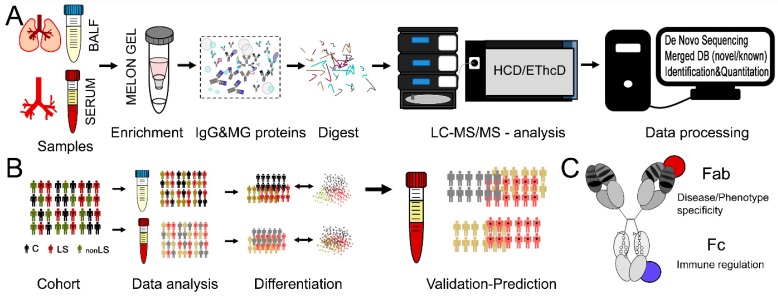
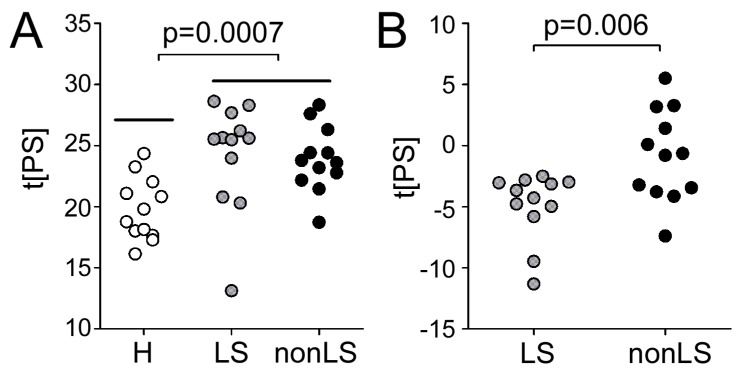
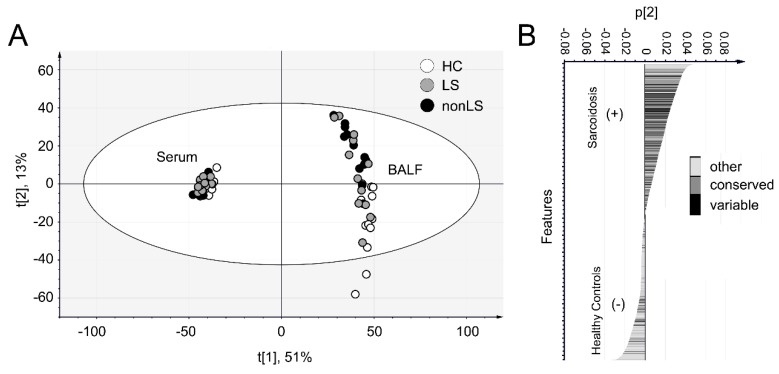
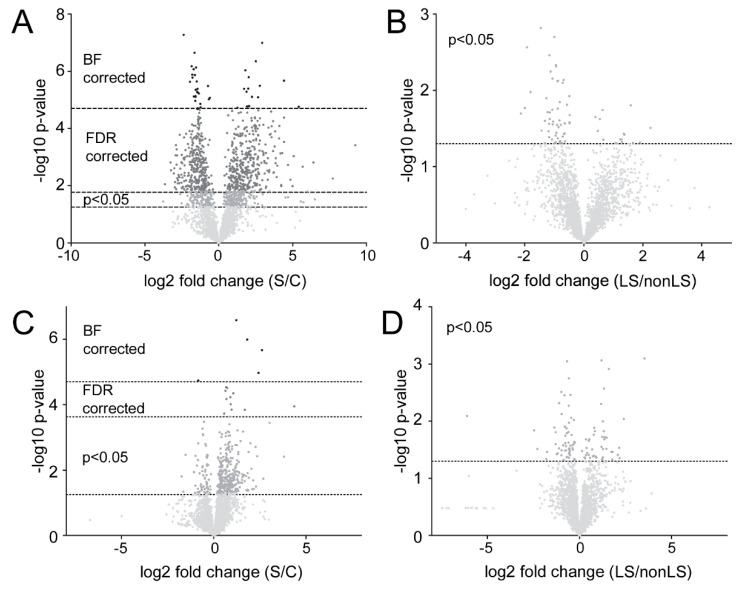
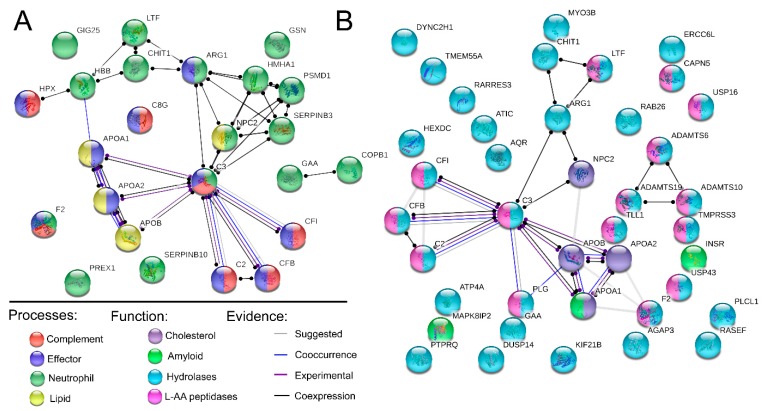
Sarcoidosis is a systemic interstitial lung disease of unknown aetiology. Less invasive diagnostics are needed to decipher disease pathology and to distinguish sub-phenotypes. Here we test if SpotLight proteomics, which combines de novo MS/MS sequencing of enriched IgG and co-extracted proteins with subsequent label-free quantification of new and known peptides, can differentiate controls and sarcoidosis phenotypes (Löfgrens and non-Löfgrens syndrome, LS and nonLS). Intra-individually matched IgG enriched from serum and bronchial lavage fluid (BALF) from controls ( = 12), LS ( = 11) and nonLS ( = 12) were investigated. High-resolution mass-spectrometry SpotLight proteomics and uni- and multivariate-statistical analyses were used for data processing. Major differences were particularly observed in control-BALF versus sarcoidosis-BALF. However, interestingly, information obtained from BALF profiles was still present (but less prominent) in matched serum profiles. By using information from orthogonal partial least squares discriminant analysis (OPLS-DA) differentiating 1) sarcoidosis-BALF and control-BALF and 2) LS-BALF vs. nonLS-BALF, control-serum and sarcoidosis-serum ( = 0.0007) as well as LS-serum and nonLS-serum ( = 0.006) could be distinguished. Noteworthy, many factors prominent in identifying controls and patients were those associated with Fc-regulation, but also features from the IgG-Fab region and novel peptide variants. Differences between phenotypes were mostly IgG-specificity related. The results support the analytical utility of SpotLight proteomics which prospectively have potential to differentiate closely related phenotypes from a simple blood test.
结节病是一种病因不明的系统性间质性肺疾病。需要更具侵袭性的诊断方法来解析疾病的病理机制并区分亚表型。在这里,我们测试了 SpotLight 蛋白质组学,该技术结合了富集 IgG 的从头 MS/MS 测序和共提取蛋白质,并随后对新肽和已知肽进行无标记定量,是否可以区分对照和结节病表型(Löfgrens 和非 Löfgrens 综合征,LS 和非 LS)。我们对内源性匹配的 IgG 进行了研究,这些 IgG 是从对照( = 12)、LS( = 11)和非 LS( = 12)的血清和支气管肺泡灌洗液(BALF)中富集得到的。使用高分辨率质谱 SpotLight 蛋白质组学和单变量和多变量统计分析进行数据处理。在对照 BALF 与结节病 BALF 之间观察到了特别大的差异。但是,有趣的是,从 BALF 谱中获得的信息仍然存在(但不那么明显)在匹配的血清谱中。通过使用区分 1)结节病 BALF 和对照 BALF 以及 2)LS-BALF 与非 LS-BALF 的正交偏最小二乘判别分析(OPLS-DA)的信息,我们可以区分对照血清和结节病血清( = 0.0007)以及 LS 血清和非 LS 血清( = 0.006)。值得注意的是,许多在识别对照和患者方面很重要的因素是与 Fc 调节相关的因素,但也包括 IgG-Fab 区域的特征和新型肽变体。表型之间的差异主要与 IgG 的特异性有关。这些结果支持了 SpotLight 蛋白质组学的分析实用性,它有望通过简单的血液测试来区分密切相关的表型。