Department of Pathology and Molecular Medicine, Queen's University, Kingston, ON K7L 3N6, Canada.
Department of Biology, Queen's University, Kingston, ON K7L 3N6, Canada.
Cells. 2019 May 1;8(5):407. doi: 10.3390/cells8050407.
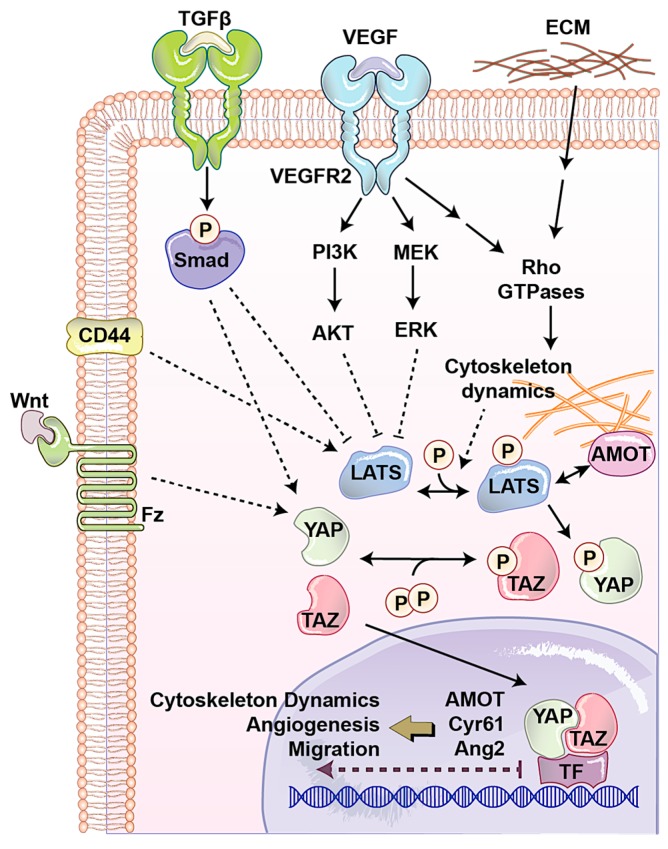
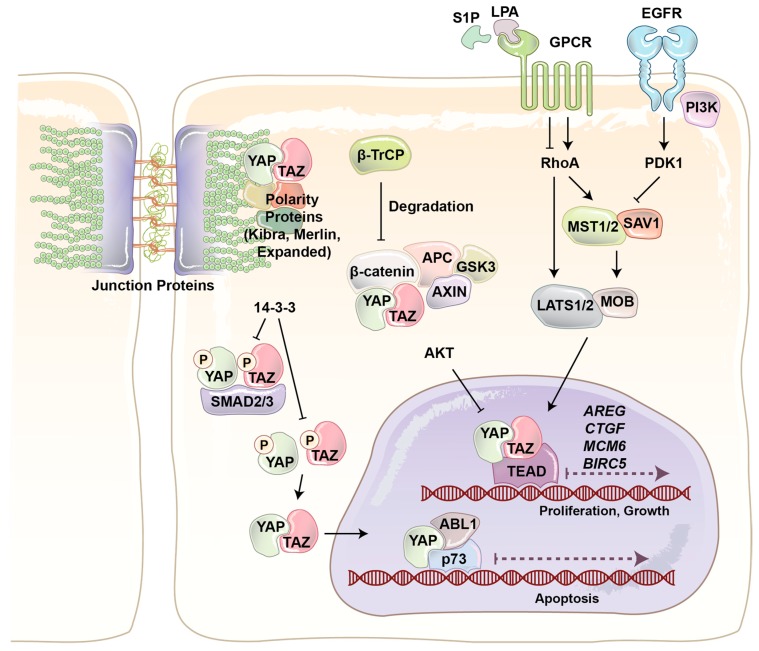
Angiogenesis, the formation of new blood vessels from pre-existing vasculature, is a physiological process that begins in utero and continues throughout life in both good health and disease. Understanding the underlying mechanism in angiogenesis could uncover a new therapeutic approach in pathological angiogenesis. Since its discovery, the Hippo signaling pathway has emerged as a key player in controlling organ size and tissue homeostasis. Recently, new studies have discovered that Hippo and two of its main effectors, Yes-associated protein (YAP) and its paralog transcription activator with PDZ binding motif (TAZ), play critical roles during angiogenesis. In this review, we summarize the mechanisms by which YAP/TAZ regulate endothelial cell shape, behavior, and function in angiogenesis. We further discuss how YAP/TAZ function as part of developmental and pathological angiogenesis. Finally, we review the role of YAP/TAZ in tumor vascular mimicry and propose directions for future work.
血管生成,即从预先存在的脉管系统中形成新的血管,是一种生理过程,始于子宫内,并在健康和疾病状态下贯穿一生。了解血管生成中的潜在机制可能会为病理性血管生成提供新的治疗方法。自发现以来,Hippo 信号通路已成为控制器官大小和组织平衡的关键因素。最近的研究发现,Hippo 及其两个主要效应因子,Yes 相关蛋白 (YAP) 和其 PDZ 结合基序转录激活因子 (TAZ),在血管生成过程中发挥关键作用。在这篇综述中,我们总结了 YAP/TAZ 调节血管生成中内皮细胞形状、行为和功能的机制。我们进一步讨论了 YAP/TAZ 如何作为发育和病理性血管生成的一部分发挥作用。最后,我们回顾了 YAP/TAZ 在肿瘤血管拟态中的作用,并提出了未来工作的方向。