Division of Pediatric Nephrology, University Children's Hospital Heidelberg, Im Neuenheimer Feld 430, 69120, Heidelberg, Germany.
Department of Pediatric Nephrology, University Hospitals Leuven, Herestraat 49, B-3000, Leuven, Belgium.
Eur J Pediatr. 2019 Jul;178(7):1013-1021. doi: 10.1007/s00431-019-03384-x. Epub 2019 May 3.
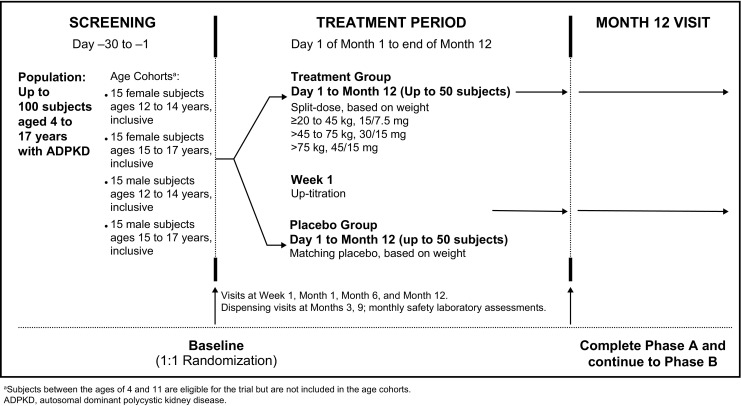
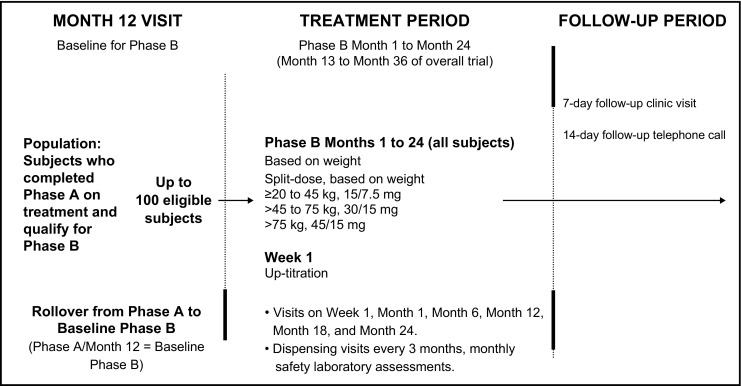
This report describes the rationale and design of a study assessing tolvaptan in children with autosomal dominant polycystic kidney disease (ADPKD). Phase A is a 1-year, randomized, double-blind, placebo-controlled, multicenter trial. Phase B is a 2-year, open-label extension. The target population is at least 60 children aged 12-17 years, diagnosed by family history and/or genetic criteria and the presence of ≥ 10 renal cysts, each ≥ 0.5 cm on magnetic resonance imaging. Subjects will be allocated into 4 groups: females 15-17 years; females 12-14 years; males 15-17 years; and males 12-14 years. Up to 40 subjects aged 4-11 years may also enroll, provided they meet the entry criteria. Weight-adjusted tolvaptan doses, titrated once to achieve a tolerated maintenance dose, and matching placebo will be administered twice-daily. Assessments include spot urine osmolality and specific gravity (co-primary endpoints), height-adjusted total kidney volume, estimated glomerular filtration rate, pharmacodynamic parameters (urine volume, fluid intake and fluid balance, serum sodium, serum creatinine, free water clearance), pharmacokinetic parameters, safety (aquaretic adverse events, changes from baseline in creatinine, vital signs, laboratory values including liver function tests), and generic pediatric quality of life assessments.Conclusion: This will be the first clinical study to evaluate tolvaptan in pediatric ADPKD. What is Known: • Autosomal dominant polycystic kidney disease (ADPKD) is a genetic disorder causing the development of cysts that impede kidney function over time and eventually induce renal failure • There are few data on the effects of tolvaptan, the only treatment approved for adults to slow disease progression, in pediatric ADPKD patients with early-stage disease What is New: • A phase 3, placebo-controlled study is evaluating tolvaptan over 3 years in children and adolescents with ADPKD • This study is designed to account for challenges of tolvaptan dosing and outcome assessment specific to the pediatric population.
本报告介绍了一项评估托伐普坦在常染色体显性多囊肾病(ADPKD)儿童患者中的作用和设计原理。研究分为 A 期(1 年,随机、双盲、安慰剂对照、多中心试验)和 B 期(2 年,开放标签扩展期)。目标人群为至少 60 名年龄在 12-17 岁的儿童患者,其诊断依据为家族史和/或基因标准,以及存在≥10 个磁共振成像上≥0.5cm 的肾囊肿。受试者将被分为 4 组:15-17 岁女性;12-14 岁女性;15-17 岁男性;12-14 岁男性。如果符合入组标准,最多可纳入 40 名年龄在 4-11 岁的儿童患者。根据体重调整托伐普坦剂量,滴定至耐受维持剂量,给予托伐普坦或匹配安慰剂,每日 2 次。评估指标包括随机尿液渗透压和比重(主要终点)、身高校正的全肾体积、估算肾小球滤过率、药效学参数(尿量、液体摄入和液体平衡、血清钠、血清肌酐、游离水清除率)、药代动力学参数、安全性(水潴留不良反应、血清肌酐自基线的变化、生命体征、实验室检查值,包括肝功能检查)和一般儿科生活质量评估。结论:这将是第一项评估托伐普坦在儿科 ADPKD 患者中应用的临床研究。已知情况:•常染色体显性多囊肾病(ADPKD)是一种遗传疾病,导致囊肿的形成,随着时间的推移逐渐阻碍肾脏功能,最终导致肾衰竭。•托伐普坦是唯一批准用于延缓成人疾病进展的治疗药物,关于其在早期 ADPKD 儿科患者中的作用的数据有限。新发现:•一项为期 3 年、安慰剂对照的研究正在评估托伐普坦在 ADPKD 儿童和青少年患者中的应用。•该研究旨在解决托伐普坦在儿科人群中的剂量和结局评估问题。