Division of Nephrology, Department of Pediatric Subspecialties, and.
Polycystic Kidney Disease Research Group, Laboratory of Pediatrics, Department of Development and Regeneration, Gynaecology Pediatrics and Urology (G-PURE), Katholieke Universiteit Leuven, Leuven, Belgium.
Clin J Am Soc Nephrol. 2018 Jun 7;13(6):874-883. doi: 10.2215/CJN.11401017. Epub 2018 Apr 19.
Autosomal dominant polycystic kidney disease is the most common inheritable kidney disease, frequently thought to become symptomatic in adulthood. However, patients with autosomal dominant polycystic kidney disease may develop signs or symptoms during childhood, in particular hypertension. Although ambulatory BP monitoring is the preferred method to diagnose hypertension in pediatrics, data in children with autosomal dominant polycystic kidney disease are limited.
DESIGN, SETTING, PARTICIPANTS, & MEASUREMENTS: Our retrospective multicenter study was conducted to collect ambulatory BP monitoring recordings from patients with autosomal dominant polycystic kidney disease age <18 years old. Basic anthropometric parameters as well as data on kidney function, BP treatment, and kidney ultrasound were also collected.
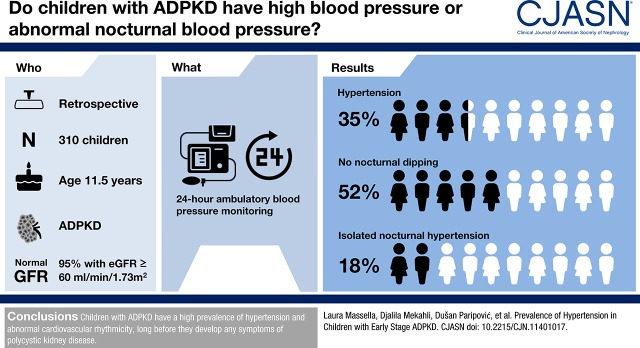
Data from 310 children with autosomal dominant polycystic kidney disease with a mean age of 11.5±4.1 years old were collected at 22 European centers. At the time when ambulatory BP monitoring was performed, 95% of children had normal kidney function. Reference data for ambulatory BP monitoring were available for 292 patients. The prevalence rates of children with hypertension and/or those who were treated with antihypertensive drugs were 31%, 42%, and 35% during daytime, nighttime, or the entire 24-hour cycle, respectively. In addition, 52% of participants lacked a physiologic nocturnal BP dipping, and 18% had isolated nocturnal hypertension. Logistic regression analysis showed a significant association between a categorical cyst score that was calculated on the basis of the number of cysts >1 cm per kidney and daytime hypertension (odds ratio, 1.70; 95% confidence interval, 1.21 to 2.4; =0.002), nighttime hypertension (odds ratio, 1.31; 95% confidence interval, 1.05 to 1.63; =0.02), or 24-hour hypertension (odds ratio, 1.39; 95% confidence interval, 1.08 to 1.81; =0.01). Kidney length, expressed as SD score, was also significantly associated with nighttime hypertension (odds ratio, 1.23; 95% confidence interval, 1.06 to 1.42; =0.10).
These data indicate high prevalence of hypertension in children with autosomal dominant polycystic kidney disease starting at young ages.
常染色体显性遗传性多囊肾病是最常见的遗传性肾脏疾病,通常认为该病在成年后才会出现症状。然而,常染色体显性遗传性多囊肾病患者可能在儿童期就出现体征或症状,特别是高血压。虽然动态血压监测是儿科诊断高血压的首选方法,但关于常染色体显性遗传性多囊肾病患儿的数据有限。
设计、地点、参与者和测量方法:我们进行了这项回顾性多中心研究,以收集年龄<18 岁的常染色体显性遗传性多囊肾病患者的动态血压监测记录。还收集了基本的人体测量参数以及肾功能、血压治疗和肾脏超声数据。
在 22 个欧洲中心共收集了 310 名年龄 11.5±4.1 岁的常染色体显性遗传性多囊肾病患儿的数据。在进行动态血压监测时,95%的患儿肾功能正常。有 292 名患儿有动态血压监测参考数据。日间、夜间或整个 24 小时周期中,高血压和/或接受降压药物治疗的患儿的患病率分别为 31%、42%和 35%。此外,52%的参与者缺乏生理性夜间血压下降,18%存在孤立性夜间高血压。logistic 回归分析显示,基于每侧肾脏>1cm 囊肿数计算的分类囊肿评分与日间高血压(比值比,1.70;95%置信区间,1.21 至 2.4;=0.002)、夜间高血压(比值比,1.31;95%置信区间,1.05 至 1.63;=0.02)或 24 小时高血压(比值比,1.39;95%置信区间,1.08 至 1.81;=0.01)显著相关。肾脏长度(以 SD 评分表示)也与夜间高血压显著相关(比值比,1.23;95%置信区间,1.06 至 1.42;=0.10)。
这些数据表明,常染色体显性遗传性多囊肾病患儿在很小的年龄就出现高血压的高患病率。