Primary Care Stratified Medicine (PRISM), Division of Primary Care, University of Nottingham, Nottingham, UK.
Primary Care Stratified Medicine (PRISM), Division of Primary Care, University of Nottingham, Nottingham, UK.
Lancet Public Health. 2019 May;4(5):e256-e264. doi: 10.1016/S2468-2667(19)30061-1.
The vast majority of individuals with familial hypercholesterolaemia in the general population remain unidentified worldwide. Recognising patients most likely to have the condition, to enable targeted specialist assessment and treatment, could prevent major coronary morbidity and mortality. We aimed to evaluate a clinical case-finding algorithm, the familial hypercholesterolaemia case ascertainment tool (FAMCAT), and compare it with currently recommended methods for detection of familial hypercholesterolaemia in primary care.
In this external validation study, FAMCAT regression equations were applied to a retrospective cohort of patients aged 16 years or older with cholesterol assessed, who were randomly selected from 1500 primary care practices across the UK contributing to the QResearch database. In the main analysis, we assessed the ability of FAMCAT to detect familial hypercholesterolaemia (ie, its discrimination) and compared it with that of other established clinical case-finding approaches recommended internationally (Simon Broome, Dutch Lipid Clinic Network, Make Early Diagnosis to Prevent Early Deaths [MEDPED] and cholesterol concentrations higher than the 99th percentile of the general population in the UK). We assessed discrimination by area under the receiver operating curve (AUROC; ranging from 0·5, indicating pure chance, to 1, indicating perfect discrimination). Using a probability threshold of more than 1 in 500 (prevalence of familial hypercholesterolaemia), we also assessed sensitivity, specificity, positive predictive values, and negative predictive values in the main analysis.
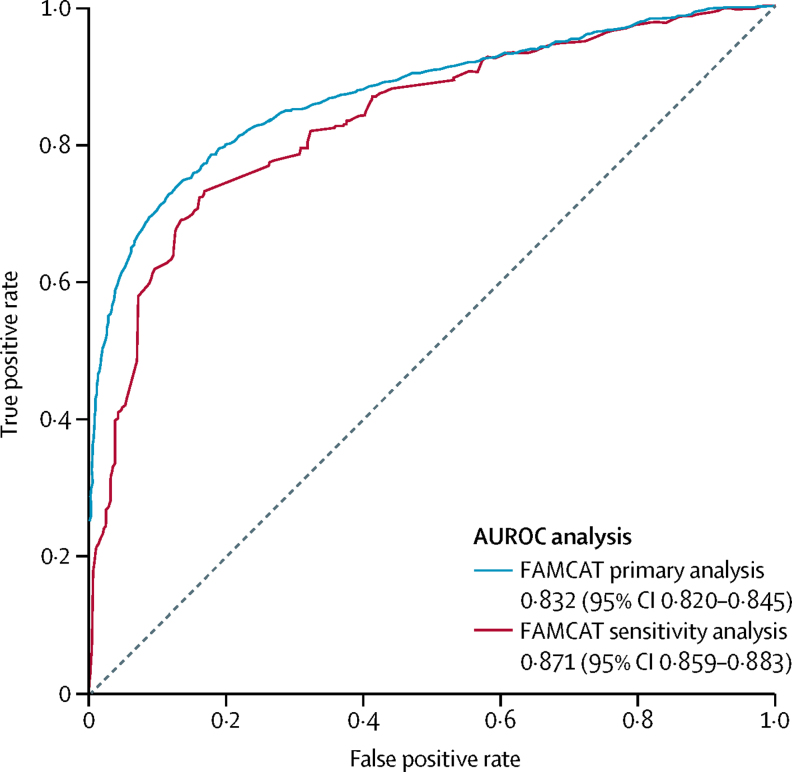
A sample of 750 000 patients who registered in 1500 UK primary care practices that contribute anonymised data to the QResearch database between Jan 1, 1999, and Sept 1, 2017, was randomly selected, of which 747 000 patients were assessed. FAMCAT showed a high degree of discrimination (AUROC 0·832, 95% CI 0·820-0·845), which was higher than that of Simon Broome criteria (0·694, 0·681-0·703), Dutch Lipid Clinic Network criteria (0·724, 0·710-0·738), MEDPED criteria (0·624, 0·609-0·638), and screening cholesterol concentrations higher than the 99th percentile (0·581, 0·570-0·591). Using a 1 in 500 probability threshold, FAMCAT achieved a sensitivity of 84% (1028 predicted vs 1219 observed cases) and specificity of 60% (443 949 predicted vs 745 781 observed non-cases), with a corresponding positive predictive value of 0·84% and a negative predictive value of 99·2%.
FAMCAT identifies familial hypercholesterolaemia with greater accuracy than currently recommended approaches and could be considered for clinical case finding of patients with the highest likelihood of having hypercholesterolaemia in primary care.
UK National Institute for Health Research School for Primary Care Research.
在全球范围内,绝大多数普通人群中的家族性高胆固醇血症患者尚未被发现。识别出最有可能患有该疾病的患者,以便进行有针对性的专家评估和治疗,可预防主要的冠状动脉发病率和死亡率。我们旨在评估一种临床病例发现算法,即家族性高胆固醇血症病例确定工具(FAMCAT),并将其与目前在初级保健中用于检测家族性高胆固醇血症的推荐方法进行比较。
在这项外部验证研究中,将 FAMCAT 回归方程应用于从参与 QResearch 数据库的英国 1500 个初级保健实践中随机选择的年龄在 16 岁或以上且胆固醇水平已评估的患者的回顾性队列中。在主要分析中,我们评估了 FAMCAT 检测家族性高胆固醇血症(即其判别能力)的能力,并将其与国际上推荐的其他既定临床病例发现方法(Simon Broome、荷兰脂质诊所网络、早期诊断以预防早期死亡[MEDPED]和胆固醇浓度高于英国普通人群的第 99 百分位)进行了比较。我们通过接受者操作特征曲线下的面积(AUROC;范围从 0.5,指示纯机会,到 1,指示完美的判别)来评估判别能力。使用大于 1/500(家族性高胆固醇血症的患病率)的概率阈值,我们还在主要分析中评估了敏感性、特异性、阳性预测值和阴性预测值。
从 1999 年 1 月 1 日至 2017 年 9 月 1 日在 QResearch 数据库中注册的 1500 个英国初级保健实践中随机选择了一个样本量为 750 万患者的队列,对其中的 747 万患者进行了评估。FAMCAT 表现出高度的判别能力(AUROC 0.832,95%CI 0.820-0.845),高于 Simon Broome 标准(0.694,0.681-0.703)、荷兰脂质诊所网络标准(0.724,0.710-0.738)、MEDPED 标准(0.624,0.609-0.638)和胆固醇浓度高于第 99 百分位(0.581,0.570-0.591)。使用 1/500 的概率阈值,FAMCAT 实现了 84%的敏感性(1028 例预测 vs 1219 例观察病例)和 60%的特异性(443949 例预测 vs 745781 例观察非病例),相应的阳性预测值为 0.84%,阴性预测值为 99.2%。
FAMCAT 比目前推荐的方法更准确地识别家族性高胆固醇血症,可考虑用于初级保健中具有高胆固醇血症可能性的患者的临床病例发现。
英国国家健康研究所初级保健研究学院。