Plant Ecophysiology, Institute of Environmental Biology, Utrecht University, Kruytgebouw, Padualaan 8, 3584CH, Utrecht, the Netherlands; Centro Nacional de Biotecnología, CSIC, Calle Darwin 3, Madrid 28049, Spain.
Plant Ecophysiology, Institute of Environmental Biology, Utrecht University, Kruytgebouw, Padualaan 8, 3584CH, Utrecht, the Netherlands.
Curr Biol. 2019 May 20;29(10):1669-1676.e4. doi: 10.1016/j.cub.2019.03.042. Epub 2019 May 2.
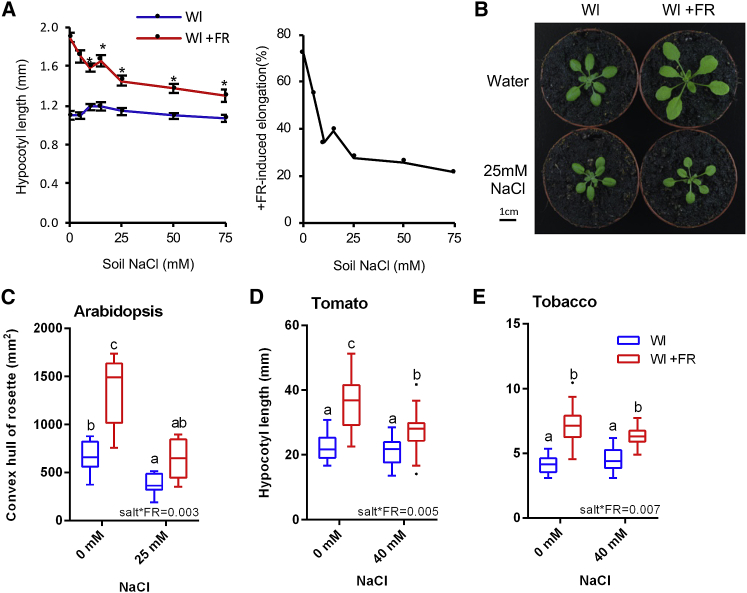
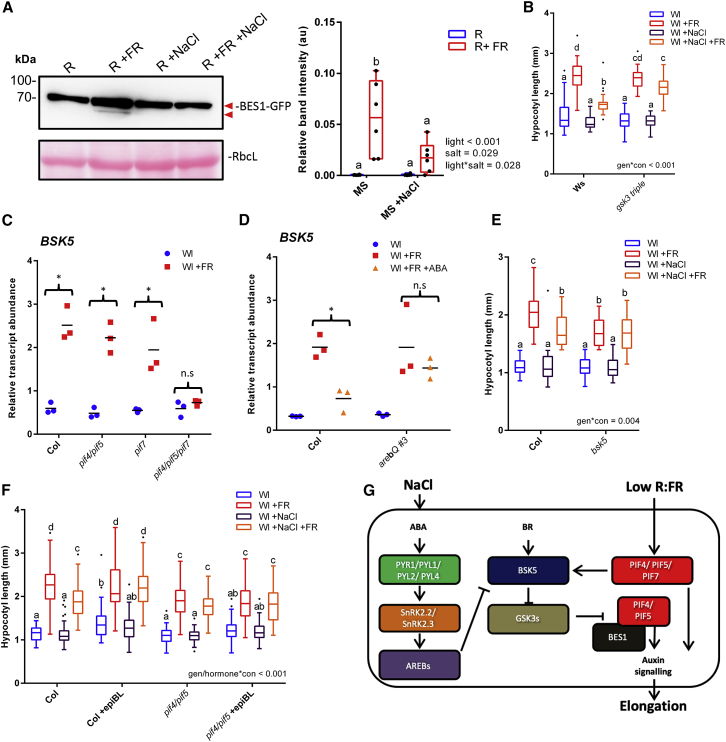
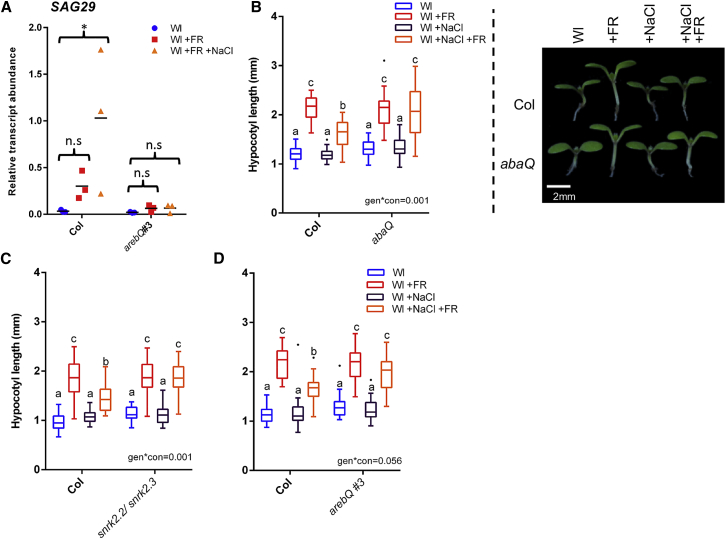
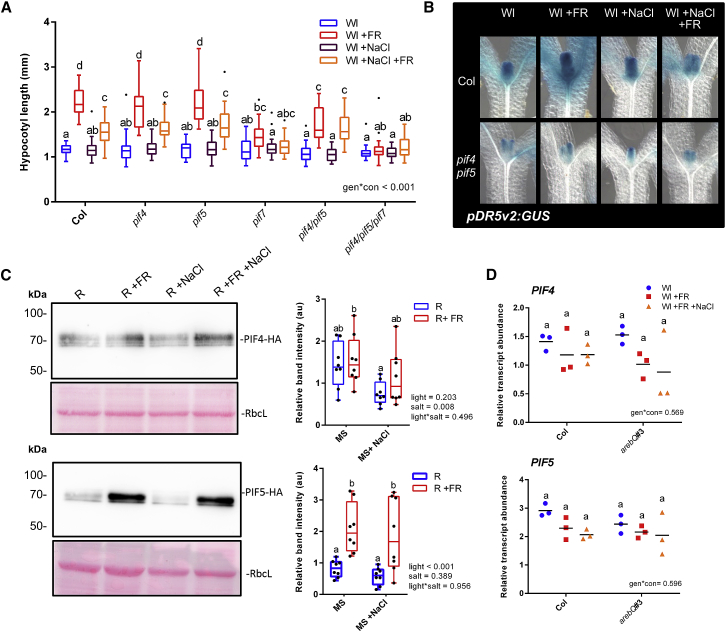
Global food production is set to keep increasing despite a predicted decrease in total arable land [1]. To achieve higher production, denser planting will be required on increasingly degraded soils. When grown in dense stands, crops elongate and raise their leaves in an effort to reach sunlight, a process termed shade avoidance [2]. Shade is perceived by a reduction in the ratio of red (R) to far-red (FR) light and results in the stabilization of a class of transcription factors known as PHYTOCHROME INTERACTING FACTORS (PIFs) [3, 4]. PIFs activate the expression of auxin biosynthesis genes [4, 5] and enhance auxin sensitivity [6], which promotes cell-wall loosening and drives elongation growth. Despite our molecular understanding of shade-induced growth, little is known about how this developmental program is integrated with other environmental factors. Here, we demonstrate that low levels of NaCl in soil strongly impair the ability of plants to respond to shade. This block is dependent upon abscisic acid (ABA) signaling and the canonical ABA signaling pathway. Low R:FR light enhances brassinosteroid (BR) signaling through BRASSINOSTEROID SIGNALING KINASE 5 (BSK5) and leads to the activation of BRI1 EMS SUPPRESSOR 1 (BES1). ABA inhibits BSK5 upregulation and interferes with GSK3-like kinase inactivation by the BR pathway, thus leading to a suppression of BES1:PIF function. By demonstrating a link between light, ABA-, and BR-signaling pathways, this study provides an important step forward in our understanding of how multiple environmental cues are integrated into plant development.
尽管预计耕地总面积会减少,但全球粮食产量仍将继续增长。[1]为了实现更高的产量,需要在日益退化的土壤上进行更密集的种植。[2]当作物在密集的林分中生长时,它们会伸长并将叶子举高,以争取到阳光,这个过程被称为避荫。[2] 荫蔽通过降低红光(R)与远红光(FR)的比例来感知,并导致一类被称为光形态建成素互作因子(PIFs)的转录因子稳定。[3,4] PIFs 激活生长素生物合成基因的表达[4,5]并增强生长素敏感性[6],从而促进细胞壁松弛并驱动伸长生长。[6]尽管我们对荫蔽诱导生长的分子机制有了一定的了解,但对于这个发育程序如何与其他环境因素整合在一起,我们知之甚少。[7]在这里,我们证明土壤中低水平的 NaCl 会严重削弱植物对荫蔽的反应能力。[8]这种抑制作用依赖于脱落酸(ABA)信号转导和经典的 ABA 信号通路。[8]低 R:FR 光通过 BRASSINOSTEROID SIGNALING KINASE 5 (BSK5) 增强了油菜素内酯(BR)信号转导,导致 BRASSINOSTEROID SIGNALING KINASE 5 (BSK5) 的激活,并激活了 BRI1 EMS SUPPRESSOR 1 (BES1)。[9] ABA 抑制 BSK5 的上调,并通过 BR 途径干扰 GSK3 样激酶的失活,从而抑制 BES1:PIF 功能。[10]通过证明光、ABA-和 BR 信号通路之间的联系,本研究为我们理解多个环境线索如何整合到植物发育中提供了重要的一步。