Charalambous Andreas, Zorpas Marios, Cloconi Constantina, Kading Yolanda
Department of Nursing, Cyprus University of Technology, Limassol, Cyprus.
Department of Nursing Science, University of Turku, Turku, Finland.
SAGE Open Med. 2019 Apr 4;7:2050312119841823. doi: 10.1177/2050312119841823. eCollection 2019.
Pain is considered the most common and debilitating symptom reported by patients affected by cancer, and opioids are at the front line for its effective management. However, the appropriate use of opioids can be limited by healthcare professionals' perceptions on opioids. Therefore, the aim of this study was to explore their perceptions on the use of opioids medication.
This was a study of sequential mixed-method design conducted in Cyprus. As part of the quantitative phase of the study, the Barriers to Opioid Analgesic Availability Test questionnaire was completed by 73 physicians randomly selected. In the qualitative phase, 28 healthcare professionals working in primary and secondary healthcare centers participated in two focus groups. They were asked to express their perceptions on the use of opioid analgesics for the treatment of cancer-related pain. Data were analyzed according to Colaizzis' seven-stage phenomenological analysis.
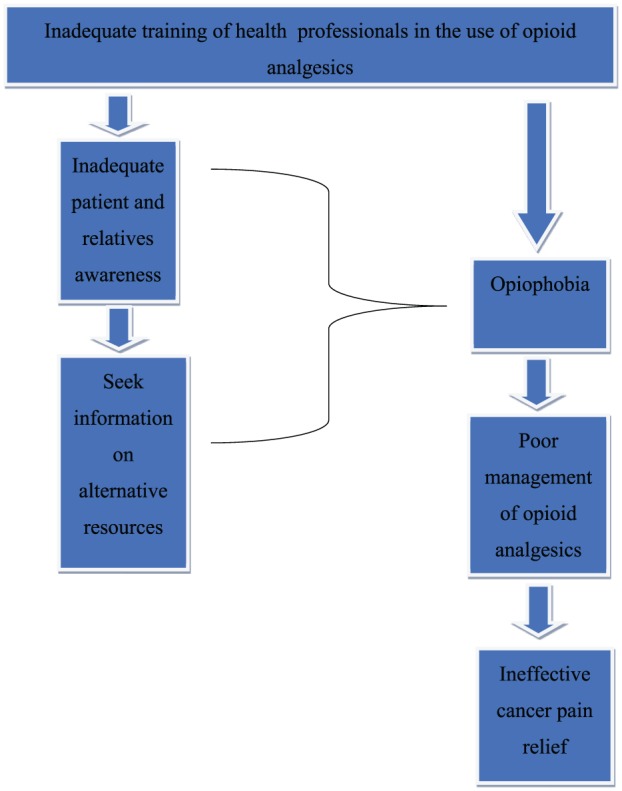
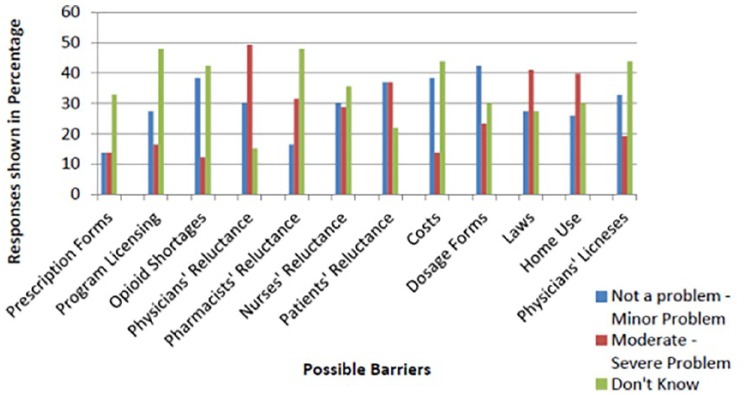
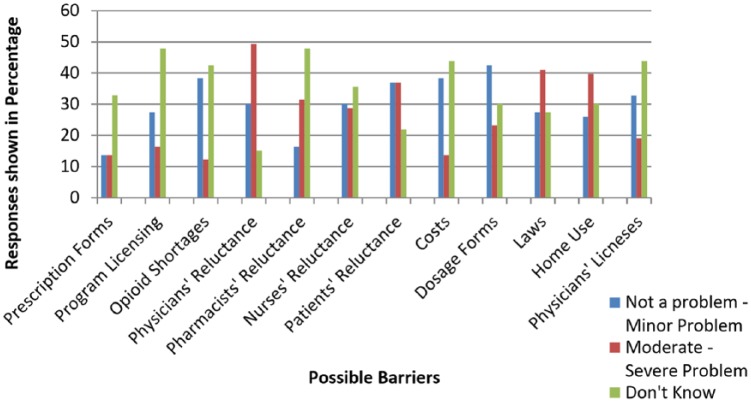
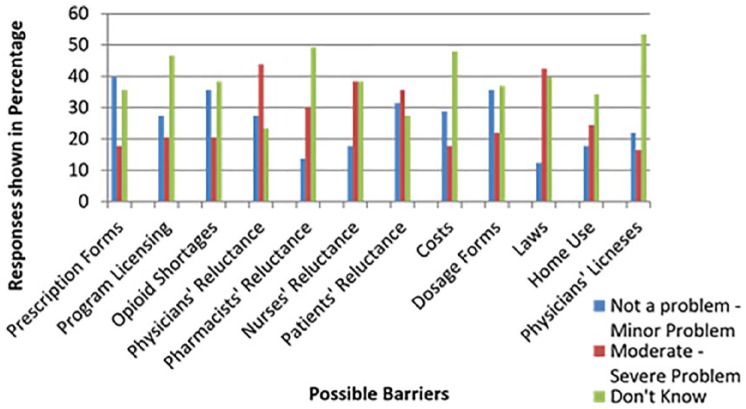
The quantitative analysis showed that 69.85% of physicians acknowledge opiophobia as a main barrier to appropriate pain relief but also explicitly for cancer pain which is not adequately managed (45.19%). In terms of opioids availability, physicians stated that moderate to severe problems in opioids availability were mainly caused by their reluctance to prescribe opioids (49.3%) followed by the laws/regulations in place (41.08%). The qualitative analysis yielded the following six main themes: inadequate training of healthcare professionals in the use of opioid analgesics, inadequate patient/caregivers' awareness of opioid analgesics, opiophobia in healthcare professionals, opiophobia of patients/caregivers, poor management of opioid analgesics by healthcare professionals and patients/caregivers, and ineffective pain relief with opioids.
The lack of appropriate education is a significant barrier to opioids use in Cyprus. This is compounded by the attitudes and phobias of both healthcare professionals and the general public. In addition, there are barriers to opioid availability and unsatisfactory cancer pain relief.
疼痛被认为是癌症患者报告的最常见且使人虚弱的症状,而阿片类药物是有效管理疼痛的一线用药。然而,阿片类药物的合理使用可能会受到医护人员对阿片类药物认知的限制。因此,本研究的目的是探讨他们对阿片类药物使用的看法。
这是一项在塞浦路斯进行的序贯混合方法设计研究。作为研究定量阶段的一部分,73名随机挑选的医生完成了阿片类镇痛药物可及性障碍测试问卷。在定性阶段,28名在初级和二级医疗中心工作的医护人员参加了两个焦点小组。他们被要求表达对使用阿片类镇痛药治疗癌症相关疼痛的看法。数据根据科莱齐的七阶段现象学分析进行分析。
定量分析表明,69.85%的医生承认阿片恐惧症是适当缓解疼痛的主要障碍,对于未得到充分管理的癌症疼痛也是如此(45.19%)。在阿片类药物可及性方面,医生表示,阿片类药物可及性的中度至重度问题主要是由于他们不愿开具阿片类药物(49.3%),其次是现行法律法规(41.08%)。定性分析得出以下六个主要主题:医护人员在使用阿片类镇痛药方面培训不足、患者/护理人员对阿片类镇痛药的认识不足、医护人员的阿片恐惧症、患者/护理人员的阿片恐惧症、医护人员和患者/护理人员对阿片类镇痛药管理不善以及阿片类药物缓解疼痛效果不佳。
缺乏适当的教育是塞浦路斯阿片类药物使用的一个重大障碍。医护人员和公众的态度及恐惧心理使这一情况更加复杂。此外,阿片类药物的可及性存在障碍,癌症疼痛缓解效果也不尽人意。