Clark Joseph, Gnanapragasam Sam, Greenley Sarah, Pearce Jessica, Johnson Miriam
Wolfson Palliative Care Research Centre, University of Hull, Hull, UK.
The Institute of Psychiatry, Psychology and Neuroscience, King's College London, London, UK.
Palliat Med. 2021 Jan;35(1):59-75. doi: 10.1177/0269216320966505. Epub 2020 Oct 29.
Opioids are essential medicines. Despite international and national laws permitting availability, opioid access remains inadequate, particularly in South, Southeast, East and Central Asia.
To review evidence of perceptions and experiences of regulatory enablers and barriers to opioid access in South, Southeast, East and Central Asia.
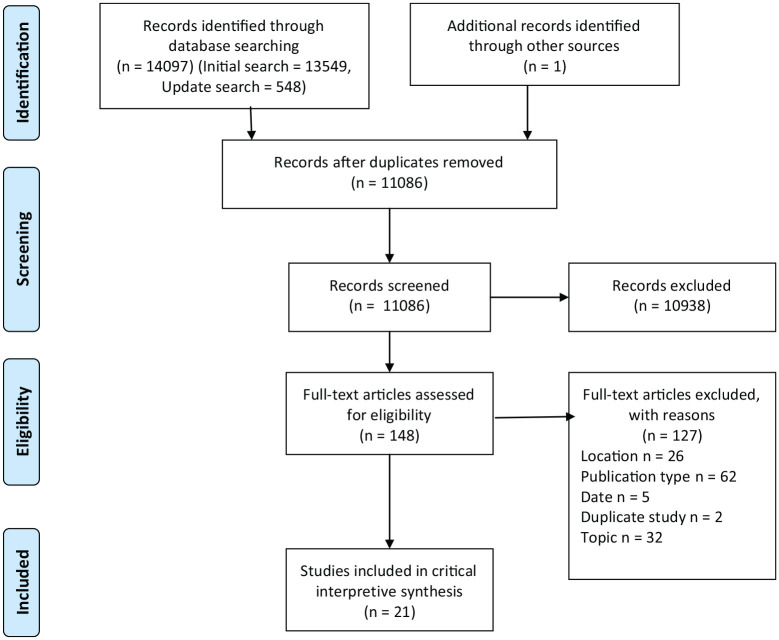
Systematic review of post-2000 research according to PRISMA guidelines. Data were subjected to critical interpretive synthesis. International, national and sub-national barriers were organised developing a conceptual framework of opioid availability.
PsycINFO, Medline, Embase, The Cochrane Library. CINAHL, Complete and ASSIA from 2000 until 20th May 2019.
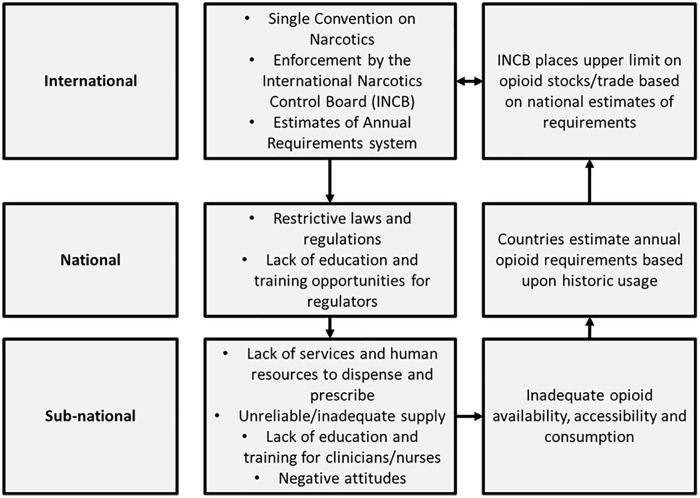
21/14097 studies included: quantitative = 15, qualitative = 3 and mixed-methods = 3. Four barrier/enabler themes were developed: lack of laws explicitly enabling opioid access, restrictive international controls and clinician prescribing concerns. limited availability, poor policymaker and clinician education regarding opioid benefits, poor continuity of supply. medicine costs, distance to prescribing centres. extensive bureaucratic barriers, lack of human resources for prescribing. We present a novel framework of a self-perpetuating model of inadequate opioid provision. The Single Convention on Narcotics provides the context of restrictive laws and negative attitudes amongst policymakers. A consequent lack of prescribers and clinicians' negative attitudes at sub-national levels, results in inadequate access to and use of opioids. Data of inadequate consumption informs annual requirement estimates used by the International Narcotics Control Board to determine future opioid availability.
Regulatory and socio-political actions unintentionally limit opioid access. International and national laws explicitly enabling opioid access are required, to assuage concerns, promote training and appropriate prescribing.
阿片类药物是基本药物。尽管国际和国家法律允许其供应,但阿片类药物的可及性仍然不足,尤其是在南亚、东南亚、东亚和中亚地区。
回顾关于南亚、东南亚、东亚和中亚地区阿片类药物获取的监管促进因素和障碍的认知及经验证据。
根据PRISMA指南对2000年后的研究进行系统综述。数据进行批判性解释性综合分析。按照阿片类药物可及性的概念框架,梳理国际、国家和次国家级层面的障碍。
2000年至2019年5月20日期间的PsycINFO、Medline、Embase、Cochrane图书馆、CINAHL、Complete和ASSIA。
纳入21项/14097项研究:定量研究=15项,定性研究=3项,混合方法研究=3项。确定了四个障碍/促进因素主题:缺乏明确允许阿片类药物获取的法律、严格的国际管控和临床医生处方顾虑;可及性有限、政策制定者和临床医生对阿片类药物益处的教育不足、供应连续性差;药品成本、到开处方中心的距离;广泛的官僚障碍、缺乏开处方的人力资源。我们提出了一个阿片类药物供应不足的自我延续模型的新框架。《麻醉品单一公约》提供了限制性法律背景以及政策制定者的负面态度。随之而来的是次国家级层面开处方者的缺乏和临床医生的负面态度,导致阿片类药物的获取和使用不足。消费不足的数据为国际麻醉品管制局用于确定未来阿片类药物可及性的年度需求估计提供依据。
监管及社会政治行动无意地限制了阿片类药物的获取。需要国际和国家法律明确允许阿片类药物获取,以缓解顾虑、促进培训和合理处方。