Mirani Shahid H, Areja Dharmoon, Gilani Syeda Suman, Tahir Amber, Pathan Murk, Bhatti Suman
Surgery, Ghulam Mohammad Mahar Medical College and Hospital, Sukkur, PAK.
Surgery, Ghulam Muhammad Mahar Medical College and Hospital, Sukkur, PAK.
Cureus. 2019 Feb 26;11(2):e4141. doi: 10.7759/cureus.4141.
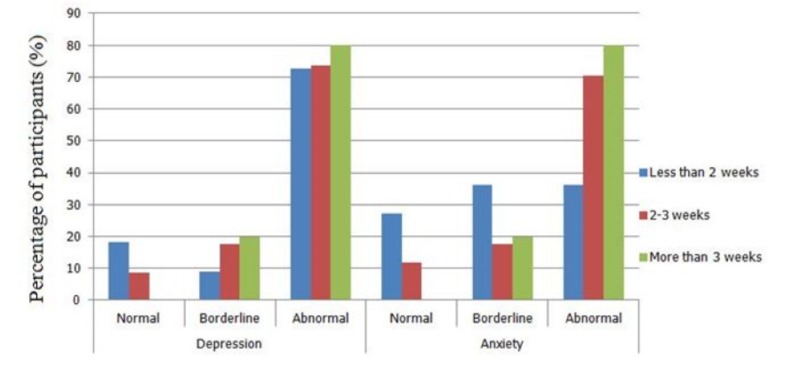
Background Patients hospitalized for surgeries and those with chronic remitting health conditions develop hospital-induced anxiety and depression. Unfamiliar hospital environment, insufficient privacy, exposure to strange instruments, financial concerns, disease stress, and prolonged hospital stay contribute to this anxiety. The aim of this study was to assess the frequency of depression and anxiety in surgical patients. Material and methods This observational study was conducted among 50 patients hospitalized for 10 days or more in the surgical unit. All patients completed the Hospital Anxiety and Depression Scale (HADS). It has seven items for anxiety and depression each. Each item scores 0-3. A subscale score >8 denotes anxiety or depression. Data were entered and analyzed using SPSS v.20. Mean and standard deviation (SD) were calculated for descriptive data, and frequencies and percentages were calculated for categorical data. Results On the HADS, the mean ± SD score of anxiety was 11.84 ± 4.16 and that of depression was 12.78 ± 4.16. There were 64% severely anxious and 74% severely depressed hospitalized patients. More patients with less than two weeks of hospital stay were severely depressed than severely anxious (72.7% vs. 36.3%). There were 20% patients with moderate anxiety and depression with hospital stay longer than three weeks and 80% with severe anxiety and depression. Conclusion There is a high incidence of anxiety and depression in surgical patients. Patients at risk of developing these symptoms must be identified and psychological care should be provided to them.
背景 因手术住院的患者以及患有慢性缓解性健康状况的患者会产生医院引发的焦虑和抑郁。陌生的医院环境、隐私不足、接触陌生器械、经济担忧、疾病压力以及住院时间延长都会导致这种焦虑。本研究的目的是评估外科手术患者中抑郁和焦虑的发生率。
材料与方法 本观察性研究在外科病房住院10天或更长时间的50名患者中进行。所有患者均完成了医院焦虑抑郁量表(HADS)。该量表焦虑和抑郁各有七个项目。每个项目的得分是0 - 3分。分量表得分>8表示焦虑或抑郁。使用SPSS v.20录入和分析数据。描述性数据计算均值和标准差(SD),分类数据计算频率和百分比。
结果 在HADS量表上,焦虑的平均±SD得分为11.84±4.16,抑郁的平均±SD得分为12.78±4.16。住院患者中64%有严重焦虑,74%有严重抑郁。住院时间少于两周的患者中,严重抑郁的比严重焦虑的更多(72.7%对36.3%)。住院时间超过三周的患者中,20%有中度焦虑和抑郁,80%有严重焦虑和抑郁。
结论 外科手术患者中焦虑和抑郁的发生率很高。必须识别有出现这些症状风险的患者,并为他们提供心理护理。