Hartl Markus, Schneider Rainer
Center of Molecular Biosciences (CMBI), Institute of Biochemistry, University of Innsbruck, Innsbruck, Austria.
Front Oncol. 2019 Apr 17;9:289. doi: 10.3389/fonc.2019.00289. eCollection 2019.
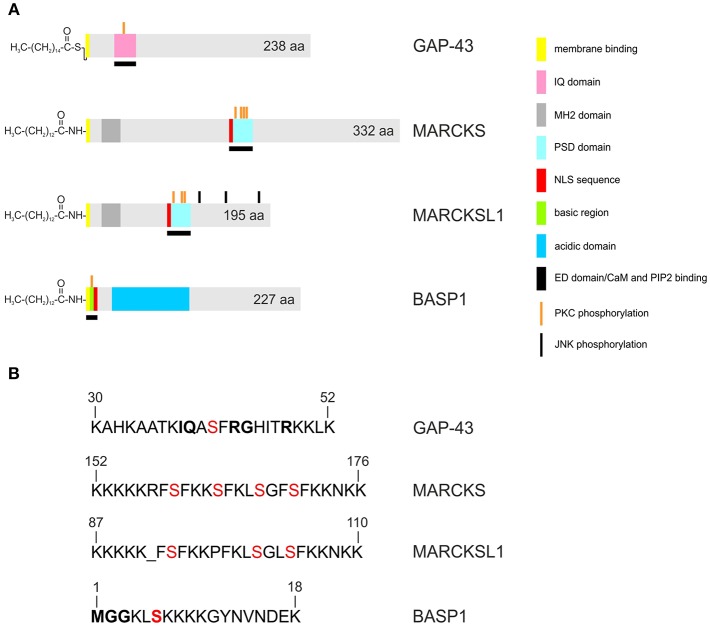
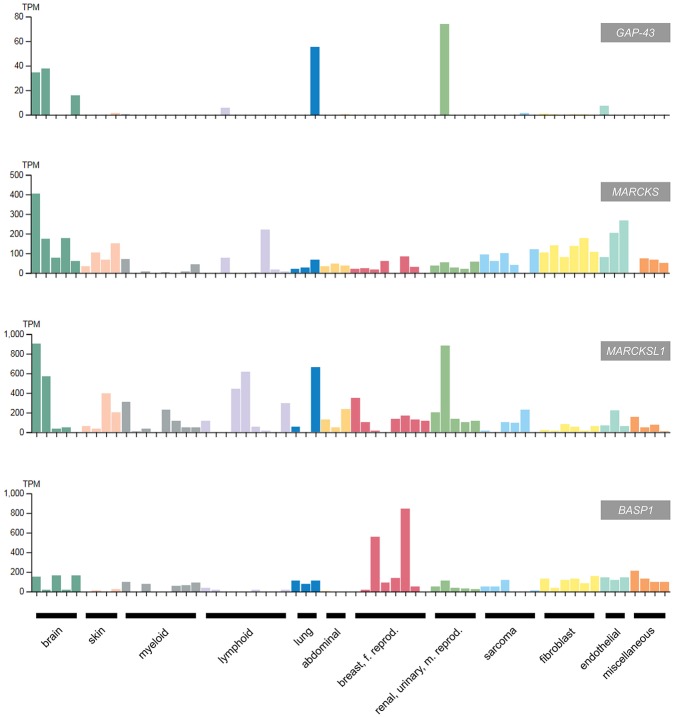
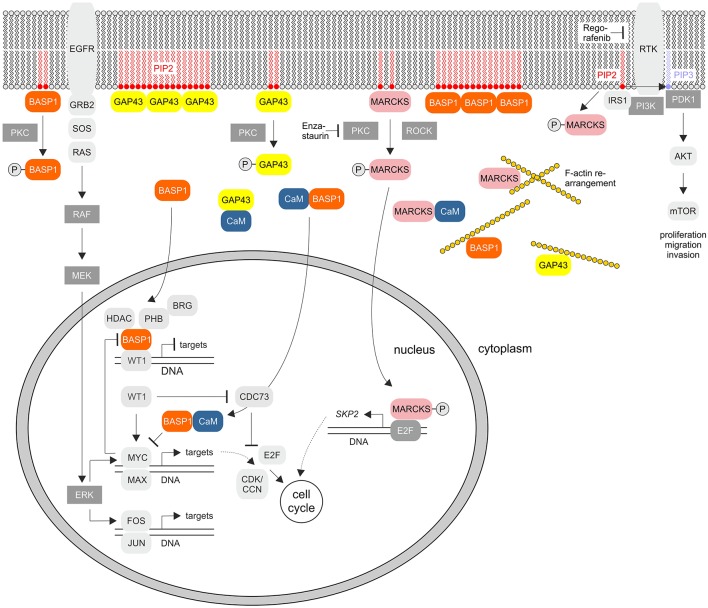
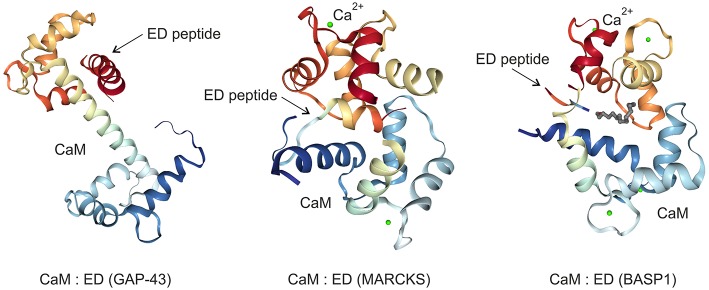
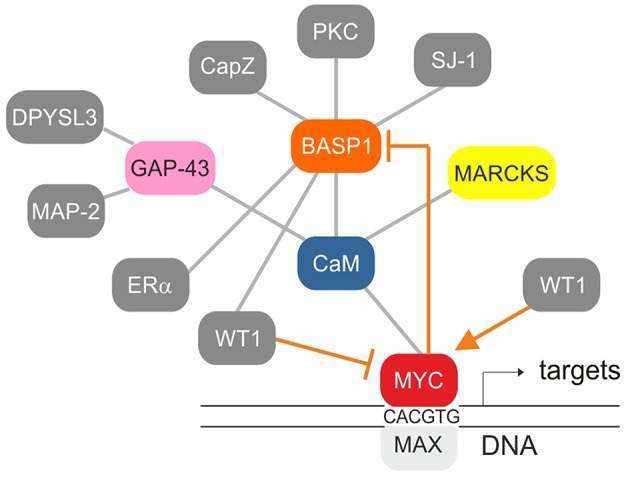
The neuronal proteins GAP43 (neuromodulin), MARCKS, and BASP1 are highly expressed in the growth cones of nerve cells where they are involved in signal transmission and cytoskeleton organization. Although their primary structures are unrelated, these signaling proteins share several structural properties like fatty acid modification, and the presence of cationic effector domains. GAP43, MARCKS, and BASP1 bind to cell membrane phospholipids, a process reversibly regulated by protein kinase C-phosphorylation or by binding to the calcium sensor calmodulin (CaM). GAP43, MARCKS, and BASP1 are also expressed in non-neuronal cells, where they may have important functions to manage cytoskeleton architecture, and in case of MARCKS and BASP1 to act as cofactors in transcriptional regulation. During neoplastic cell transformation, the proteins reveal differential expression in normal vs. tumor cells, and display intrinsic tumor promoting or tumor suppressive activities. Whereas GAP43 and MARCKS are oncogenic, tumor suppressive functions have been ascribed to BASP1 and in part to MARCKS depending on the cell type. Like MARCKS, the myristoylated BASP1 protein is localized both in the cytoplasm and in the cell nucleus. Nuclear BASP1 participates in gene regulation converting the Wilms tumor transcription factor WT1 from an oncoprotein into a tumor suppressor. The gene is downregulated in many human tumor cell lines particularly in those derived from leukemias, which display elevated levels of WT1 and of the major cancer driver MYC. BASP1 specifically inhibits MYC-induced cell transformation in cultured cells. The tumor suppressive functions of BASP1 and MARCKS could be exploited to expand the spectrum of future innovative therapeutic approaches to inhibit growth and viability of susceptible human tumors.
神经元蛋白GAP43(神经调节蛋白)、MARCKS和BASP1在神经细胞的生长锥中高度表达,它们参与信号传递和细胞骨架组织。尽管它们的一级结构不相关,但这些信号蛋白具有一些共同的结构特性,如脂肪酸修饰以及阳离子效应结构域的存在。GAP43、MARCKS和BASP1与细胞膜磷脂结合,这一过程可通过蛋白激酶C磷酸化或与钙传感器钙调蛋白(CaM)结合进行可逆调节。GAP43、MARCKS和BASP1也在非神经元细胞中表达,在这些细胞中它们可能在管理细胞骨架结构方面具有重要功能,就MARCKS和BASP1而言,它们还可作为转录调节的辅助因子。在肿瘤细胞转化过程中,这些蛋白在正常细胞与肿瘤细胞中表现出差异表达,并具有内在的肿瘤促进或肿瘤抑制活性。GAP43和MARCKS具有致癌性,而BASP1具有肿瘤抑制功能,MARCKS的肿瘤抑制功能则部分取决于细胞类型。与MARCKS一样,肉豆蔻酰化的BASP1蛋白定位于细胞质和细胞核中。核BASP1参与基因调控,将威尔姆斯肿瘤转录因子WT1从一种癌蛋白转化为肿瘤抑制因子。该基因在许多人类肿瘤细胞系中下调,尤其是在源自白血病的细胞系中,这些细胞系中WT1和主要癌症驱动因子MYC的水平升高。BASP1在培养细胞中特异性抑制MYC诱导的细胞转化。BASP1和MARCKS的肿瘤抑制功能可用于拓展未来创新治疗方法的范围,以抑制易感人类肿瘤的生长和存活。