Department of Hepatobiliary Surgery, The Second Affiliated Hospital of Harbin Medical University, Harbin, Heilongjiang 150001, P.R. China.
Int J Oncol. 2019 Jul;55(1):45-58. doi: 10.3892/ijo.2019.4798. Epub 2019 May 6.
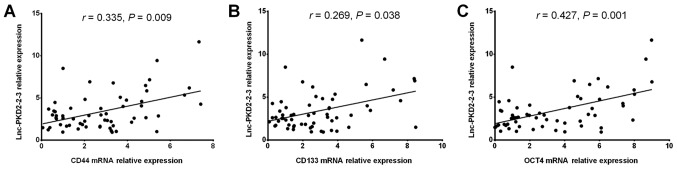
The present study aimed to explore the long non‑coding RNA (lncRNA) expression profiles and correlation of lnc‑PKD2‑2‑3 with tumor features and prognosis, and to investigate its effect on regulating cancer‑cell stemness and its potential as a cancer stem cell (CSC) marker in cholangiocarcinoma (CCA). lncRNA expression profiles were determined in 3 pairs of CCA tumors and adjacent tissues by microarray analysis, and lnc‑PKD2‑2‑3 expression was then validated in 60 paired samples by reverse transcription‑quantitative polymerase chain reaction (RT‑qPCR). Expression of common CSC markers [(CD44, CD133 and octamer‑binding transcription factor 4 (OCT4)], CD44+CD133+ cell proportions, sphere formation efficiency and drug resistance to 5‑fluorouracil (5‑FU) were measured following ectopic overexpression of lnc‑PKD2‑2‑3 or silencing via small hairpin RNA lentivirus transfection into the TFK‑1 and Huh‑28 CCA cell lines. Finally, lnc‑PKD2‑2‑3 expression was measured in CCA stem‑like cells and normal CCA cells. The results from the microarray analysis identified a total of 4,223 upregulated and 4,596 downregulated lncRNAs between CCA tumor tissue and paired adjacent tissue, which were enriched in regulating cancer‑associated pathways. RT‑qPCR validation revealed that lnc‑PKD2‑2‑3 was upregulated in CCA and associated with a higher Eastern Cooperative Oncology Group performance score, poor differentiation, advanced TNM stage, increased carcinoembryonic antigen and poor overall survival in CCA patients. In vitro, lnc‑PKD2‑2‑3 increased CD44, CD133 and OCT4 expression as well as the CD44+CD133+ cell proportion, raised the sphere formation efficiency and enhanced drug resistance to 5‑FU in TFK‑1 and Huh‑28 cells. In addition, lnc‑PKD2‑2‑3 was positively correlated with CSC markers in CCA tumor tissues and was markedly upregulated in CCA stem‑like cells compared with that in normal CCA cells. In conclusion, lnc‑PKD2‑2‑3, selected by lncRNA expression profiling, was associated with pejorative tumor features and poor prognosis, enhanced cancer stemness and may serve as a CSC marker in CCA.
本研究旨在探讨长链非编码 RNA(lncRNA)表达谱与 lnc-PKD2-2-3 与肿瘤特征和预后的相关性,并研究其对调节肿瘤细胞干性的影响及其作为胆管癌(CCA)癌干细胞(CSC)标志物的潜力。通过微阵列分析确定了 3 对 CCA 肿瘤组织和相邻组织中的 lncRNA 表达谱,然后通过逆转录-定量聚合酶链反应(RT-qPCR)验证了 60 对配对样本中的 lnc-PKD2-2-3 表达。通过外源性过表达 lnc-PKD2-2-3 或通过小发夹 RNA 慢病毒转染到 TFK-1 和 Huh-28 CCA 细胞系中沉默,测量了常见 CSC 标志物[(CD44、CD133 和八聚体结合转录因子 4(OCT4)]、CD44+CD133+细胞比例、球体形成效率和对 5-氟尿嘧啶(5-FU)的耐药性。最后,在 CCA 干性样细胞和正常 CCA 细胞中测量了 lnc-PKD2-2-3 的表达。微阵列分析的结果总共鉴定出 4223 个上调和 4596 个下调的 lncRNA 之间 CCA 肿瘤组织和配对相邻组织,这些 lncRNA 富集在调节癌症相关途径中。RT-qPCR 验证显示,lnc-PKD2-2-3 在 CCA 中上调,与更高的东部合作肿瘤学组表现评分、分化不良、晚期 TNM 分期、癌胚抗原升高和 CCA 患者总体生存不良相关。在体外,lnc-PKD2-2-3 增加了 TFK-1 和 Huh-28 细胞中的 CD44、CD133 和 OCT4 表达以及 CD44+CD133+细胞比例,提高了球体形成效率,并增强了对 5-FU 的耐药性。此外,lnc-PKD2-2-3 与 CCA 肿瘤组织中的 CSC 标志物呈正相关,并且在 CCA 干性样细胞中明显上调,与正常 CCA 细胞相比。总之,通过 lncRNA 表达谱选择的 lnc-PKD2-2-3 与不良肿瘤特征和预后不良相关,增强了癌症干性,可能作为 CCA 的 CSC 标志物。