School of Nursing and Midwifery, Western Sydney University, Ingham Institute for Applied Medical Research, Liverpool, New South Wales, Australia.
Sydney Local Health District, Camperdown, New South Wales, Australia.
PLoS One. 2019 May 6;14(5):e0215371. doi: 10.1371/journal.pone.0215371. eCollection 2019.
Home visiting programs are implemented in high income countries to improve outcomes for families with young children. Significant resources are invested in such programs and high quality evaluations are important. In the context of research trials, implementation quality is often poorly reported and, when reported, is variable. This paper presents the quality of implementation of the right@home program, a sustained nurse home visiting intervention trialled in Australia, and delivered in a 'real world' context through usual child and family health services. right@home is structured around the core Maternal Early Childhood Sustained Home-visiting (MECSH) program, which is a salutogenic, child focused prevention model.
At each visit right@home practitioners completed a checklist detailing the client unique identifier, date of contact and activities undertaken. These checklists were collated to provide data on intervention dose, retention to program completion at child age 2 years, and visit content, which were compared with the program schedule. Quality of family-provider relationship was measured using the Session Rating Scale. Exploratory factor analysis was conducted to identify clusters of activities and allow qualitative assessment of concordance between program aims and program delivery.
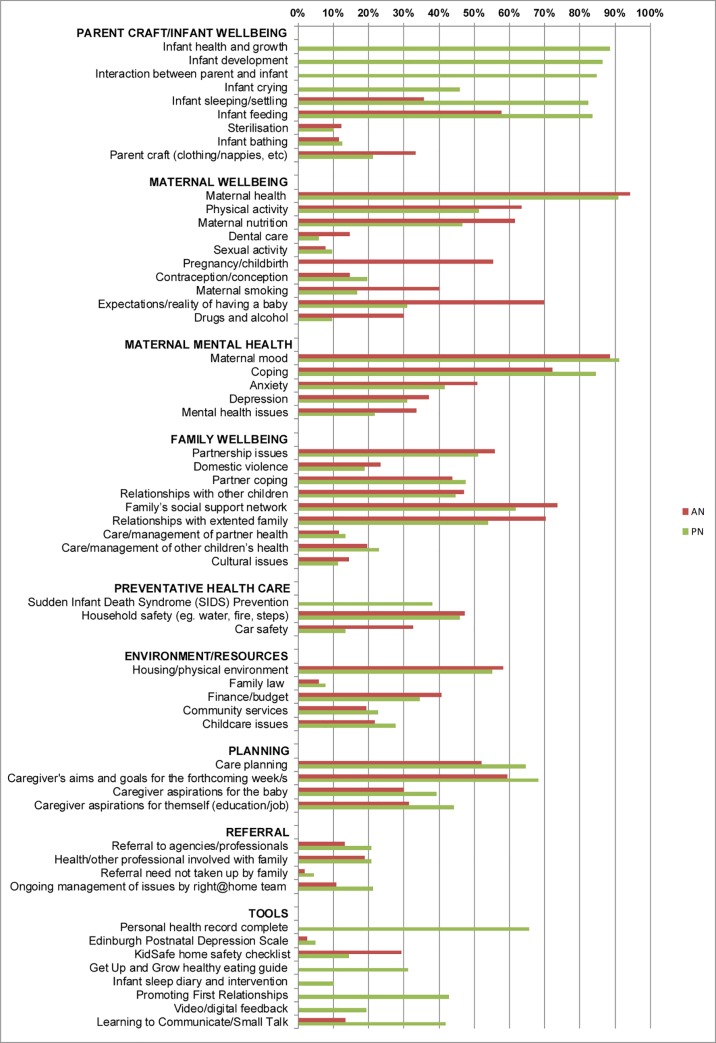
Of 363 intervention families offered the program, 352 (97·0%) commenced the program and 304 (87·3%) completed the program to child age 2 years. 253 of 352 (71·9%) families who commenced the program received more than 75 percent of scheduled visits including at least one antenatal visit. Families rated the participant-practitioner relationship highly (mean 39.4/40). The factor analysis identified six antenatal and six postnatal components which were concordant with the program aims.
The right@home program was delivered with higher adherence to program dose, schedule and content, and retention than usually reported in other home visiting research. Program compliance may have resulted from program design (visit schedule, dose, content and delivery flexibility) that was consistent with family aims.
家庭访视计划在高收入国家实施,以改善有幼儿的家庭的结果。此类计划投入了大量资源,因此高质量的评估至关重要。在研究试验的背景下,实施质量通常报道不足,即使有报道,也存在差异。本文介绍了 right@home 计划的实施质量,该计划是在澳大利亚进行的一项持续的护士家庭访视干预措施,通过常规的儿童和家庭健康服务在“真实世界”环境中提供。right@home 以核心母婴持续家庭访视(MECSH)计划为基础,该计划是一种健康促进、以儿童为中心的预防模式。
每次访视时,right@home 的从业者都会填写一份检查表,详细说明客户的唯一标识符、联系日期和所开展的活动。这些检查表被汇总起来,提供干预剂量的数据、儿童 2 岁时完成方案的保留率以及访视内容,并与方案时间表进行比较。家庭与提供者关系的质量使用会话评分量表进行测量。进行探索性因子分析以确定活动群集,并允许对方案目标与方案交付之间的一致性进行定性评估。
在 363 个接受该方案的干预家庭中,有 352 个(97.0%)开始了该方案,有 304 个(87.3%)完成了该方案,直到儿童 2 岁。在开始该方案的 352 个家庭中,有 253 个(71.9%)家庭接受了超过 75%的预约访视,包括至少一次产前访视。家庭对参与者与从业者的关系评价很高(平均 39.4/40)。因子分析确定了六个产前和六个产后组成部分,与方案目标一致。
right@home 方案的实施与其他家庭访视研究中通常报道的剂量、时间表和内容以及保留率相比,具有更高的一致性。方案的合规性可能源于与家庭目标一致的方案设计(访视时间表、剂量、内容和交付灵活性)。