Department of Radiology, The First Affiliated Hospital of Wenzhou Medical University, Wenzhou, Zhejiang 325000, China.
Department of Radiology, The Second Affiliated Hospital of Wenzhou Medical University, Wenzhou, Zhejiang 325000, China.
EBioMedicine. 2019 May;43:454-459. doi: 10.1016/j.ebiom.2019.04.040. Epub 2019 May 3.
Spontaneous intracerebral hemorrhage (ICH) is a devastating disease with high mortality rate. This study aimed to predict hematoma expansion in spontaneous ICH from routinely available variables by using support vector machine (SVM) method.
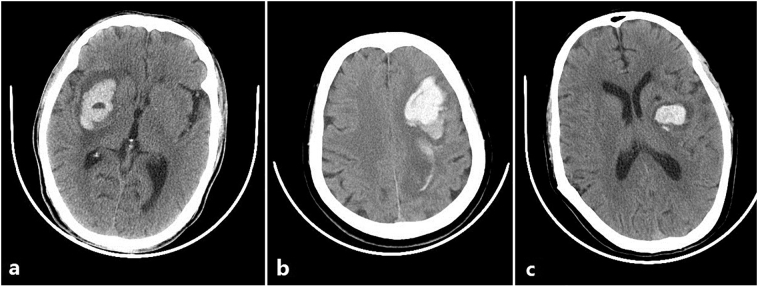
We retrospectively reviewed 1157 patients with spontaneous ICH who underwent initial computed tomography (CT) scan within 6 h and follow-up CT scan within 72 h from symptom onset in our hospital between September 2013 and August 2018. Hematoma region was manually segmented at each slice to guarantee the measurement accuracy of hematoma volume. Hematoma expansion was defined as a proportional increase of hematoma volume > 33% or an absolute growth of hematoma volume > 6 mL from initial CT scan to follow-up CT scan. Univariate and multivariate analyses were performed to assess the association between clinical variables and hematoma expansion. SVM machine learning model was developed to predict hematoma expansion.
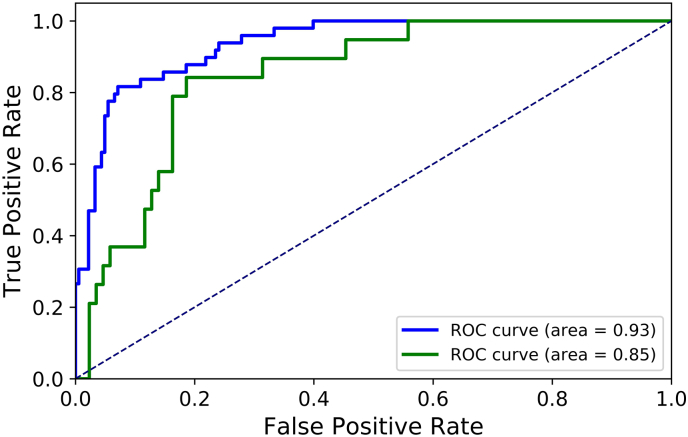
246 of 1157 (21.3%) patients experienced hematoma expansion. Multivariate analyses revealed the following 6 independent factors associated with hematoma expansion: male patient (odds ratio [OR] = 1.82), time to initial CT scan (OR = 0.73), Glasgow Coma Scale (OR = 0.86), fibrinogen level (OR = 0.72), black hole sign (OR = 2.52), and blend sign (OR = 4.03). The SVM model achieved a mean sensitivity of 81.3%, specificity of 84.8%, overall accuracy of 83.3%, and area under receiver operating characteristic curve (AUC) of 0.89 in prediction of hematoma expansion.
The designed SVM model presented good performance in predicting hematoma expansion from routinely available variables. FUND: This work was supported by Health Foundation for Creative Talents in Zhejiang Province, China, Natural Science Foundation of Zhejiang Province, China (LQ15H180002), the Science and Technology Planning Projects of Wenzhou, China (Y20180112), Scientific Research Staring Foundation for the Returned Overseas Chinese Scholars of Ministry of Education of China, and Project Foundation for the College Young and Middle-aged Academic Leader of Zhejiang Province, China. The funders had no role in study design, data collection, data analysis, interpretation, writing of the report.
自发性脑出血(ICH)是一种死亡率很高的破坏性疾病。本研究旨在通过支持向量机(SVM)方法,利用常规可获得的变量预测自发性 ICH 的血肿扩大。
我们回顾性分析了 2013 年 9 月至 2018 年 8 月期间在我院接受发病后 6 小时内首次 CT 扫描和发病后 72 小时内随访 CT 扫描的 1157 例自发性 ICH 患者。在每个层面上手动分割血肿区域,以保证血肿体积测量的准确性。血肿扩大定义为初始 CT 扫描至随访 CT 扫描的血肿体积比例增加>33%或绝对增长>6mL。进行单变量和多变量分析以评估临床变量与血肿扩大之间的关系。采用支持向量机机器学习模型预测血肿扩大。
1157 例患者中有 246 例(21.3%)发生血肿扩大。多变量分析显示以下 6 个独立因素与血肿扩大相关:男性患者(比值比[OR] 1.82)、首次 CT 扫描时间(OR 0.73)、格拉斯哥昏迷量表(OR 0.86)、纤维蛋白原水平(OR 0.72)、黑洞征(OR 2.52)和混合征(OR 4.03)。SVM 模型预测血肿扩大的平均敏感度为 81.3%,特异性为 84.8%,总准确率为 83.3%,受试者工作特征曲线下面积(AUC)为 0.89。
设计的 SVM 模型在预测常规变量血肿扩大方面具有良好的性能。
本研究得到浙江省卫生创新人才项目、浙江省自然科学基金项目(LQ15H180002)、温州市科技计划项目(Y20180112)、教育部留学回国人员科研启动基金和浙江省高校中青年学术带头人项目资助。资助者在研究设计、数据收集、数据分析、解释和报告撰写方面没有作用。