University of Cologne, Faculty of Medicine and University Hospital Cologne, Institute of Radiochemistry and Experimental Molecular Imaging, Kerpener Str. 62, 50937 Köln, Germany.
Max Planck Institute for Metabolism Research, Department of In-vivo NMR, Gleueler Str. 50, 50931 Köln, Germany.
Dis Model Mech. 2019 May 24;12(5):dmm039065. doi: 10.1242/dmm.039065.
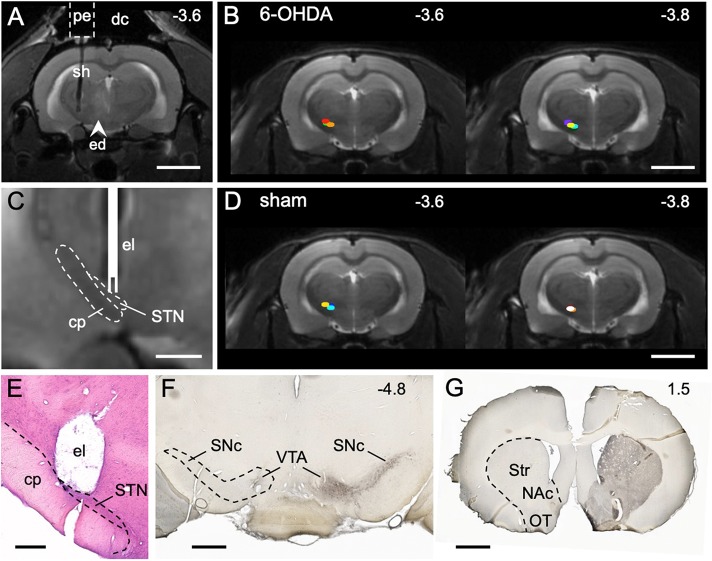
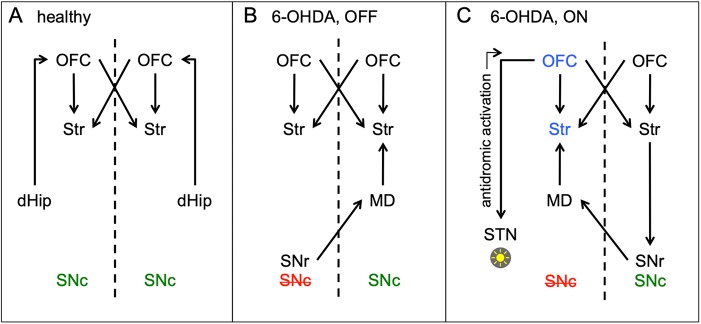
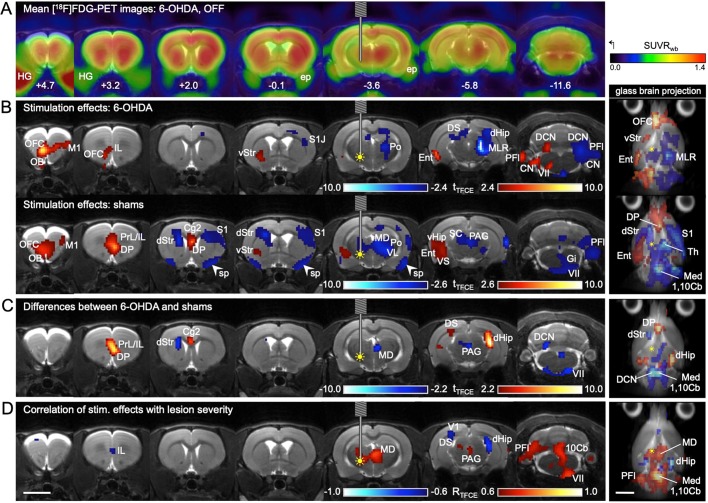
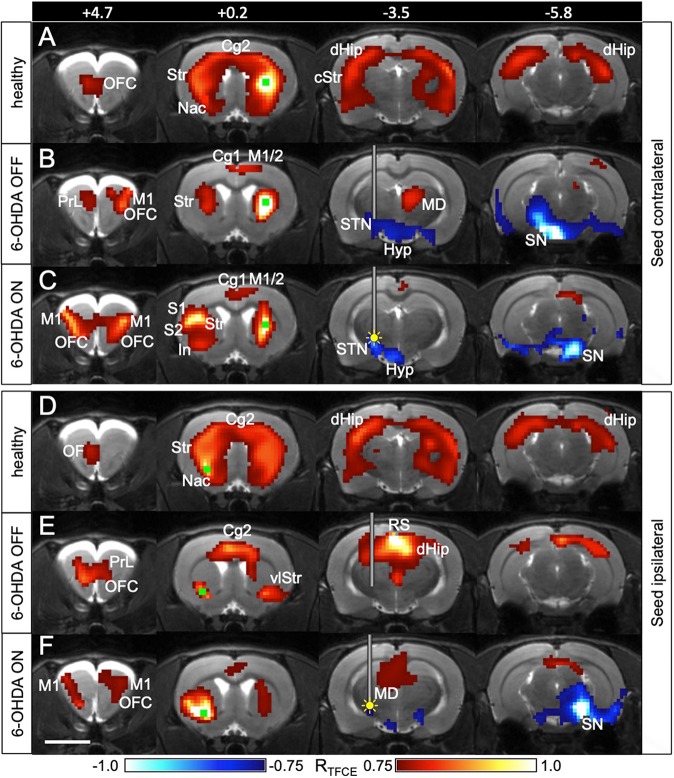
Deep brain stimulation (DBS) in the subthalamic nucleus (STN) has been successfully used for the treatment of advanced Parkinson's disease, although the underlying mechanisms are complex and not well understood. There are conflicting results about the effects of STN-DBS on neuronal activity of the striatum, and its impact on functional striatal connectivity is entirely unknown. We therefore investigated how STN-DBS changes cerebral metabolic activity in general and striatal connectivity in particular. We used ipsilesional STN stimulation in a hemiparkinsonian rat model in combination with [F]FDOPA-PET, [F]FDG-PET and metabolic connectivity analysis. STN-DBS reversed ipsilesional hypometabolism and contralesional hypermetabolism in hemiparkinsonian rats by increasing metabolic activity in the ipsilesional ventrolateral striatum and by decreasing it in the contralesional hippocampus and brainstem. Other STN-DBS effects were subject to the magnitude of dopaminergic lesion severity measured with [F]FDOPA-PET, e.g. activation of the infralimbic cortex was negatively correlated to lesion severity. Connectivity analysis revealed that, in healthy control animals, left and right striatum formed a bilateral functional unit connected by shared cortical afferents, which was less pronounced in hemiparkinsonian rats. The healthy striatum was metabolically connected to the ipsilesional substantia nigra in hemiparkinsonian rats only (OFF condition). STN-DBS (ON condition) established a new functional striatal network, in which interhemispheric striatal connectivity was strengthened, and both the dopamine-depleted and the healthy striatum were functionally connected to the healthy substantia nigra. We conclude that both unilateral dopamine depletion and STN-DBS affect the whole brain and alter complex interhemispheric networks.
深部脑刺激(DBS)在丘脑底核(STN)中的应用已成功用于治疗晚期帕金森病,尽管其潜在机制复杂且尚未完全了解。关于 STN-DBS 对纹状体神经元活动的影响存在相互矛盾的结果,其对功能性纹状体连接的影响完全未知。因此,我们研究了 STN-DBS 如何总体上改变大脑代谢活性,特别是纹状体连接。我们在半帕金森大鼠模型中使用同侧 STN 刺激结合 [F]FDOPA-PET、[F]FDG-PET 和代谢连接性分析。STN-DBS 通过增加同侧腹外侧纹状体的代谢活性并降低对侧海马体和脑干的代谢活性,逆转了半帕金森大鼠的同侧代谢不足和对侧代谢过度。其他 STN-DBS 效应取决于 [F]FDOPA-PET 测量的多巴胺能损伤严重程度,例如,扣带前皮质的激活与损伤严重程度呈负相关。连接性分析显示,在健康对照动物中,左、右纹状体形成一个由共享皮质传入连接的双侧功能单元,而在半帕金森大鼠中则不那么明显。在健康大鼠中,只有在半帕金森大鼠(OFF 状态)中,同侧纹状体与同侧黑质之间存在代谢连接。STN-DBS(ON 状态)建立了一个新的功能性纹状体网络,其中半球间纹状体连接得到加强,并且多巴胺耗竭和健康纹状体都与健康黑质具有功能性连接。我们得出结论,单侧多巴胺耗竭和 STN-DBS 都会影响整个大脑并改变复杂的半球间网络。