Grant Azure D, Wolf Gary I
The Helen Wills Neuroscience Institute, University of California, Berkeley, US.
Hanze University of Applied Sciences, Groningen, NL.
J Circadian Rhythms. 2019 Apr 24;17:3. doi: 10.5334/jcr.178.
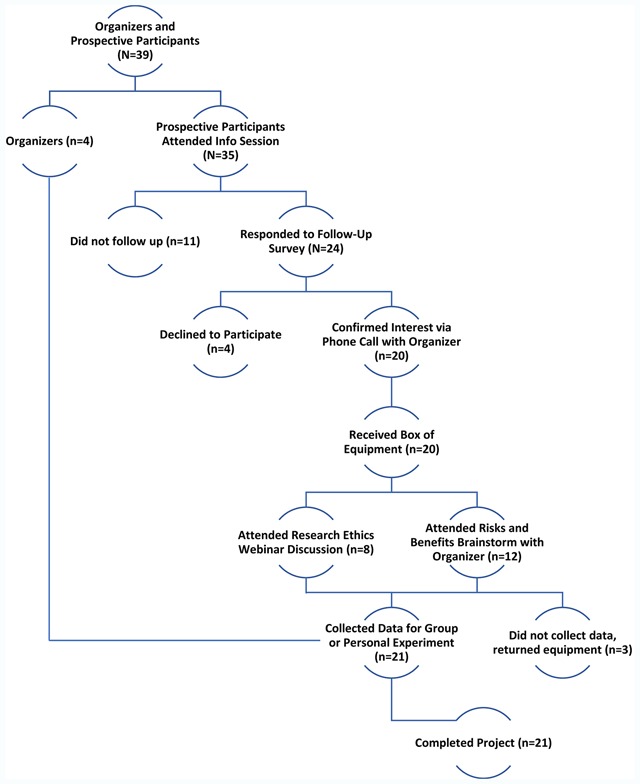
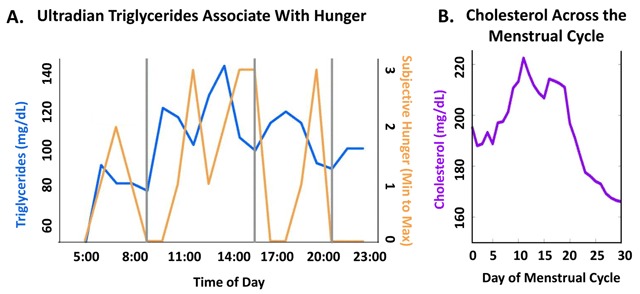
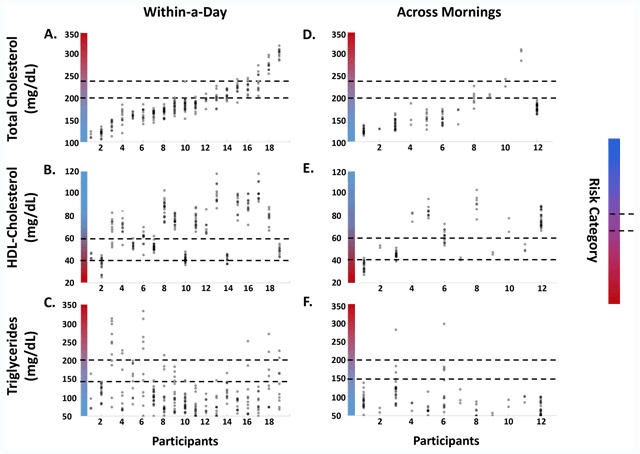
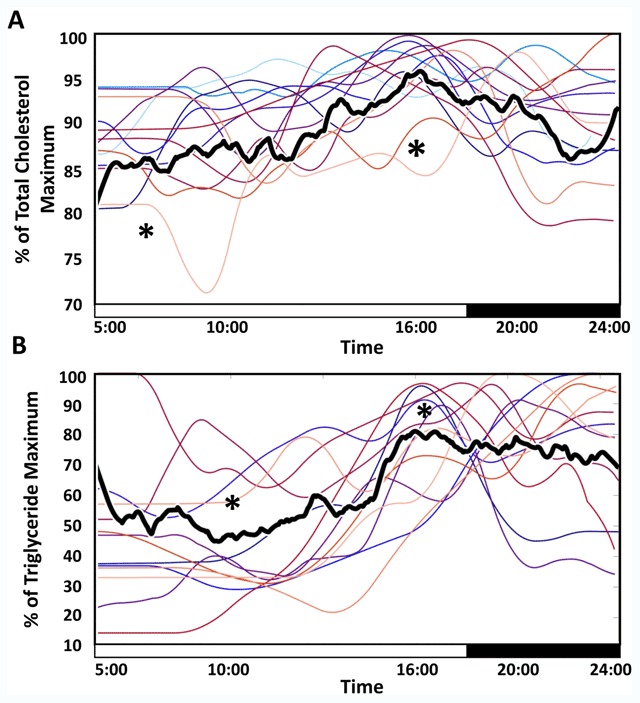
Cardiovascular disease risk assessment relies on single time-point measurement of risk factors. Although significant daily rhythmicity of some risk factors (e.g., blood pressure and blood glucose) suggests that carefully timed samples or biomarker timeseries could improve risk assessment, such rhythmicity in risk factors is not well understood in free-living humans. As recent advances in at-home blood testing permit lipid data to be frequently and reliably self-collected during daily life, we hypothesized that total cholesterol, HDL-cholesterol or triglycerides would show significant time-of-day variability under everyday conditions. To address this hypothesis, we worked with data collected by 20 self-trackers during personal projects. The dataset consisted of 1,319 samples of total cholesterol, HDL-cholesterol and triglycerides, and comprised timeseries illustrating intra and inter-day variability. All individuals crossed at least one risk category in at least one output within a single day. 90% of fasted individuals (n = 12) crossed at least one risk category in one output during the morning hours alone (06:00-08:00) across days. Both individuals and the aggregated group show significant, rhythmic change by time of day in total cholesterol and triglycerides, but not HDL-cholesterol. Two individuals collected additional data sufficient to illustrate ultradian (hourly) fluctuation in triglycerides, and total cholesterol fluctuation across the menstrual cycle. Short-term variability of sufficient amplitude to affect diagnosis appears common. We conclude that cardiovascular risk assessment may be augmented via further research into the temporal dynamics of lipids. Some variability can be accounted for by a daily rhythm, but ultradian and menstrual rhythms likely contribute additional variance.
心血管疾病风险评估依赖于风险因素的单次时间点测量。尽管一些风险因素(如血压和血糖)存在显著的每日节律性,这表明精心定时采集样本或生物标志物时间序列可能会改善风险评估,但在自由生活的人群中,对这些风险因素的这种节律性还没有很好的理解。由于近期家庭血液检测技术的进步使得在日常生活中能够频繁且可靠地自行采集血脂数据,我们推测在日常条件下,总胆固醇、高密度脂蛋白胆固醇或甘油三酯会呈现出显著的每日时间变异性。为了验证这一假设,我们使用了20名自我追踪者在个人项目中收集的数据。该数据集包含1319个总胆固醇、高密度脂蛋白胆固醇和甘油三酯样本,并构成了说明日内和日间变异性的时间序列。所有个体在一天内至少有一个输出结果跨越了至少一个风险类别。90%的禁食个体(n = 12)仅在早晨时段(06:00 - 08:00)的一次输出结果中就跨越了至少一个风险类别。个体和总体组在总胆固醇和甘油三酯方面均呈现出显著的每日节律性变化,但高密度脂蛋白胆固醇没有。两名个体收集了足够的数据以说明甘油三酯的超日(每小时)波动以及月经周期中总胆固醇的波动。足以影响诊断的短期变异性似乎很常见。我们得出结论,通过进一步研究血脂的时间动态,心血管风险评估可能会得到增强。一些变异性可由每日节律来解释,但超日节律和月经节律可能会导致额外的变异性。