van den Berg Rosa, Noordam Raymond, Kooijman Sander, Jansen Steffy W M, Akintola Abimbola A, Slagboom P Eline, Pijl Hanno, Rensen Patrick C N, Biermasz Nienke R, van Heemst Diana
Department of Medicine, Division of Endocrinology, Leiden University Medical Center.
Einthoven Laboratory for Experimental Vascular Medicine.
Aging Cell. 2017 Apr;16(2):237-243. doi: 10.1111/acel.12547. Epub 2016 Nov 19.
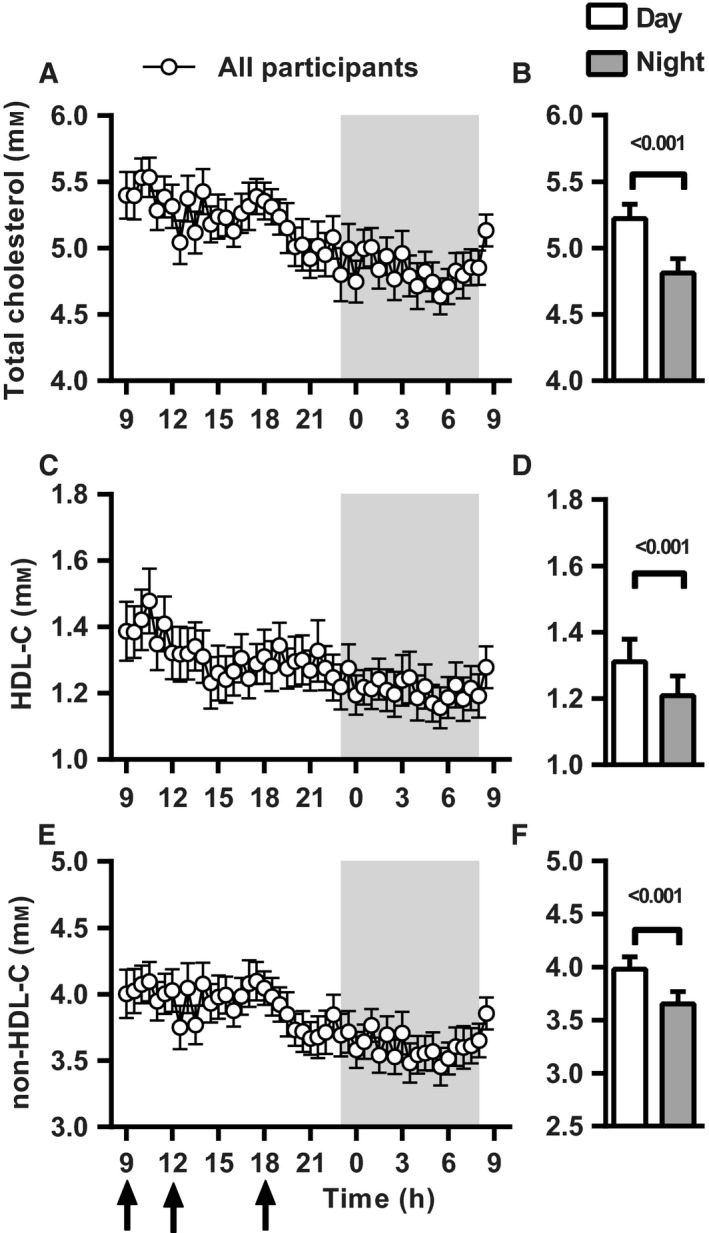
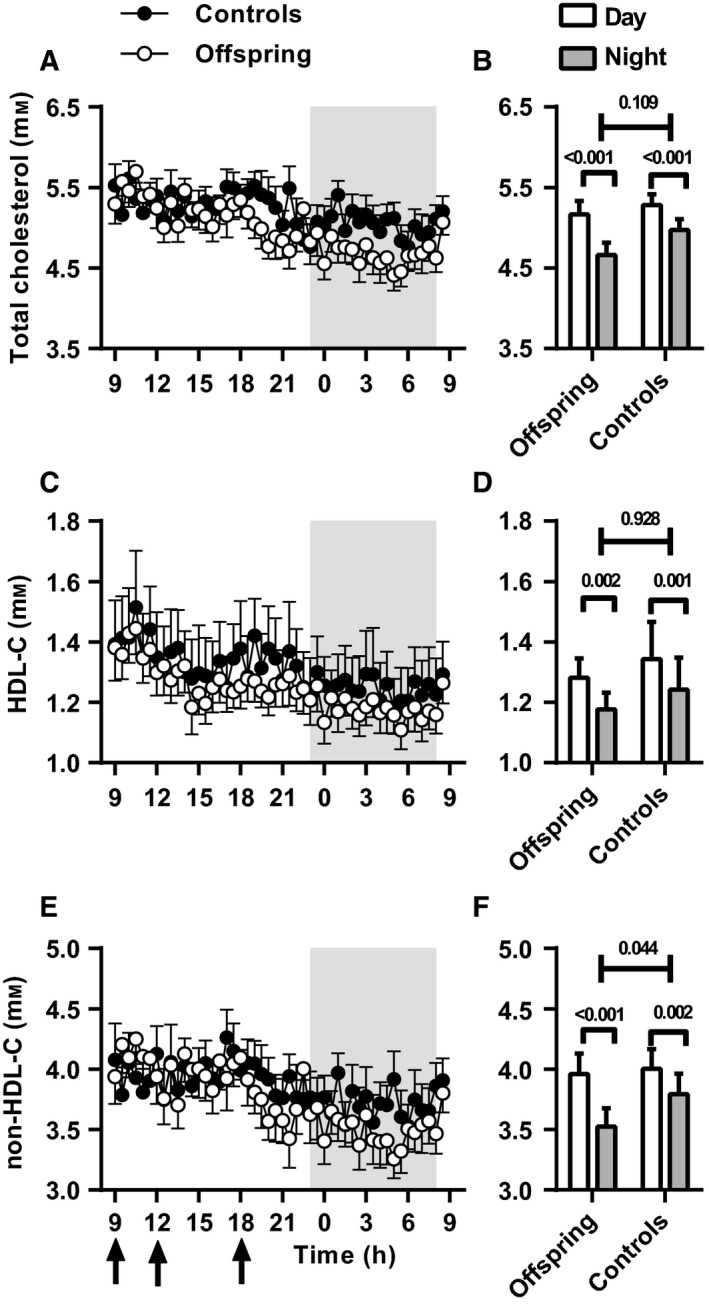
The biological clock, whose function deteriorates with increasing age, determines bodily circadian (i.e. 24h) rhythms, including that of cholesterol metabolism. Dampening of circadian rhythms has been associated with aging and disease. Therefore, we hypothesized that individuals with a familial predisposition for longevity have a higher amplitude circadian serum cholesterol concentration rhythm. The aim of this study was to investigate circadian rhythmicity of serum cholesterol concentrations in offspring of nonagenarian siblings and their partners. Offspring from nonagenarian siblings (n = 19), and their partners as controls (n = 18), were recruited from the Leiden Longevity Study. Participants (mean age 65 years) were studied in a controlled in-hospital setting over a 24-h period, receiving three isocaloric meals at 9:00 h, 12:00 h and 18:00 h. Lights were off between 23:00 h and 8:00 h. Serum total cholesterol (TC), HDL cholesterol (HDL-C), non-HDL-C and triglycerides (TG) were determined every 30 min over a 24-h period. Serum TC concentrations were higher during day than during night in offspring (5.2 vs. 4.7 mm, P < 0.001) and in controls (5.3 vs. 5.0 mm, P < 0.001). The difference in TC concentrations between day and night tended to be greater in offspring than in controls (0.5 vs. 0.3 mm, P = 0.109), reaching statistical significance in females (P = 0.045). Notably, the day-night serum differences in non-HDL-C were twofold greater in offspring than in controls (0.43 vs. 0.21 mm, P = 0.044) and most explicit in females (0.53 vs. 0.22, P = 0.078). We conclude that familial longevity is characterized by a high circadian rhythmicity of non-HDL-C in healthy elderly offspring from nonagenarian siblings.
生物钟决定身体的昼夜节律(即24小时节律),包括胆固醇代谢的节律,其功能会随着年龄增长而衰退。昼夜节律的减弱与衰老和疾病有关。因此,我们推测具有长寿家族倾向的个体具有更高幅度的昼夜血清胆固醇浓度节律。本研究的目的是调查非agenarian兄弟姐妹及其配偶的后代血清胆固醇浓度的昼夜节律性。从莱顿长寿研究中招募了非agenarian兄弟姐妹的后代(n = 19)及其作为对照的配偶(n = 18)。参与者(平均年龄65岁)在医院的受控环境中进行了24小时的研究,在9:00、12:00和18:00接受三餐等热量饮食。23:00至8:00熄灯。在24小时内每30分钟测定一次血清总胆固醇(TC)、高密度脂蛋白胆固醇(HDL-C)、非高密度脂蛋白胆固醇和甘油三酯(TG)。后代(5.2 vs. 4.7 mmol/L,P < 0.001)和对照组(5.3 vs. 5.0 mmol/L,P < 0.001)白天的血清TC浓度高于夜间。后代白天和夜间TC浓度的差异往往大于对照组(0.5 vs. 0.3 mmol/L,P = 0.109),在女性中达到统计学意义(P = 0.045)。值得注意的是,后代非高密度脂蛋白胆固醇的昼夜血清差异比对照组大两倍(0.43 vs. 0.21 mmol/L,P = 0.044),在女性中最为明显(0.53 vs. 0.22,P = 0.078)。我们得出结论,家族长寿的特征是来自非agenarian兄弟姐妹的健康老年后代中非高密度脂蛋白胆固醇具有较高的昼夜节律性。 (注:“nonagenarian”未找到准确对应中文,暂保留英文)