Department of Medical Oncology & Phase 1 Research Centre ASST-Monza, Via Pergolesi 33, 20900, Monza, Italy.
Unit of Clinical Pharmacology and Pharmacogenetics, Department of Clinical and Experimental Medicine, University of Pisa, Pisa, Italy.
Breast Cancer Res Treat. 2019 Aug;176(3):483-494. doi: 10.1007/s10549-019-05261-5. Epub 2019 May 7.
Agents targeting HR-positive, HER2-negative locally advanced or metastatic breast cancer have improved patient outcomes compared with conventional single-agent endocrine therapy. Currently, approved targeted agents include everolimus and three CDK4/6 inhibitors, palbociclib, ribociclib, and abemaciclib. Unlike the well-characterized and easily manageable safety profile of endocrine therapies, adverse events associated with targeted therapies are complex and potentially severe. Their prompt recognition and treatment, crucial for prolonged endocrine sensitivity and survival, may be challenging and requires a multidisciplinary effort and a good knowledge of drug interactions.
We reviewed the current evidence on the drug safety of targeted agents for metastatic breast cancer currently used in clinical practice in Italy, supported by the clinical experience of Italian oncologists with expertise in the field.
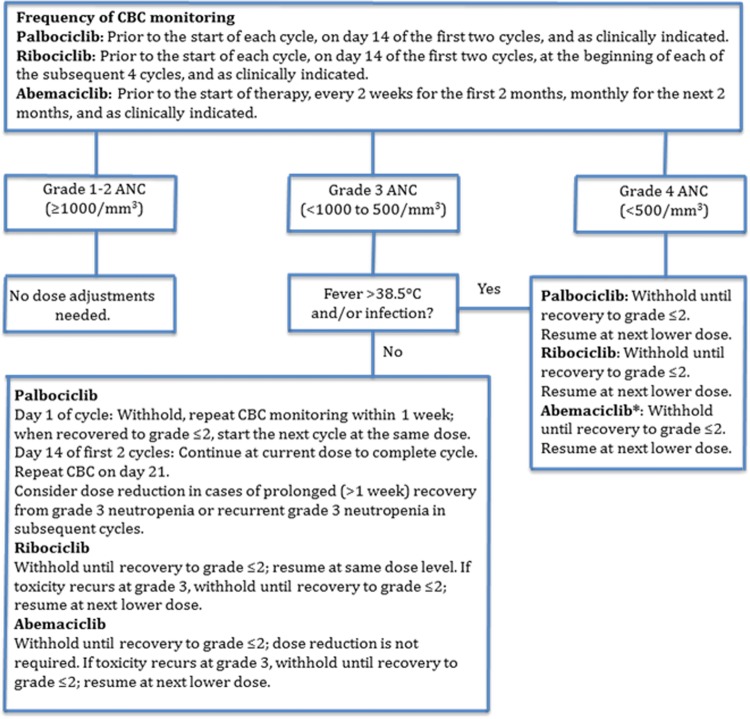
All oncologists had used CDK4/6 inhibitors in clinical practice and/or within a clinical trial. The clinical management of toxicities, including dose adjustments, treatment interruptions, and concerns regarding special populations is discussed, and the management of relevant adverse events, related to individual agents and class-specific, toxicities is reviewed. Hematologic toxicities have the greatest impact on clinical management of the disease and on patients. Although toxicities associated with the new treatments result in more visits to the physician and more time and attention with patients, they are manageable, with no need for the oncologist to consult with specialist physicians.
Based on the available evidence and current guidelines, we propose a series of practical recommendations for multidisciplinary clinical management of the various toxicities associated with the addition of targeted agents to endocrine therapy.
与传统的单一内分泌治疗相比,针对 HR 阳性、HER2 阴性局部晚期或转移性乳腺癌的药物能够改善患者的预后。目前,已批准的靶向药物包括依维莫司和三种 CDK4/6 抑制剂,即哌柏西利、瑞博西林和阿贝西利。与内分泌治疗具有良好特征且易于管理的安全性特征不同,靶向治疗相关的不良反应较为复杂,且可能较为严重。及时识别和治疗这些不良反应对于延长内分泌敏感性和生存至关重要,但可能具有挑战性,需要多学科的努力和对药物相互作用的深入了解。
我们复习了目前在意大利临床实践中使用的针对转移性乳腺癌的靶向药物的安全性证据,这些证据得到了意大利肿瘤学家在该领域的临床经验的支持。
所有肿瘤学家均在临床实践中和/或临床试验中使用过 CDK4/6 抑制剂。讨论了毒性的临床管理,包括剂量调整、治疗中断以及对特殊人群的关注,还回顾了与个别药物和特定类别相关的毒性的相关不良反应的管理。血液学毒性对疾病的临床管理和患者的影响最大。尽管新治疗相关的毒性会导致更多的就诊和更多的时间和精力用于患者管理,但这些毒性是可以管理的,肿瘤学家无需咨询专科医生。
根据现有证据和当前指南,我们提出了一系列针对内分泌治疗中添加靶向药物相关各种毒性的多学科临床管理的实用建议。