Massachusetts General Hospital Cancer Center, Harvard Medical School, Boston, Massachusetts, USA.
Massachusetts General Hospital Cancer Center, Harvard Medical School, Boston, Massachusetts, USA
Oncologist. 2017 Sep;22(9):1039-1048. doi: 10.1634/theoncologist.2017-0142. Epub 2017 Jul 13.
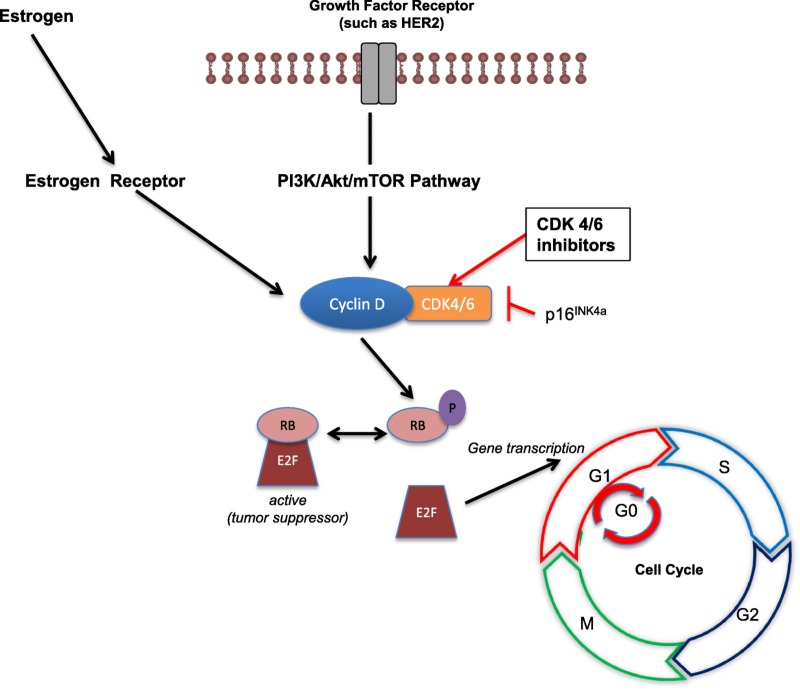
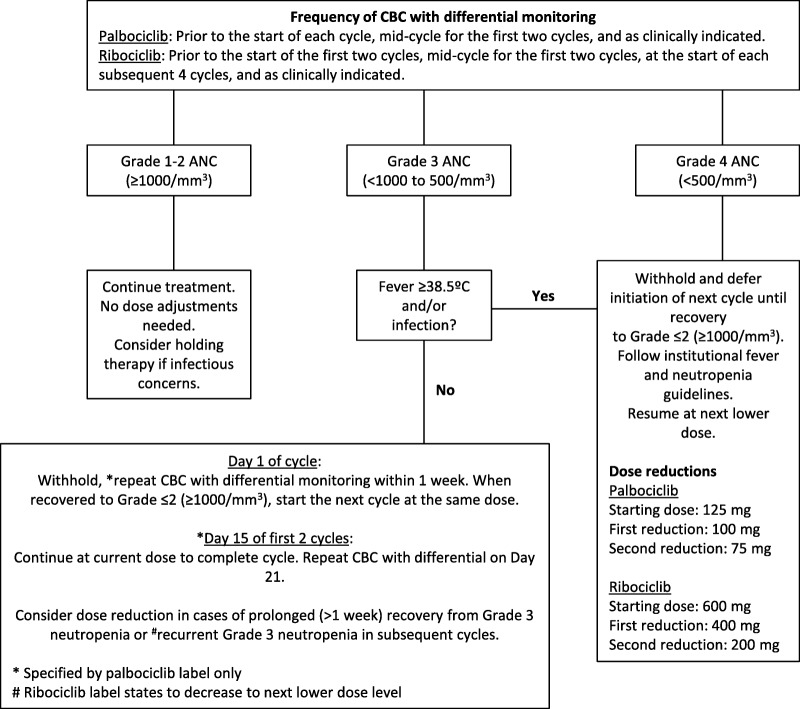
Aberrations of the cell cycle are pervasive in cancer, and selective cell cycle inhibition of cancer cells is a target of choice for a number of novel cancer therapeutics. Cyclin-dependent kinases (CDKs) are key regulatory enzymes that control cell cycle transitions and the commitment to cell division. Palbociclib and ribociclib are both orally active, highly selective reversible inhibitors of CDK4 and CDK6 that are approved by the U.S. Food and Drug Administration (FDA) for hormone receptor-positive metastatic breast cancer in combination with specific endocrine therapies. A third oral CDK4/6 inhibitor, abemaciclib, received Breakthrough Therapy designation status from the FDA and is also being developed in breast cancer. The most common adverse events associated with palbociclib and ribociclib are hematologic, particularly neutropenia. However, the neutropenia associated with CDK4/6 inhibitors is distinct from chemotherapy-induced neutropenia in that it is rapidly reversible, reflecting a cytostatic effect on neutrophil precursors in the bone marrow. Most hematologic abnormalities seen with CDK4/6 inhibitors are not complicated and are adequately managed with standard supportive care and dose adjustments when indicated. Cytopenias are less prevalent with abemaciclib, although fatigue and gastrointestinal toxicity is more common with this agent. This review focuses on the clinical management of potential toxicities and drug interactions seen with the use of CDK4/6 inhibitors in breast cancer, with a focus on palbociclib and ribociclib, and summarizes practical management strategies for an oncologist.
The emergence of modern cyclin-dependent kinase (CDK) inhibitors has changed the treatment paradigm for metastatic hormone receptor (HR)-positive breast cancer. Palbociclib, ribociclib, and abemaciclib are highly selective reversible inhibitors of CDK4 and CDK6. Palbociclib is U.S. Food and Drug Administration (FDA)-approved in the first- and second-line settings in combination with endocrine therapy for HR-positive metastatic breast cancer. Ribociclib is FDA-approved in the first-line setting. Abemaciclib has received FDA Breakthrough Therapy designation status. This review focuses on the clinical management of potential toxicities and drug interactions seen with the use of CDK4/6 inhibitors in breast cancer.
细胞周期的失常在癌症中普遍存在,选择性的细胞周期抑制癌症细胞是许多新型癌症治疗的目标。细胞周期蛋白依赖性激酶(CDKs)是控制细胞周期转换和细胞分裂的关键调节酶。Palbociclib 和 ribociclib 是两种口服活性、高度选择性的 CDK4 和 CDK6 可逆抑制剂,已被美国食品和药物管理局(FDA)批准与特定内分泌治疗联合用于激素受体阳性转移性乳腺癌。第三种口服 CDK4/6 抑制剂 abemaciclib 获得了 FDA 的突破性治疗指定地位,也在乳腺癌中开发。与 palbociclib 和 ribociclib 相关的最常见不良事件是血液学的,特别是中性粒细胞减少症。然而,与 CDK4/6 抑制剂相关的中性粒细胞减少症与化疗诱导的中性粒细胞减少症不同,因为它是快速可逆的,反映了骨髓中中性粒细胞前体的细胞抑制作用。大多数与 CDK4/6 抑制剂相关的血液学异常并不复杂,并且在需要时通过标准支持性护理和剂量调整可以充分管理。与 abemaciclib 相关的细胞减少症较少见,尽管该药物更常见疲劳和胃肠道毒性。这篇综述重点讨论了在乳腺癌中使用 CDK4/6 抑制剂时出现的潜在毒性和药物相互作用的临床管理,重点是 palbociclib 和 ribociclib,并总结了肿瘤学家的实用管理策略。
现代细胞周期蛋白依赖性激酶(CDK)抑制剂的出现改变了转移性激素受体(HR)阳性乳腺癌的治疗模式。Palbociclib、ribociclib 和 abemaciclib 是 CDK4 和 CDK6 的高度选择性可逆抑制剂。Palbociclib 在美国食品和药物管理局(FDA)批准的联合内分泌治疗用于 HR 阳性转移性乳腺癌的一线和二线治疗。Ribociclib 在美国 FDA 批准的一线治疗。Abemaciclib 获得了 FDA 的突破性治疗指定地位。这篇综述重点讨论了在乳腺癌中使用 CDK4/6 抑制剂时出现的潜在毒性和药物相互作用的临床管理。